

London
The American Ambassador presents his complements to His
Majesty’s Secretary of State for Foreign Affairs and
has the honour to transmit herewith enclosed a copy of a
letter he has received from the Embassy at Berlin, dated
the 31
st ultimo, regarding the case of one Robert Le
Rossignol, who has been released from Ruhleben for the
purpose of resuming his former occupation.
November 8
th , 1916.
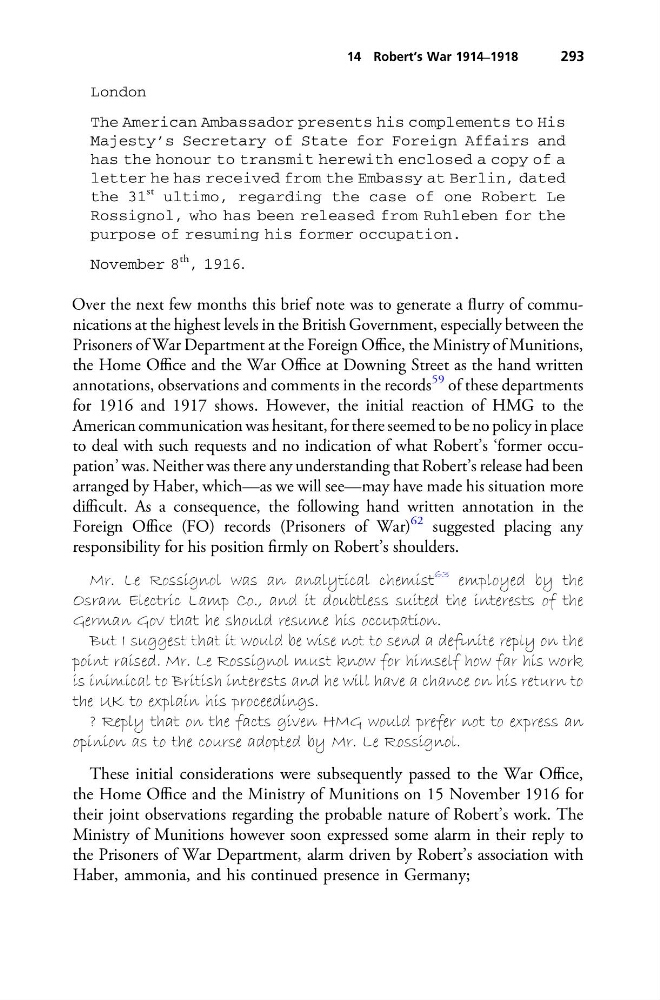
Over the next few months this brief note was to generate a flurry of communications at the highest levels in the British Government, especially between the
Prisoners of War Department at the Foreign Office, the Ministry of Munitions,
the Home Office and the War Office at Downing Street as the hand written
annotations, observations and comments in the records
59 of these departments
for 1916 and 1917 shows. However, the initial reaction of HMG to the
American communication was hesitant, for there seemed to be no policy in place
to deal with such requests and no indication of what Robert’s ‘former occupation’ was. Neither was there any understanding that Robert’s release had been
arranged by Haber, which—as we will see—may have made his situation more
difficult. As a consequence, the following hand written annotation in the
Foreign Office (FO) records (Prisoners of War)
62 suggested placing any
responsibility for his position firmly on Robert’s shoulders.
Mr. Le Rossignol was an analytical chemist
63 employed by the
Osram Electric Lamp Co., and it doubtless suited the interests of the
German Gov that he should resume his occupation.
But I suggest that it would be wise not to send a definite reply on the
point raised. Mr. Le Rossignol must know for himself how far his work
is inimical to British interests and he will have a chance on his return to
the UK to explain his proceedings.
? Reply that on the facts given HMG would prefer not to express an
opinion as to the course adopted by Mr. Le Rossignol.
These initial considerations were subsequently passed to the War Office,
the Home Office and the Ministry of Munitions on 15 November 1916 for
their joint observations regarding the probable nature of Robert’s work. The
Ministry of Munitions however soon expressed some alarm in their reply to
the Prisoners of War Department, alarm driven by Robert’s association with
Haber, ammonia, and his continued presence in Germany;
14 Robert’s War 1914–1918
293
The American Ambassador presents his complements to His
Majesty’s Secretary of State for Foreign Affairs and
has the honour to transmit herewith enclosed a copy of a
letter he has received from the Embassy at Berlin, dated
the 31
st ultimo, regarding the case of one Robert Le
Rossignol, who has been released from Ruhleben for the
purpose of resuming his former occupation.
November 8
th , 1916.
Over the next few months this brief note was to generate a flurry of communications at the highest levels in the British Government, especially between the
Prisoners of War Department at the Foreign Office, the Ministry of Munitions,
the Home Office and the War Office at Downing Street as the hand written
annotations, observations and comments in the records
59 of these departments
for 1916 and 1917 shows. However, the initial reaction of HMG to the
American communication was hesitant, for there seemed to be no policy in place
to deal with such requests and no indication of what Robert’s ‘former occupation’ was. Neither was there any understanding that Robert’s release had been
arranged by Haber, which—as we will see—may have made his situation more
difficult. As a consequence, the following hand written annotation in the
Foreign Office (FO) records (Prisoners of War)
62 suggested placing any
responsibility for his position firmly on Robert’s shoulders.
Mr. Le Rossignol was an analytical chemist
63 employed by the
Osram Electric Lamp Co., and it doubtless suited the interests of the
German Gov that he should resume his occupation.
But I suggest that it would be wise not to send a definite reply on the
point raised. Mr. Le Rossignol must know for himself how far his work
is inimical to British interests and he will have a chance on his return to
the UK to explain his proceedings.
? Reply that on the facts given HMG would prefer not to express an
opinion as to the course adopted by Mr. Le Rossignol.
These initial considerations were subsequently passed to the War Office,
the Home Office and the Ministry of Munitions on 15 November 1916 for
their joint observations regarding the probable nature of Robert’s work. The
Ministry of Munitions however soon expressed some alarm in their reply to
the Prisoners of War Department, alarm driven by Robert’s association with
Haber, ammonia, and his continued presence in Germany;
14 Robert’s War 1914–1918
293