

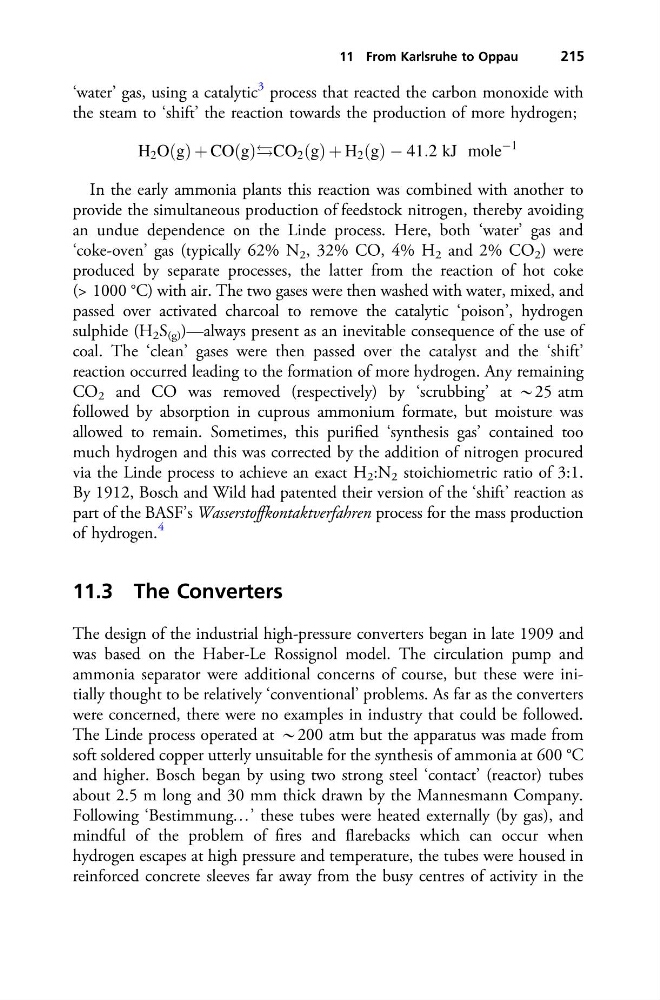
‘water’ gas, using a catalytic
3 process that reacted the carbon monoxide with
the steam to ‘shift’ the reaction towards the production of more hydrogen;
H 2 OðgÞ þ COðgÞCO 2 ðgÞ þ H 2 ðgÞ À 41:2 kJ mole
À1
In the early ammonia plants this reaction was combined with another to
provide the simultaneous production of feedstock nitrogen, thereby avoiding
an undue dependence on the Linde process. Here, both ‘water’ gas and
‘coke-oven’ gas (typically 62% N 2 , 32% CO, 4% H 2 and 2% CO 2 ) were
produced by separate processes, the latter from the reaction of hot coke
(> 1000 °C) with air. The two gases were then washed with water, mixed, and
passed over activated charcoal to remove the catalytic ‘poison’, hydrogen
sulphide (H 2 S (g) )—always present as an inevitable consequence of the use of
coal. The ‘clean’ gases were then passed over the catalyst and the ‘shift’
reaction occurred leading to the formation of more hydrogen. Any remaining
CO 2 and CO was removed (respectively) by ‘scrubbing’ at *25 atm
followed by absorption in cuprous ammonium formate, but moisture was
allowed to remain. Sometimes, this purified ‘synthesis gas’ contained too
much hydrogen and this was corrected by the addition of nitrogen procured
via the Linde process to achieve an exact H 2 :N 2 stoichiometric ratio of 3:1.
By 1912, Bosch and Wild had patented their version of the ‘shift’ reaction as
part of the BASF’s Wasserstoffkontaktverfahren process for the mass production
of hydrogen.
4
11.3 The Converters
The design of the industrial high-pressure converters began in late 1909 and
was based on the Haber-Le Rossignol model. The circulation pump and
ammonia separator were additional concerns of course, but these were initially thought to be relatively ‘conventional’ problems. As far as the converters
were concerned, there were no examples in industry that could be followed.
The Linde process operated at *200 atm but the apparatus was made from
soft soldered copper utterly unsuitable for the synthesis of ammonia at 600 °C
and higher. Bosch began by using two strong steel ‘contact’ (reactor) tubes
about 2.5 m long and 30 mm thick drawn by the Mannesmann Company.
Following ‘Bestimmung…’ these tubes were heated externally (by gas), and
mindful of the problem of fires and flarebacks which can occur when
hydrogen escapes at high pressure and temperature, the tubes were housed in
reinforced concrete sleeves far away from the busy centres of activity in the
11 From Karlsruhe to Oppau
215
3 process that reacted the carbon monoxide with
the steam to ‘shift’ the reaction towards the production of more hydrogen;
H 2 OðgÞ þ COðgÞCO 2 ðgÞ þ H 2 ðgÞ À 41:2 kJ mole
À1
In the early ammonia plants this reaction was combined with another to
provide the simultaneous production of feedstock nitrogen, thereby avoiding
an undue dependence on the Linde process. Here, both ‘water’ gas and
‘coke-oven’ gas (typically 62% N 2 , 32% CO, 4% H 2 and 2% CO 2 ) were
produced by separate processes, the latter from the reaction of hot coke
(> 1000 °C) with air. The two gases were then washed with water, mixed, and
passed over activated charcoal to remove the catalytic ‘poison’, hydrogen
sulphide (H 2 S (g) )—always present as an inevitable consequence of the use of
coal. The ‘clean’ gases were then passed over the catalyst and the ‘shift’
reaction occurred leading to the formation of more hydrogen. Any remaining
CO 2 and CO was removed (respectively) by ‘scrubbing’ at *25 atm
followed by absorption in cuprous ammonium formate, but moisture was
allowed to remain. Sometimes, this purified ‘synthesis gas’ contained too
much hydrogen and this was corrected by the addition of nitrogen procured
via the Linde process to achieve an exact H 2 :N 2 stoichiometric ratio of 3:1.
By 1912, Bosch and Wild had patented their version of the ‘shift’ reaction as
part of the BASF’s Wasserstoffkontaktverfahren process for the mass production
of hydrogen.
4
11.3 The Converters
The design of the industrial high-pressure converters began in late 1909 and
was based on the Haber-Le Rossignol model. The circulation pump and
ammonia separator were additional concerns of course, but these were initially thought to be relatively ‘conventional’ problems. As far as the converters
were concerned, there were no examples in industry that could be followed.
The Linde process operated at *200 atm but the apparatus was made from
soft soldered copper utterly unsuitable for the synthesis of ammonia at 600 °C
and higher. Bosch began by using two strong steel ‘contact’ (reactor) tubes
about 2.5 m long and 30 mm thick drawn by the Mannesmann Company.
Following ‘Bestimmung…’ these tubes were heated externally (by gas), and
mindful of the problem of fires and flarebacks which can occur when
hydrogen escapes at high pressure and temperature, the tubes were housed in
reinforced concrete sleeves far away from the busy centres of activity in the
11 From Karlsruhe to Oppau
215