

discovery of the technology when he developed a process for making tungsten
that could be drawn out into long fine wires (Chap. 15). These filaments were
in use world-wide by 1911, and they remain the standard filament today.
From now on, technological advances were to move away from the filament
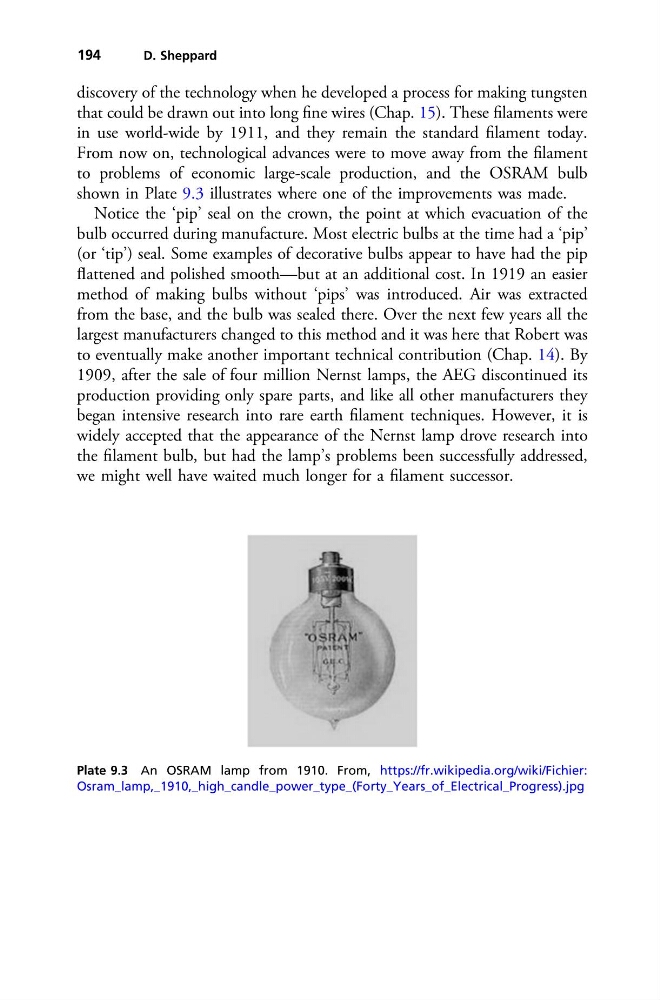
to problems of economic large-scale production, and the OSRAM bulb
shown in Plate 9.3 illustrates where one of the improvements was made.
Notice the ‘pip’ seal on the crown, the point at which evacuation of the
bulb occurred during manufacture. Most electric bulbs at the time had a ‘pip’
(or ‘tip’) seal. Some examples of decorative bulbs appear to have had the pip
flattened and polished smooth—but at an additional cost. In 1919 an easier
method of making bulbs without ‘pips’ was introduced. Air was extracted
from the base, and the bulb was sealed there. Over the next few years all the
largest manufacturers changed to this method and it was here that Robert was
to eventually make another important technical contribution (Chap. 14). By
1909, after the sale of four million Nernst lamps, the AEG discontinued its
production providing only spare parts, and like all other manufacturers they
began intensive research into rare earth filament techniques. However, it is
widely accepted that the appearance of the Nernst lamp drove research into
the filament bulb, but had the lamp’s problems been successfully addressed,
we might well have waited much longer for a filament successor.
Plate 9.3 An OSRAM lamp from 1910. From, https://fr.wikipedia.org/wiki/Fichier:
Osram_lamp,_1910,_high_candle_power_type_(Forty_Years_of_Electrical_Progress).jpg
194
D. Sheppard
that could be drawn out into long fine wires (Chap. 15). These filaments were
in use world-wide by 1911, and they remain the standard filament today.
From now on, technological advances were to move away from the filament
to problems of economic large-scale production, and the OSRAM bulb
shown in Plate 9.3 illustrates where one of the improvements was made.
Notice the ‘pip’ seal on the crown, the point at which evacuation of the
bulb occurred during manufacture. Most electric bulbs at the time had a ‘pip’
(or ‘tip’) seal. Some examples of decorative bulbs appear to have had the pip
flattened and polished smooth—but at an additional cost. In 1919 an easier
method of making bulbs without ‘pips’ was introduced. Air was extracted
from the base, and the bulb was sealed there. Over the next few years all the
largest manufacturers changed to this method and it was here that Robert was
to eventually make another important technical contribution (Chap. 14). By
1909, after the sale of four million Nernst lamps, the AEG discontinued its
production providing only spare parts, and like all other manufacturers they
began intensive research into rare earth filament techniques. However, it is
widely accepted that the appearance of the Nernst lamp drove research into
the filament bulb, but had the lamp’s problems been successfully addressed,
we might well have waited much longer for a filament successor.
Plate 9.3 An OSRAM lamp from 1910. From, https://fr.wikipedia.org/wiki/Fichier:
Osram_lamp,_1910,_high_candle_power_type_(Forty_Years_of_Electrical_Progress).jpg
194
D. Sheppard