

competitor technologies but at ordinary temperatures the glower materials
were non-conductors. Lamp engineering was therefore complicated by the
need for a ‘pre-heater’ which had to be switched off once the operating
temperature had been reached and which also introduced a delay before the
lamp became luminous. Excessive surges in current also had to be avoided as
these lowered the resistance of the glower and so the whole was quite a
sophisticated piece of ‘micro engineering’.
In 1897 Nernst formed the ‘Nernst Electric Light Company’ and produced
a number of variations of his basic lamp most using a ceramic of zirconium
and yttrium oxides as the ‘glower’. The production models were given
alphabetic labels, the ‘A’ type had a vertical filament and operated between
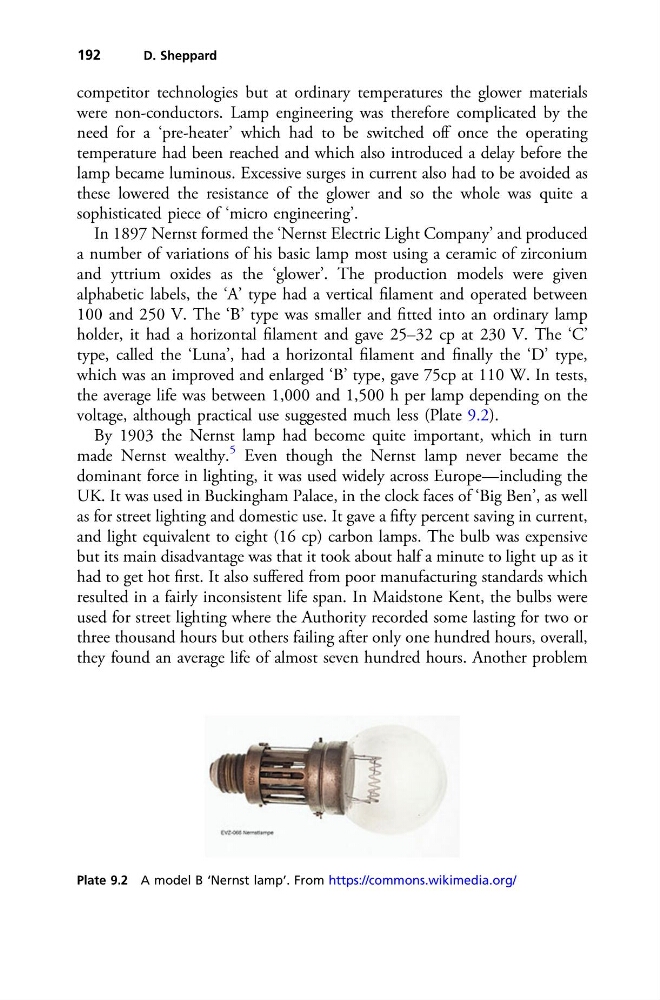
100 and 250 V. The ‘B’ type was smaller and fitted into an ordinary lamp
holder, it had a horizontal filament and gave 25–32 cp at 230 V. The ‘C’
type, called the ‘Luna’, had a horizontal filament and finally the ‘D’ type,
which was an improved and enlarged ‘B’ type, gave 75cp at 110 W. In tests,
the average life was between 1,000 and 1,500 h per lamp depending on the
voltage, although practical use suggested much less (Plate 9.2).
By 1903 the Nernst lamp had become quite important, which in turn
made Nernst wealthy.
5 Even though the Nernst lamp never became the
dominant force in lighting, it was used widely across Europe—including the
UK. It was used in Buckingham Palace, in the clock faces of ‘Big Ben’, as well
as for street lighting and domestic use. It gave a fifty percent saving in current,
and light equivalent to eight (16 cp) carbon lamps. The bulb was expensive
but its main disadvantage was that it took about half a minute to light up as it
had to get hot first. It also suffered from poor manufacturing standards which
resulted in a fairly inconsistent life span. In Maidstone Kent, the bulbs were
used for street lighting where the Authority recorded some lasting for two or
three thousand hours but others failing after only one hundred hours, overall,
they found an average life of almost seven hundred hours. Another problem
Plate 9.2 A model B ‘Nernst lamp’. From https://commons.wikimedia.org/
192
D. Sheppard
were non-conductors. Lamp engineering was therefore complicated by the
need for a ‘pre-heater’ which had to be switched off once the operating
temperature had been reached and which also introduced a delay before the
lamp became luminous. Excessive surges in current also had to be avoided as
these lowered the resistance of the glower and so the whole was quite a
sophisticated piece of ‘micro engineering’.
In 1897 Nernst formed the ‘Nernst Electric Light Company’ and produced
a number of variations of his basic lamp most using a ceramic of zirconium
and yttrium oxides as the ‘glower’. The production models were given
alphabetic labels, the ‘A’ type had a vertical filament and operated between
100 and 250 V. The ‘B’ type was smaller and fitted into an ordinary lamp
holder, it had a horizontal filament and gave 25–32 cp at 230 V. The ‘C’
type, called the ‘Luna’, had a horizontal filament and finally the ‘D’ type,
which was an improved and enlarged ‘B’ type, gave 75cp at 110 W. In tests,
the average life was between 1,000 and 1,500 h per lamp depending on the
voltage, although practical use suggested much less (Plate 9.2).
By 1903 the Nernst lamp had become quite important, which in turn
made Nernst wealthy.
5 Even though the Nernst lamp never became the
dominant force in lighting, it was used widely across Europe—including the
UK. It was used in Buckingham Palace, in the clock faces of ‘Big Ben’, as well
as for street lighting and domestic use. It gave a fifty percent saving in current,
and light equivalent to eight (16 cp) carbon lamps. The bulb was expensive
but its main disadvantage was that it took about half a minute to light up as it
had to get hot first. It also suffered from poor manufacturing standards which
resulted in a fairly inconsistent life span. In Maidstone Kent, the bulbs were
used for street lighting where the Authority recorded some lasting for two or
three thousand hours but others failing after only one hundred hours, overall,
they found an average life of almost seven hundred hours. Another problem
Plate 9.2 A model B ‘Nernst lamp’. From https://commons.wikimedia.org/
192
D. Sheppard