

Haber suggested that removal of the ammonia could be achieved by
absorption (conventional in industry), followed by recovery through a
reduction in pressure.
7 But when yields rose to around 6%, according to
Robert
10 Haber ‘had the idea of [continuously] producing [then removing]
liquid ammonia in very small quantities … of about 1 cm
3
’—an approach
facilitated by the fact that the compressor they purchased came with a liquefaction capability (Chap. 7). However, in conversation with Chirnside in
1976, Robert says that he discounted Haber’s absorption idea in favour of his
own suggestion of liquefying the ammonia by cooling. By crediting Haber
with the idea in his 1928 paper,
10 Robert probably avoided ‘upstaging’ the
old man. Whichever way, removing the ammonia displaced the formation
equilibrium to the right, but doing so by cooling in a circulation apparatus,
returned
31 very cold residual gas to the furnace. Another heat exchanger was
therefore indicated—later called the ‘cold regenerator’—which used the relatively warm gas leaving the furnace and entering the liquefier, to heat up the
very cold gas leaving the liquefier on its way back to the furnace. The final
form of the Haber-Le Rossignol apparatus therefore consisted of a ‘furnace’
containing the ‘contact substance’, a ‘heat regenerator’, a liquefier and a ‘cold
regenerator’, a circulation pump, valves to control the flow of gas, soldered
copper tubing, and ‘Kirchenbauer’s’ joints to connect all the components, the
whole being supplied by a high pressure gas reservoir maintained by the
compressor.
8.2.3 The Final Form of the Circulation Apparatus
The original Haber-Le Rossignol apparatus is shown in the photograph,
Plate 8.4. Figure 8.5 shows the Haber-Le Rossignol schematic
15 of the
modified furnace and the circulation apparatus—now incorporating a drier,
32
a pressure gauge and a liquid ammonia ‘water’ gauge glass. Most of the
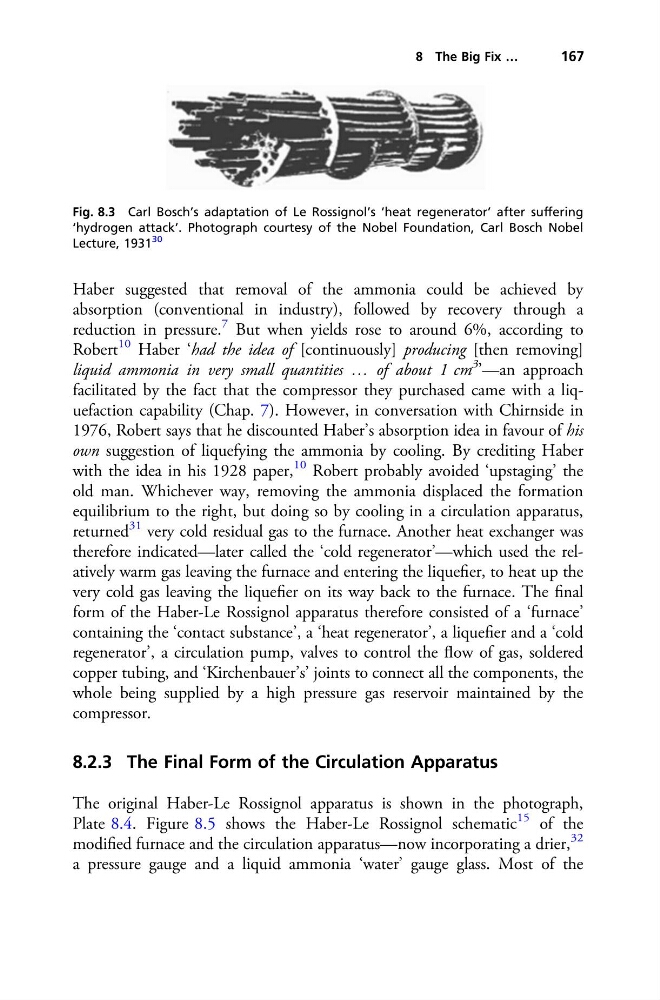
Fig. 8.3 Carl Bosch’s adaptation of Le Rossignol’s ‘heat regenerator’ after suffering
‘hydrogen attack’. Photograph courtesy of the Nobel Foundation, Carl Bosch Nobel
Lecture, 1931
30
8 The Big Fix …
167
absorption (conventional in industry), followed by recovery through a
reduction in pressure.
7 But when yields rose to around 6%, according to
Robert
10 Haber ‘had the idea of [continuously] producing [then removing]
liquid ammonia in very small quantities … of about 1 cm
3
’—an approach
facilitated by the fact that the compressor they purchased came with a liquefaction capability (Chap. 7). However, in conversation with Chirnside in
1976, Robert says that he discounted Haber’s absorption idea in favour of his
own suggestion of liquefying the ammonia by cooling. By crediting Haber
with the idea in his 1928 paper,
10 Robert probably avoided ‘upstaging’ the
old man. Whichever way, removing the ammonia displaced the formation
equilibrium to the right, but doing so by cooling in a circulation apparatus,
returned
31 very cold residual gas to the furnace. Another heat exchanger was
therefore indicated—later called the ‘cold regenerator’—which used the relatively warm gas leaving the furnace and entering the liquefier, to heat up the
very cold gas leaving the liquefier on its way back to the furnace. The final
form of the Haber-Le Rossignol apparatus therefore consisted of a ‘furnace’
containing the ‘contact substance’, a ‘heat regenerator’, a liquefier and a ‘cold
regenerator’, a circulation pump, valves to control the flow of gas, soldered
copper tubing, and ‘Kirchenbauer’s’ joints to connect all the components, the
whole being supplied by a high pressure gas reservoir maintained by the
compressor.
8.2.3 The Final Form of the Circulation Apparatus
The original Haber-Le Rossignol apparatus is shown in the photograph,
Plate 8.4. Figure 8.5 shows the Haber-Le Rossignol schematic
15 of the
modified furnace and the circulation apparatus—now incorporating a drier,
32
a pressure gauge and a liquid ammonia ‘water’ gauge glass. Most of the
Fig. 8.3 Carl Bosch’s adaptation of Le Rossignol’s ‘heat regenerator’ after suffering
‘hydrogen attack’. Photograph courtesy of the Nobel Foundation, Carl Bosch Nobel
Lecture, 1931
30
8 The Big Fix …
167