

nicety and its retention, if required, secured in a very perfect manner …’.
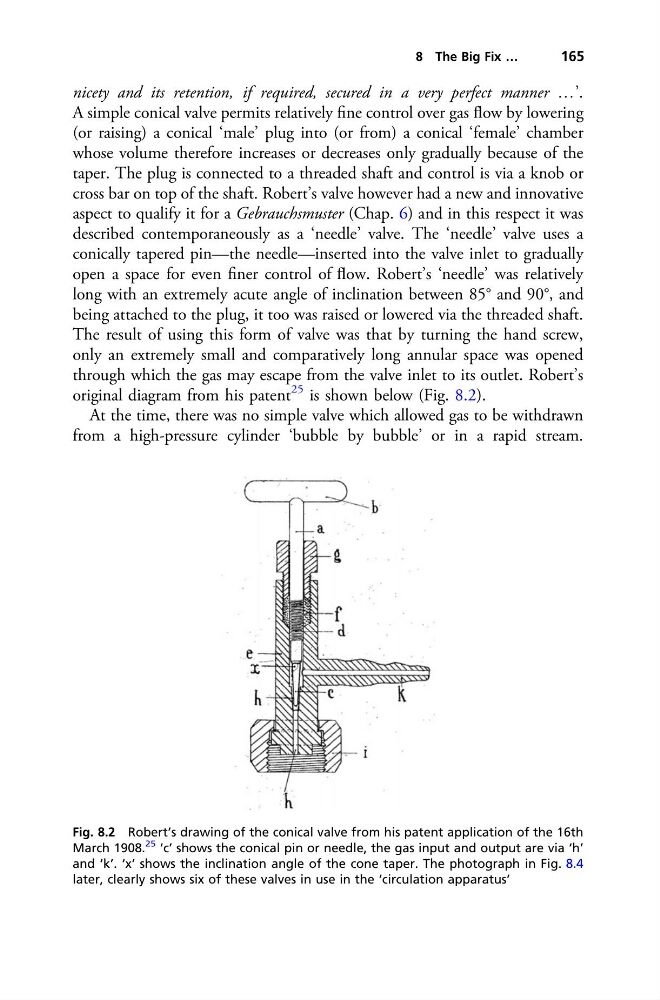
A simple conical valve permits relatively fine control over gas flow by lowering
(or raising) a conical ‘male’ plug into (or from) a conical ‘female’ chamber
whose volume therefore increases or decreases only gradually because of the
taper. The plug is connected to a threaded shaft and control is via a knob or
cross bar on top of the shaft. Robert’s valve however had a new and innovative
aspect to qualify it for a Gebrauchsmuster (Chap. 6) and in this respect it was
described contemporaneously as a ‘needle’ valve. The ‘needle’ valve uses a
conically tapered pin—the needle—inserted into the valve inlet to gradually
open a space for even finer control of flow. Robert’s ‘needle’ was relatively
long with an extremely acute angle of inclination between 85° and 90°, and
being attached to the plug, it too was raised or lowered via the threaded shaft.
The result of using this form of valve was that by turning the hand screw,
only an extremely small and comparatively long annular space was opened
through which the gas may escape from the valve inlet to its outlet. Robert’s
original diagram from his patent
25 is shown below (Fig. 8.2).
At the time, there was no simple valve which allowed gas to be withdrawn
from a high-pressure cylinder ‘bubble by bubble’ or in a rapid stream.
Fig. 8.2 Robert’s drawing of the conical valve from his patent application of the 16th
March 1908.
25 ‘c’ shows the conical pin or needle, the gas input and output are via ‘h’
and ‘k’. ‘x’ shows the inclination angle of the cone taper. The photograph in Fig. 8.4
later, clearly shows six of these valves in use in the ‘circulation apparatus’
8 The Big Fix …
165
A simple conical valve permits relatively fine control over gas flow by lowering
(or raising) a conical ‘male’ plug into (or from) a conical ‘female’ chamber
whose volume therefore increases or decreases only gradually because of the
taper. The plug is connected to a threaded shaft and control is via a knob or
cross bar on top of the shaft. Robert’s valve however had a new and innovative
aspect to qualify it for a Gebrauchsmuster (Chap. 6) and in this respect it was
described contemporaneously as a ‘needle’ valve. The ‘needle’ valve uses a
conically tapered pin—the needle—inserted into the valve inlet to gradually
open a space for even finer control of flow. Robert’s ‘needle’ was relatively
long with an extremely acute angle of inclination between 85° and 90°, and
being attached to the plug, it too was raised or lowered via the threaded shaft.
The result of using this form of valve was that by turning the hand screw,
only an extremely small and comparatively long annular space was opened
through which the gas may escape from the valve inlet to its outlet. Robert’s
original diagram from his patent
25 is shown below (Fig. 8.2).
At the time, there was no simple valve which allowed gas to be withdrawn
from a high-pressure cylinder ‘bubble by bubble’ or in a rapid stream.
Fig. 8.2 Robert’s drawing of the conical valve from his patent application of the 16th
March 1908.
25 ‘c’ shows the conical pin or needle, the gas input and output are via ‘h’
and ‘k’. ‘x’ shows the inclination angle of the cone taper. The photograph in Fig. 8.4
later, clearly shows six of these valves in use in the ‘circulation apparatus’
8 The Big Fix …
165