

12. Temperature measurements were made as in Hamburg with an accurately
calibrated thermocouple.
13. Later, during the industrial scaling of the process, the BASF, after trying
thousands of catalysts, found iron oxides acceptable. (See Chaps. 10 and 11).
14. The carbon dioxide was therefore removed by ‘kalilauge’ ([caustic] potash
solution) vessels attached to the high-pressure cylinders.
15. In ‘Bestimmung …’ Haber and Robert referred to labels on a diagram (‘figurentafel’) but no diagram appeared in the paper nor indeed that issue of
Zeitschrift. Even with the help of Wiley Interscience we have not been able to
trace it. Even so, Coates, op. cit. (note 7), described the apparatus as ‘simple
and admirably adapted to its purpose’.
16. At the time pressures up to about 100 atm. were available from commercial
cylinders.
17. Robert later observed that gas cylinders at the time were supplied with simple
shut off valves that “in no way allows an easy regulation of the out-flowing gas
stream. For this purpose, complicated or reducing valves are necessary” This
observation led eventually to his special conical valve (see Chap. 8).
18. ‘Bestimmung …’ was published in April 1908, the valve patent was applied
for earlier in Germany on 16 March 1908, (see Chap. 8). Because the
diagram is missing, we cannot be exactly certain about the use of the valve,
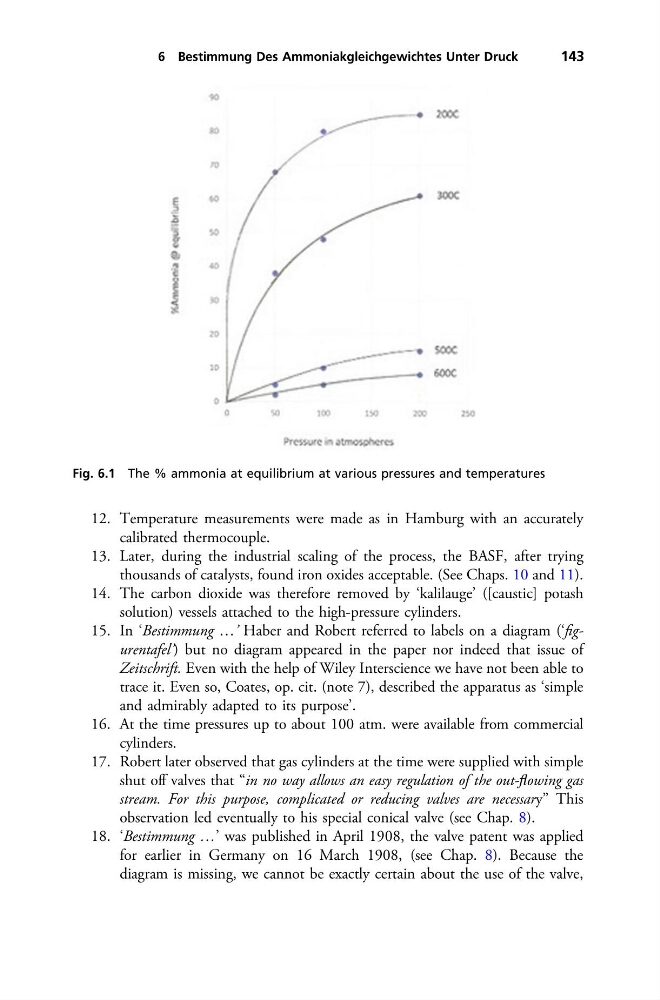
Fig. 6.1 The % ammonia at equilibrium at various pressures and temperatures
6 Bestimmung Des Ammoniakgleichgewichtes Unter Druck
143
calibrated thermocouple.
13. Later, during the industrial scaling of the process, the BASF, after trying
thousands of catalysts, found iron oxides acceptable. (See Chaps. 10 and 11).
14. The carbon dioxide was therefore removed by ‘kalilauge’ ([caustic] potash
solution) vessels attached to the high-pressure cylinders.
15. In ‘Bestimmung …’ Haber and Robert referred to labels on a diagram (‘figurentafel’) but no diagram appeared in the paper nor indeed that issue of
Zeitschrift. Even with the help of Wiley Interscience we have not been able to
trace it. Even so, Coates, op. cit. (note 7), described the apparatus as ‘simple
and admirably adapted to its purpose’.
16. At the time pressures up to about 100 atm. were available from commercial
cylinders.
17. Robert later observed that gas cylinders at the time were supplied with simple
shut off valves that “in no way allows an easy regulation of the out-flowing gas
stream. For this purpose, complicated or reducing valves are necessary” This
observation led eventually to his special conical valve (see Chap. 8).
18. ‘Bestimmung …’ was published in April 1908, the valve patent was applied
for earlier in Germany on 16 March 1908, (see Chap. 8). Because the
diagram is missing, we cannot be exactly certain about the use of the valve,
Fig. 6.1 The % ammonia at equilibrium at various pressures and temperatures
6 Bestimmung Des Ammoniakgleichgewichtes Unter Druck
143