

equilibria. By winning the gold medal he had clearly demonstrated outstanding practical ability and all that was needed was the good luck to be
introduced to a problem that needed all this expertise. By choosing to go to
Haber he unwittingly achieved this. It is arguable whether any of the talented
people Haber had assembled at Karlsruhe would have been capable of
bringing the rich mix of theoretical understanding and practical expertise that
Robert did, and maybe this explains why Haber chose Robert to help him.
A much less generous view would assume that no-one at Karlsruhe wanted to
grasp the ‘ammonia nettle’ and as a new recruit, Robert ‘drew the short straw’.
Haber however, was a good judge of his students and he would never have
tolerated mediocrity for this task. The letter from Nernst was potentially
damaging to Haber and he would have demanded the best available collaborator to confirm the credibility of his work for the Margulies brothers. The
best it seems was Robert, and both he and Haber began their re-investigation
of the ammonia equilibrium around February 1907.
Many years later, R. C. Chirnside
4 observed;
[Le Rossignol] was essentially a chemist, with strong engineering skills and
understanding. He had an amazing grasp of the inter-relation of fundamental
chemical, physical and electrical concepts and could work out on paper complex problems from a few basic relationships. Throughout his life he maintained his practical mechanical aptitude.
By Robert choosing Haber and then Haber choosing Robert, serendipity was
to provide a solution to the ammonia problem. But firstly, Nernst’s criticism
had to be addressed and it was the painstaking, professional, practical work of
Robert Le Rossignol that Haber ‘clothed himself in’ to meet the challenge
that came at Hamburg in May, 1907.
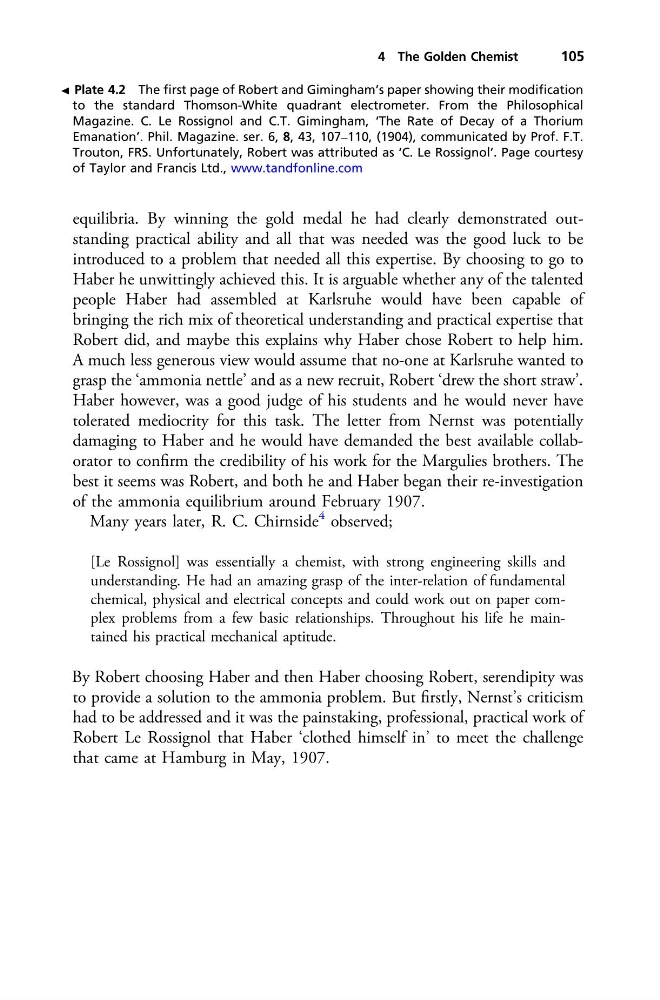
J Plate 4.2 The first page of Robert and Gimingham’s paper showing their modification
to the standard Thomson-White quadrant electrometer. From the Philosophical
Magazine. C. Le Rossignol and C.T. Gimingham, ‘The Rate of Decay of a Thorium
Emanation’. Phil. Magazine. ser. 6, 8, 43, 107–110, (1904), communicated by Prof. F.T.
Trouton, FRS. Unfortunately, Robert was attributed as ‘C. Le Rossignol’. Page courtesy
of Taylor and Francis Ltd., www.tandfonline.com
4 The Golden Chemist
105
introduced to a problem that needed all this expertise. By choosing to go to
Haber he unwittingly achieved this. It is arguable whether any of the talented
people Haber had assembled at Karlsruhe would have been capable of
bringing the rich mix of theoretical understanding and practical expertise that
Robert did, and maybe this explains why Haber chose Robert to help him.
A much less generous view would assume that no-one at Karlsruhe wanted to
grasp the ‘ammonia nettle’ and as a new recruit, Robert ‘drew the short straw’.
Haber however, was a good judge of his students and he would never have
tolerated mediocrity for this task. The letter from Nernst was potentially
damaging to Haber and he would have demanded the best available collaborator to confirm the credibility of his work for the Margulies brothers. The
best it seems was Robert, and both he and Haber began their re-investigation
of the ammonia equilibrium around February 1907.
Many years later, R. C. Chirnside
4 observed;
[Le Rossignol] was essentially a chemist, with strong engineering skills and
understanding. He had an amazing grasp of the inter-relation of fundamental
chemical, physical and electrical concepts and could work out on paper complex problems from a few basic relationships. Throughout his life he maintained his practical mechanical aptitude.
By Robert choosing Haber and then Haber choosing Robert, serendipity was
to provide a solution to the ammonia problem. But firstly, Nernst’s criticism
had to be addressed and it was the painstaking, professional, practical work of
Robert Le Rossignol that Haber ‘clothed himself in’ to meet the challenge
that came at Hamburg in May, 1907.
J Plate 4.2 The first page of Robert and Gimingham’s paper showing their modification
to the standard Thomson-White quadrant electrometer. From the Philosophical
Magazine. C. Le Rossignol and C.T. Gimingham, ‘The Rate of Decay of a Thorium
Emanation’. Phil. Magazine. ser. 6, 8, 43, 107–110, (1904), communicated by Prof. F.T.
Trouton, FRS. Unfortunately, Robert was attributed as ‘C. Le Rossignol’. Page courtesy
of Taylor and Francis Ltd., www.tandfonline.com
4 The Golden Chemist
105