

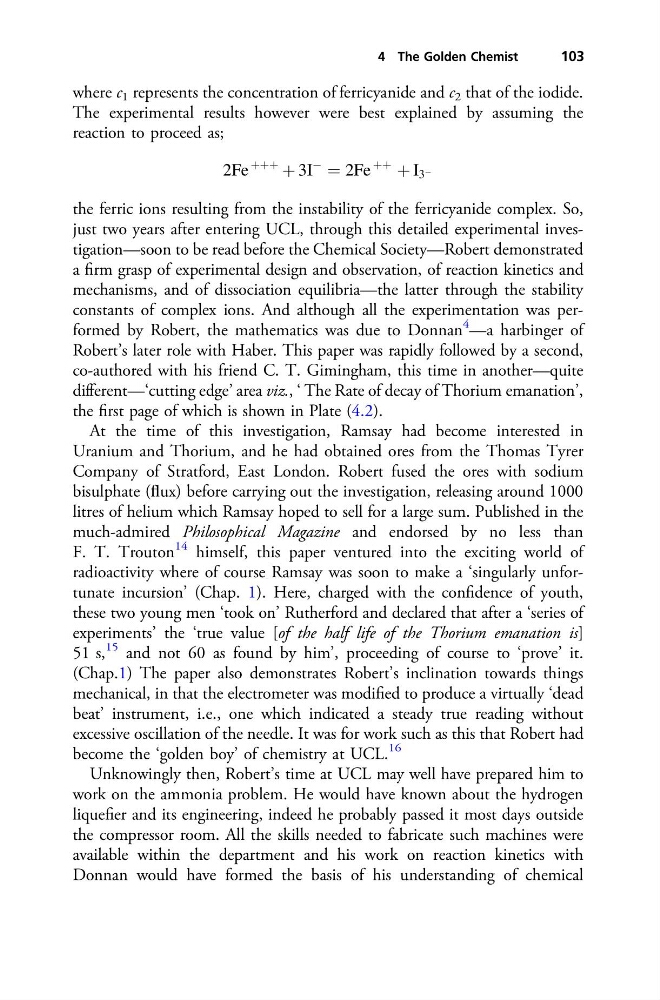
where c 1 represents the concentration of ferricyanide and c 2 that of the iodide.
The experimental results however were best explained by assuming the
reaction to proceed as;
2Fe
þþþ
þ 3I
À
¼ 2Fe
þþ
þ I 3 À
the ferric ions resulting from the instability of the ferricyanide complex. So,
just two years after entering UCL, through this detailed experimental investigation—soon to be read before the Chemical Society—Robert demonstrated
a firm grasp of experimental design and observation, of reaction kinetics and
mechanisms, and of dissociation equilibria—the latter through the stability
constants of complex ions. And although all the experimentation was performed by Robert, the mathematics was due to Donnan
4
—a harbinger of
Robert’s later role with Haber. This paper was rapidly followed by a second,
co-authored with his friend C. T. Gimingham, this time in another—quite
different—‘cutting edge’ area viz., ‘ The Rate of decay of Thorium emanation’,
the first page of which is shown in Plate (4.2).
At the time of this investigation, Ramsay had become interested in
Uranium and Thorium, and he had obtained ores from the Thomas Tyrer
Company of Stratford, East London. Robert fused the ores with sodium
bisulphate (flux) before carrying out the investigation, releasing around 1000
litres of helium which Ramsay hoped to sell for a large sum. Published in the
much-admired Philosophical Magazine and endorsed by no less than
F. T. Trouton
14 himself, this paper ventured into the exciting world of
radioactivity where of course Ramsay was soon to make a ‘singularly unfortunate incursion’ (Chap. 1). Here, charged with the confidence of youth,
these two young men ‘took on’ Rutherford and declared that after a ‘series of
experiments’ the ‘true value [of the half life of the Thorium emanation is]
51 s,
15 and not 60 as found by him’, proceeding of course to ‘prove’ it.
(Chap.1) The paper also demonstrates Robert’s inclination towards things
mechanical, in that the electrometer was modified to produce a virtually ‘dead
beat’ instrument, i.e., one which indicated a steady true reading without
excessive oscillation of the needle. It was for work such as this that Robert had
become the ‘golden boy’ of chemistry at UCL.
16
Unknowingly then, Robert’s time at UCL may well have prepared him to
work on the ammonia problem. He would have known about the hydrogen
liquefier and its engineering, indeed he probably passed it most days outside
the compressor room. All the skills needed to fabricate such machines were
available within the department and his work on reaction kinetics with
Donnan would have formed the basis of his understanding of chemical
4 The Golden Chemist
103
The experimental results however were best explained by assuming the
reaction to proceed as;
2Fe
þþþ
þ 3I
À
¼ 2Fe
þþ
þ I 3 À
the ferric ions resulting from the instability of the ferricyanide complex. So,
just two years after entering UCL, through this detailed experimental investigation—soon to be read before the Chemical Society—Robert demonstrated
a firm grasp of experimental design and observation, of reaction kinetics and
mechanisms, and of dissociation equilibria—the latter through the stability
constants of complex ions. And although all the experimentation was performed by Robert, the mathematics was due to Donnan
4
—a harbinger of
Robert’s later role with Haber. This paper was rapidly followed by a second,
co-authored with his friend C. T. Gimingham, this time in another—quite
different—‘cutting edge’ area viz., ‘ The Rate of decay of Thorium emanation’,
the first page of which is shown in Plate (4.2).
At the time of this investigation, Ramsay had become interested in
Uranium and Thorium, and he had obtained ores from the Thomas Tyrer
Company of Stratford, East London. Robert fused the ores with sodium
bisulphate (flux) before carrying out the investigation, releasing around 1000
litres of helium which Ramsay hoped to sell for a large sum. Published in the
much-admired Philosophical Magazine and endorsed by no less than
F. T. Trouton
14 himself, this paper ventured into the exciting world of
radioactivity where of course Ramsay was soon to make a ‘singularly unfortunate incursion’ (Chap. 1). Here, charged with the confidence of youth,
these two young men ‘took on’ Rutherford and declared that after a ‘series of
experiments’ the ‘true value [of the half life of the Thorium emanation is]
51 s,
15 and not 60 as found by him’, proceeding of course to ‘prove’ it.
(Chap.1) The paper also demonstrates Robert’s inclination towards things
mechanical, in that the electrometer was modified to produce a virtually ‘dead
beat’ instrument, i.e., one which indicated a steady true reading without
excessive oscillation of the needle. It was for work such as this that Robert had
become the ‘golden boy’ of chemistry at UCL.
16
Unknowingly then, Robert’s time at UCL may well have prepared him to
work on the ammonia problem. He would have known about the hydrogen
liquefier and its engineering, indeed he probably passed it most days outside
the compressor room. All the skills needed to fabricate such machines were
available within the department and his work on reaction kinetics with
Donnan would have formed the basis of his understanding of chemical
4 The Golden Chemist
103