

the lee of Dungeness, but the ship’s anchor chains parted in a squall and he was
forced to run for Dover. Standing into Dover escorted by three tugs Alert,
Albatross and John Bull, Preussen’s top hamper created so much windage that
the tow lines parted and she began to drift. Setting sail in an effort to back out
of the shallows, Preussen’s bow snagged on a reef in Crab Bay. The East Cliff
coastguards managed to get a line across the ship by rocket but the crew (and
two passengers) refused to leave. For the next two days the crew worked
tirelessly to save their magnificent ship but all attempts to free the huge
five-master failed. Crew and passengers were finally taken ashore. Later that
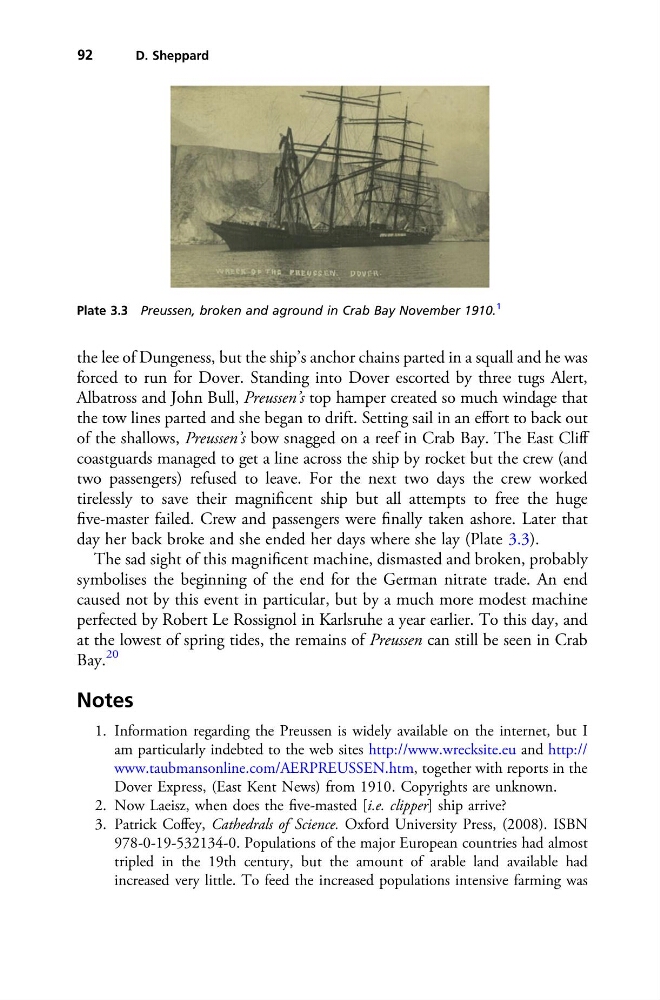
day her back broke and she ended her days where she lay (Plate 3.3).
The sad sight of this magnificent machine, dismasted and broken, probably
symbolises the beginning of the end for the German nitrate trade. An end
caused not by this event in particular, but by a much more modest machine
perfected by Robert Le Rossignol in Karlsruhe a year earlier. To this day, and
at the lowest of spring tides, the remains of Preussen can still be seen in Crab
Bay.
20
Notes
1. Information regarding the Preussen is widely available on the internet, but I
am particularly indebted to the web sites http://www.wrecksite.eu and http://
www.taubmansonline.com/AERPREUSSEN.htm, together with reports in the
Dover Express, (East Kent News) from 1910. Copyrights are unknown.
2. Now Laeisz, when does the five-masted [i.e. clipper] ship arrive?
3. Patrick Coffey, Cathedrals of Science. Oxford University Press, (2008). ISBN
978-0-19-532134-0. Populations of the major European countries had almost
tripled in the 19th century, but the amount of arable land available had
increased very little. To feed the increased populations intensive farming was
Plate 3.3 Preussen, broken and aground in Crab Bay November 1910.
1
92
D. Sheppard
forced to run for Dover. Standing into Dover escorted by three tugs Alert,
Albatross and John Bull, Preussen’s top hamper created so much windage that
the tow lines parted and she began to drift. Setting sail in an effort to back out
of the shallows, Preussen’s bow snagged on a reef in Crab Bay. The East Cliff
coastguards managed to get a line across the ship by rocket but the crew (and
two passengers) refused to leave. For the next two days the crew worked
tirelessly to save their magnificent ship but all attempts to free the huge
five-master failed. Crew and passengers were finally taken ashore. Later that
day her back broke and she ended her days where she lay (Plate 3.3).
The sad sight of this magnificent machine, dismasted and broken, probably
symbolises the beginning of the end for the German nitrate trade. An end
caused not by this event in particular, but by a much more modest machine
perfected by Robert Le Rossignol in Karlsruhe a year earlier. To this day, and
at the lowest of spring tides, the remains of Preussen can still be seen in Crab
Bay.
20
Notes
1. Information regarding the Preussen is widely available on the internet, but I
am particularly indebted to the web sites http://www.wrecksite.eu and http://
www.taubmansonline.com/AERPREUSSEN.htm, together with reports in the
Dover Express, (East Kent News) from 1910. Copyrights are unknown.
2. Now Laeisz, when does the five-masted [i.e. clipper] ship arrive?
3. Patrick Coffey, Cathedrals of Science. Oxford University Press, (2008). ISBN
978-0-19-532134-0. Populations of the major European countries had almost
tripled in the 19th century, but the amount of arable land available had
increased very little. To feed the increased populations intensive farming was
Plate 3.3 Preussen, broken and aground in Crab Bay November 1910.
1
92
D. Sheppard