

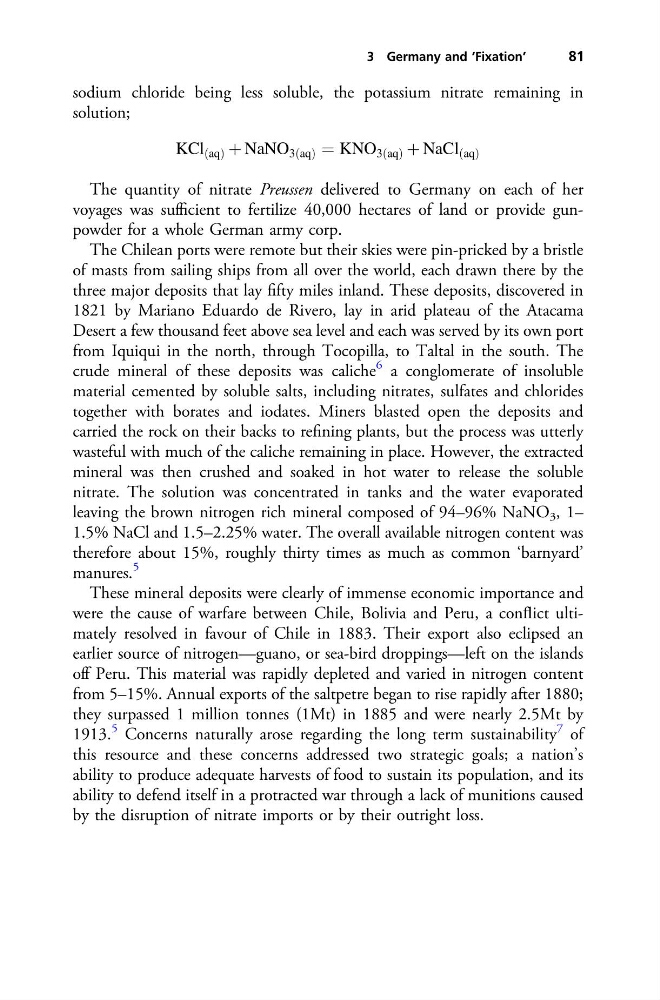
sodium chloride being less soluble, the potassium nitrate remaining in
solution;
KCl ðaqÞ þ NaNO 3ðaqÞ ¼ KNO 3ðaqÞ þ NaCl ðaqÞ
The quantity of nitrate Preussen delivered to Germany on each of her
voyages was sufficient to fertilize 40,000 hectares of land or provide gunpowder for a whole German army corp.
The Chilean ports were remote but their skies were pin-pricked by a bristle
of masts from sailing ships from all over the world, each drawn there by the
three major deposits that lay fifty miles inland. These deposits, discovered in
1821 by Mariano Eduardo de Rivero, lay in arid plateau of the Atacama
Desert a few thousand feet above sea level and each was served by its own port
from Iquiqui in the north, through Tocopilla, to Taltal in the south. The
crude mineral of these deposits was caliche
6 a conglomerate of insoluble
material cemented by soluble salts, including nitrates, sulfates and chlorides
together with borates and iodates. Miners blasted open the deposits and
carried the rock on their backs to refining plants, but the process was utterly
wasteful with much of the caliche remaining in place. However, the extracted
mineral was then crushed and soaked in hot water to release the soluble
nitrate. The solution was concentrated in tanks and the water evaporated
leaving the brown nitrogen rich mineral composed of 94–96% NaNO 3 , 1–
1.5% NaCl and 1.5–2.25% water. The overall available nitrogen content was
therefore about 15%, roughly thirty times as much as common ‘barnyard’
manures.
5
These mineral deposits were clearly of immense economic importance and
were the cause of warfare between Chile, Bolivia and Peru, a conflict ultimately resolved in favour of Chile in 1883. Their export also eclipsed an
earlier source of nitrogen—guano, or sea-bird droppings—left on the islands
off Peru. This material was rapidly depleted and varied in nitrogen content
from 5–15%. Annual exports of the saltpetre began to rise rapidly after 1880;
they surpassed 1 million tonnes (1Mt) in 1885 and were nearly 2.5Mt by
1913.
5 Concerns naturally arose regarding the long term sustainability
7 of
this resource and these concerns addressed two strategic goals; a nation’s
ability to produce adequate harvests of food to sustain its population, and its
ability to defend itself in a protracted war through a lack of munitions caused
by the disruption of nitrate imports or by their outright loss.
3 Germany and ‘Fixation’
81
solution;
KCl ðaqÞ þ NaNO 3ðaqÞ ¼ KNO 3ðaqÞ þ NaCl ðaqÞ
The quantity of nitrate Preussen delivered to Germany on each of her
voyages was sufficient to fertilize 40,000 hectares of land or provide gunpowder for a whole German army corp.
The Chilean ports were remote but their skies were pin-pricked by a bristle
of masts from sailing ships from all over the world, each drawn there by the
three major deposits that lay fifty miles inland. These deposits, discovered in
1821 by Mariano Eduardo de Rivero, lay in arid plateau of the Atacama
Desert a few thousand feet above sea level and each was served by its own port
from Iquiqui in the north, through Tocopilla, to Taltal in the south. The
crude mineral of these deposits was caliche
6 a conglomerate of insoluble
material cemented by soluble salts, including nitrates, sulfates and chlorides
together with borates and iodates. Miners blasted open the deposits and
carried the rock on their backs to refining plants, but the process was utterly
wasteful with much of the caliche remaining in place. However, the extracted
mineral was then crushed and soaked in hot water to release the soluble
nitrate. The solution was concentrated in tanks and the water evaporated
leaving the brown nitrogen rich mineral composed of 94–96% NaNO 3 , 1–
1.5% NaCl and 1.5–2.25% water. The overall available nitrogen content was
therefore about 15%, roughly thirty times as much as common ‘barnyard’
manures.
5
These mineral deposits were clearly of immense economic importance and
were the cause of warfare between Chile, Bolivia and Peru, a conflict ultimately resolved in favour of Chile in 1883. Their export also eclipsed an
earlier source of nitrogen—guano, or sea-bird droppings—left on the islands
off Peru. This material was rapidly depleted and varied in nitrogen content
from 5–15%. Annual exports of the saltpetre began to rise rapidly after 1880;
they surpassed 1 million tonnes (1Mt) in 1885 and were nearly 2.5Mt by
1913.
5 Concerns naturally arose regarding the long term sustainability
7 of
this resource and these concerns addressed two strategic goals; a nation’s
ability to produce adequate harvests of food to sustain its population, and its
ability to defend itself in a protracted war through a lack of munitions caused
by the disruption of nitrate imports or by their outright loss.
3 Germany and ‘Fixation’
81