

50
2 Description of the Wolfram SystemModeler
record RecordName "Description of the record"
// Variable declarations
end RecordName;
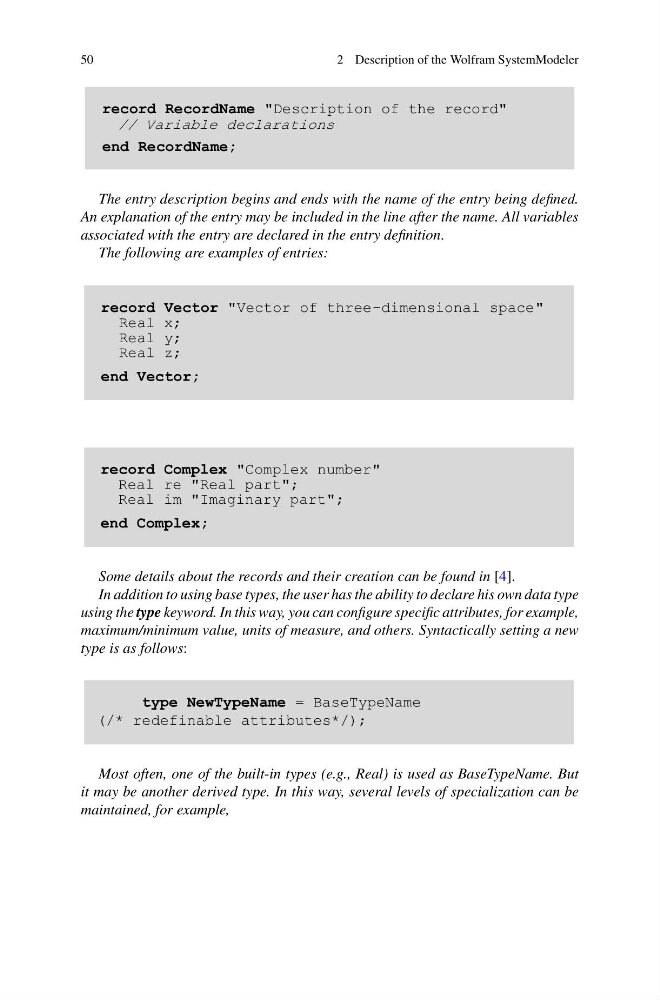
The entry description begins and ends with the name of the entry being defined.
An explanation of the entry may be included in the line after the name. All variables
associated with the entry are declared in the entry definition.
The following are examples of entries:
record Vector "Vector of three-dimensional space"
Real x;
Real y;
Real z;
end Vector;
record Complex "Complex number"
Real re "Real part";
Real im "Imaginary part";
end Complex;
Some details about the records and their creation can be found in [4].
In addition to using base types, the user has the ability to declare his own data type
using the type keyword. In this way, you can configure specific attributes, for example,
maximum/minimum value, units of measure, and others. Syntactically setting a new
type is as follows:
type NewTypeName = BaseTypeName
(/* redefinable attributes*/);
Most often, one of the built-in types (e.g., Real) is used as BaseTypeName. But
it may be another derived type. In this way, several levels of specialization can be
maintained, for example,
2 Description of the Wolfram SystemModeler
record RecordName "Description of the record"
// Variable declarations
end RecordName;
The entry description begins and ends with the name of the entry being defined.
An explanation of the entry may be included in the line after the name. All variables
associated with the entry are declared in the entry definition.
The following are examples of entries:
record Vector "Vector of three-dimensional space"
Real x;
Real y;
Real z;
end Vector;
record Complex "Complex number"
Real re "Real part";
Real im "Imaginary part";
end Complex;
Some details about the records and their creation can be found in [4].
In addition to using base types, the user has the ability to declare his own data type
using the type keyword. In this way, you can configure specific attributes, for example,
maximum/minimum value, units of measure, and others. Syntactically setting a new
type is as follows:
type NewTypeName = BaseTypeName
(/* redefinable attributes*/);
Most often, one of the built-in types (e.g., Real) is used as BaseTypeName. But
it may be another derived type. In this way, several levels of specialization can be
maintained, for example,