

6.2 Heating a Liquid Mixture
243
into the pump—the input variable, liqOut—the fluid that flows from the pump—the
output variable), and the black connector—with the regulator (signal variable).
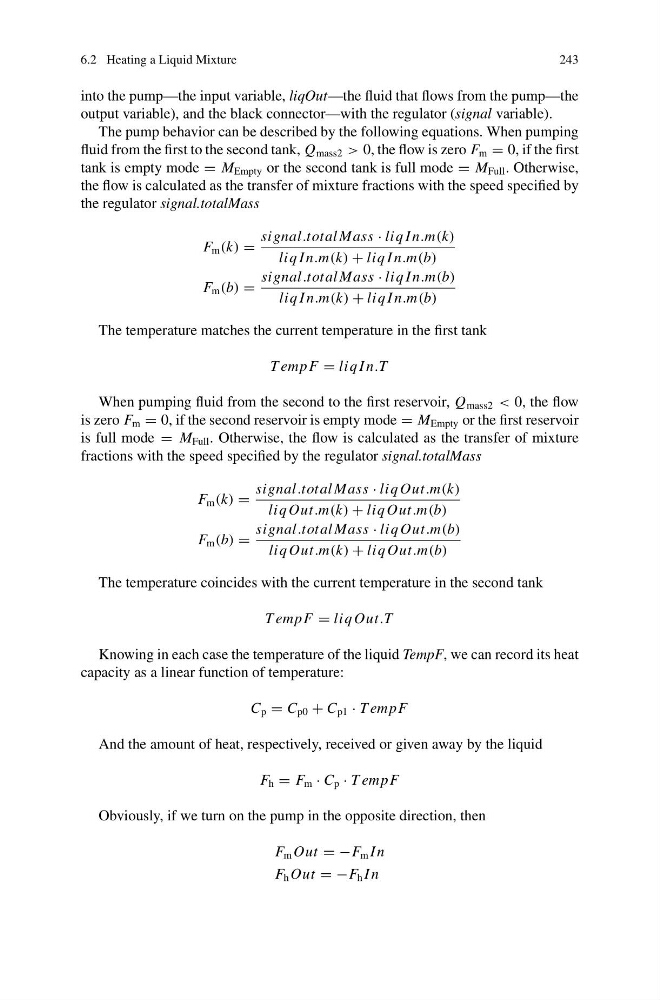
The pump behavior can be described by the following equations. When pumping
fluid from the first to the second tank, Q mass2 > 0, the flow is zero F m = 0, if the first
tank is empty mode = M Empty or the second tank is full mode = M Full . Otherwise,
the flow is calculated as the transfer of mixture fractions with the speed specified by
the regulator signal.totalMass
F m (k) =
signal.total Mass · liq I n.m(k)
liq I n.m(k) + liq I n.m(b)
F m (b) =
signal.total Mass · liq I n.m(b)
liq I n.m(k) + liq I n.m(b)
The temperature matches the current temperature in the first tank
T empF = liq I n.T
When pumping fluid from the second to the first reservoir, Q mass2 < 0, the flow
is zero F m = 0, if the second reservoir is empty mode = M Empty or the first reservoir
is full mode = M Full . Otherwise, the flow is calculated as the transfer of mixture
fractions with the speed specified by the regulator signal.totalMass
F m (k) =
signal.total Mass · liq Out.m(k)
liq Out.m(k) + liq Out.m(b)
F m (b) =
signal.total Mass · liq Out.m(b)
liq Out.m(k) + liq Out.m(b)
The temperature coincides with the current temperature in the second tank
T empF = liq Out.T
Knowing in each case the temperature of the liquid TempF, we can record its heat
capacity as a linear function of temperature:
C p = C p0 + C p1 · T empF
And the amount of heat, respectively, received or given away by the liquid
F h = F m · C p · T empF
Obviously, if we turn on the pump in the opposite direction, then
F m Out = −F m I n
F h Out = −F h I n
243
into the pump—the input variable, liqOut—the fluid that flows from the pump—the
output variable), and the black connector—with the regulator (signal variable).
The pump behavior can be described by the following equations. When pumping
fluid from the first to the second tank, Q mass2 > 0, the flow is zero F m = 0, if the first
tank is empty mode = M Empty or the second tank is full mode = M Full . Otherwise,
the flow is calculated as the transfer of mixture fractions with the speed specified by
the regulator signal.totalMass
F m (k) =
signal.total Mass · liq I n.m(k)
liq I n.m(k) + liq I n.m(b)
F m (b) =
signal.total Mass · liq I n.m(b)
liq I n.m(k) + liq I n.m(b)
The temperature matches the current temperature in the first tank
T empF = liq I n.T
When pumping fluid from the second to the first reservoir, Q mass2 < 0, the flow
is zero F m = 0, if the second reservoir is empty mode = M Empty or the first reservoir
is full mode = M Full . Otherwise, the flow is calculated as the transfer of mixture
fractions with the speed specified by the regulator signal.totalMass
F m (k) =
signal.total Mass · liq Out.m(k)
liq Out.m(k) + liq Out.m(b)
F m (b) =
signal.total Mass · liq Out.m(b)
liq Out.m(k) + liq Out.m(b)
The temperature coincides with the current temperature in the second tank
T empF = liq Out.T
Knowing in each case the temperature of the liquid TempF, we can record its heat
capacity as a linear function of temperature:
C p = C p0 + C p1 · T empF
And the amount of heat, respectively, received or given away by the liquid
F h = F m · C p · T empF
Obviously, if we turn on the pump in the opposite direction, then
F m Out = −F m I n
F h Out = −F h I n