

5.4 Connected Pendulums
171
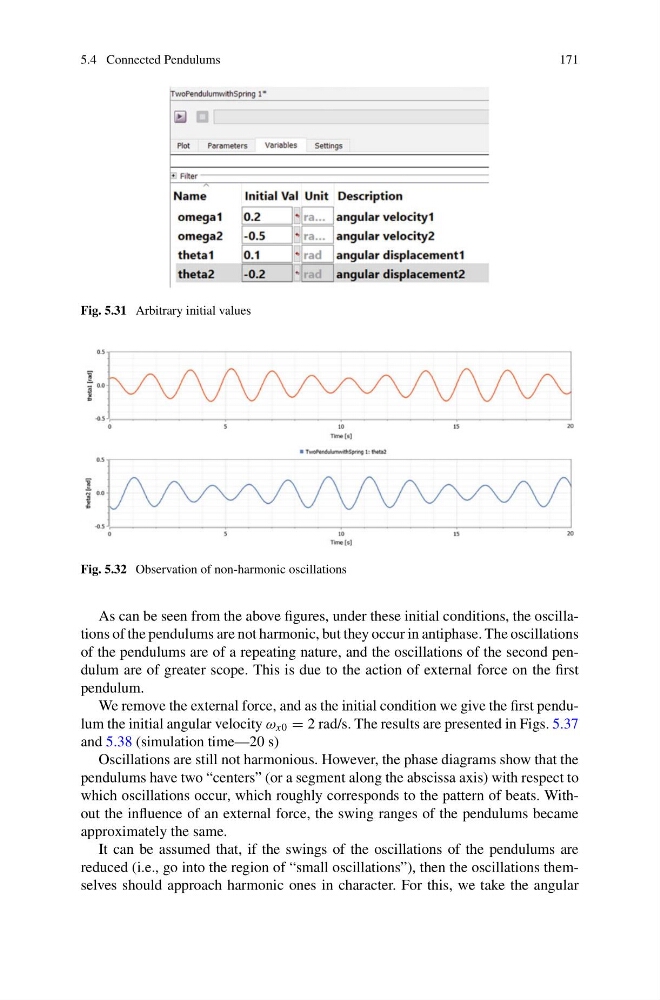
Fig. 5.31 Arbitrary initial values
Fig. 5.32 Observation of non-harmonic oscillations
As can be seen from the above figures, under these initial conditions, the oscillations of the pendulums are not harmonic, but they occur in antiphase. The oscillations
of the pendulums are of a repeating nature, and the oscillations of the second pendulum are of greater scope. This is due to the action of external force on the first
pendulum.
We remove the external force, and as the initial condition we give the first pendulum the initial angular velocity ω x0 = 2 rad/s. The results are presented in Figs. 5.37
and 5.38 (simulation time—20 s)
Oscillations are still not harmonious. However, the phase diagrams show that the
pendulums have two “centers” (or a segment along the abscissa axis) with respect to
which oscillations occur, which roughly corresponds to the pattern of beats. Without the influence of an external force, the swing ranges of the pendulums became
approximately the same.
It can be assumed that, if the swings of the oscillations of the pendulums are
reduced (i.e., go into the region of “small oscillations”), then the oscillations themselves should approach harmonic ones in character. For this, we take the angular
171
Fig. 5.31 Arbitrary initial values
Fig. 5.32 Observation of non-harmonic oscillations
As can be seen from the above figures, under these initial conditions, the oscillations of the pendulums are not harmonic, but they occur in antiphase. The oscillations
of the pendulums are of a repeating nature, and the oscillations of the second pendulum are of greater scope. This is due to the action of external force on the first
pendulum.
We remove the external force, and as the initial condition we give the first pendulum the initial angular velocity ω x0 = 2 rad/s. The results are presented in Figs. 5.37
and 5.38 (simulation time—20 s)
Oscillations are still not harmonious. However, the phase diagrams show that the
pendulums have two “centers” (or a segment along the abscissa axis) with respect to
which oscillations occur, which roughly corresponds to the pattern of beats. Without the influence of an external force, the swing ranges of the pendulums became
approximately the same.
It can be assumed that, if the swings of the oscillations of the pendulums are
reduced (i.e., go into the region of “small oscillations”), then the oscillations themselves should approach harmonic ones in character. For this, we take the angular