

5.2 Mechanical System with Damper and Spring
155
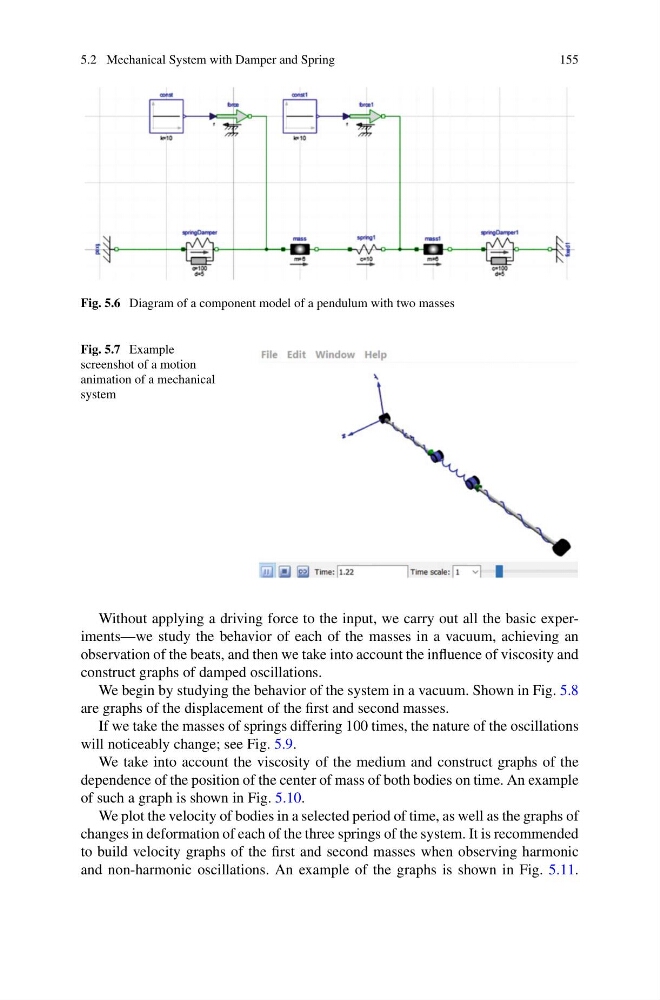
Fig. 5.6 Diagram of a component model of a pendulum with two masses
Fig. 5.7 Example
screenshot of a motion
animation of a mechanical
system
Without applying a driving force to the input, we carry out all the basic experiments—we study the behavior of each of the masses in a vacuum, achieving an
observation of the beats, and then we take into account the influence of viscosity and
construct graphs of damped oscillations.
We begin by studying the behavior of the system in a vacuum. Shown in Fig. 5.8
are graphs of the displacement of the first and second masses.
If we take the masses of springs differing 100 times, the nature of the oscillations
will noticeably change; see Fig. 5.9.
We take into account the viscosity of the medium and construct graphs of the
dependence of the position of the center of mass of both bodies on time. An example
of such a graph is shown in Fig. 5.10.
We plot the velocity of bodies in a selected period of time, as well as the graphs of
changes in deformation of each of the three springs of the system. It is recommended
to build velocity graphs of the first and second masses when observing harmonic
and non-harmonic oscillations. An example of the graphs is shown in Fig. 5.11.
155
Fig. 5.6 Diagram of a component model of a pendulum with two masses
Fig. 5.7 Example
screenshot of a motion
animation of a mechanical
system
Without applying a driving force to the input, we carry out all the basic experiments—we study the behavior of each of the masses in a vacuum, achieving an
observation of the beats, and then we take into account the influence of viscosity and
construct graphs of damped oscillations.
We begin by studying the behavior of the system in a vacuum. Shown in Fig. 5.8
are graphs of the displacement of the first and second masses.
If we take the masses of springs differing 100 times, the nature of the oscillations
will noticeably change; see Fig. 5.9.
We take into account the viscosity of the medium and construct graphs of the
dependence of the position of the center of mass of both bodies on time. An example
of such a graph is shown in Fig. 5.10.
We plot the velocity of bodies in a selected period of time, as well as the graphs of
changes in deformation of each of the three springs of the system. It is recommended
to build velocity graphs of the first and second masses when observing harmonic
and non-harmonic oscillations. An example of the graphs is shown in Fig. 5.11.