

5.2 Mechanical System with Damper and Spring
153
Build graphs of the dependence of the position of the center of mass of both bodies
on time.
Build graphs of the speed of bodies in a selected period of time, as well as graphs
of changes in the deformation of each of the springs.
Conduct a series of experiments, changing the stiffness of the springs and the
viscosity of the medium.
Calculate theoretically normal and partial oscillation frequencies of each of the
bodies to simulate the conditions under which the oscillations of the bodies will be
harmonic. In this case, it is possible to determine the oscillation frequency directly
from the graph and compare them with the theoretical values obtained for normal
frequencies. Validate results using FFT analysis.
Explore the resonance modes of a mechanical system.
Modeling and computational experiment
When modeling, it is assumed that the reader has read the previous sections on
modeling the spring.
Let the distance between the walls be constant and equal to 1, the initial coordinate
of the first body is determined by the length of the first spring in the undeformed
state x 01 = l 1 . The initial position of the second body: x 02 = x 01 + l 2 , where l 2 is
the length of the second spring in the undeformed state. And finally, l 3 is the length
of the third spring in an undeformed state
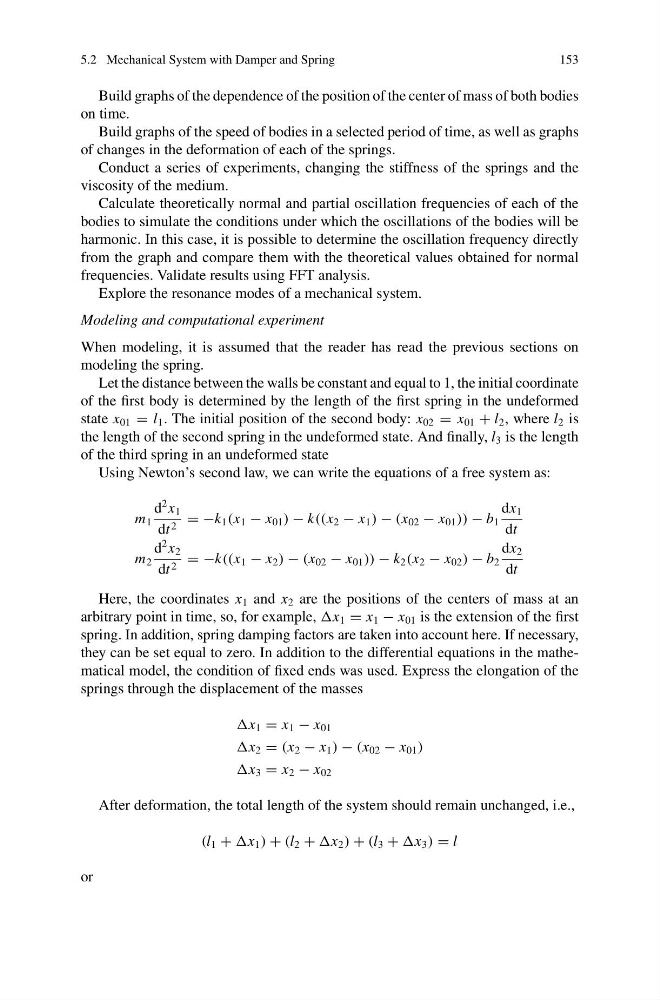
Using Newton’s second law, we can write the equations of a free system as:
m 1
d
2 x 1
dt 2 = −k 1 (x 1 − x 01 ) − k((x 2 − x 1 ) − (x 02 − x 01 )) − b 1
dx 1
dt
m 2
d
2 x 2
dt 2 = −k((x 1 − x 2 ) − (x 02 − x 01 )) − k 2 (x 2 − x 02 ) − b 2
dx 2
dt
Here, the coordinates x 1 and x 2 are the positions of the centers of mass at an
arbitrary point in time, so, for example, x 1 = x 1 − x 01 is the extension of the first
spring. In addition, spring damping factors are taken into account here. If necessary,
they can be set equal to zero. In addition to the differential equations in the mathematical model, the condition of fixed ends was used. Express the elongation of the
springs through the displacement of the masses
x 1 = x 1 − x 01
x 2 = (x 2 − x 1 ) − (x 02 − x 01 )
x 3 = x 2 − x 02
After deformation, the total length of the system should remain unchanged, i.e.,
(l 1 + x 1 ) + (l 2 + x 2 ) + (l 3 + x 3 ) = l
or
153
Build graphs of the dependence of the position of the center of mass of both bodies
on time.
Build graphs of the speed of bodies in a selected period of time, as well as graphs
of changes in the deformation of each of the springs.
Conduct a series of experiments, changing the stiffness of the springs and the
viscosity of the medium.
Calculate theoretically normal and partial oscillation frequencies of each of the
bodies to simulate the conditions under which the oscillations of the bodies will be
harmonic. In this case, it is possible to determine the oscillation frequency directly
from the graph and compare them with the theoretical values obtained for normal
frequencies. Validate results using FFT analysis.
Explore the resonance modes of a mechanical system.
Modeling and computational experiment
When modeling, it is assumed that the reader has read the previous sections on
modeling the spring.
Let the distance between the walls be constant and equal to 1, the initial coordinate
of the first body is determined by the length of the first spring in the undeformed
state x 01 = l 1 . The initial position of the second body: x 02 = x 01 + l 2 , where l 2 is
the length of the second spring in the undeformed state. And finally, l 3 is the length
of the third spring in an undeformed state
Using Newton’s second law, we can write the equations of a free system as:
m 1
d
2 x 1
dt 2 = −k 1 (x 1 − x 01 ) − k((x 2 − x 1 ) − (x 02 − x 01 )) − b 1
dx 1
dt
m 2
d
2 x 2
dt 2 = −k((x 1 − x 2 ) − (x 02 − x 01 )) − k 2 (x 2 − x 02 ) − b 2
dx 2
dt
Here, the coordinates x 1 and x 2 are the positions of the centers of mass at an
arbitrary point in time, so, for example, x 1 = x 1 − x 01 is the extension of the first
spring. In addition, spring damping factors are taken into account here. If necessary,
they can be set equal to zero. In addition to the differential equations in the mathematical model, the condition of fixed ends was used. Express the elongation of the
springs through the displacement of the masses
x 1 = x 1 − x 01
x 2 = (x 2 − x 1 ) − (x 02 − x 01 )
x 3 = x 2 − x 02
After deformation, the total length of the system should remain unchanged, i.e.,
(l 1 + x 1 ) + (l 2 + x 2 ) + (l 3 + x 3 ) = l
or