

5.1 The Movement of Two Bodies with Friction
151
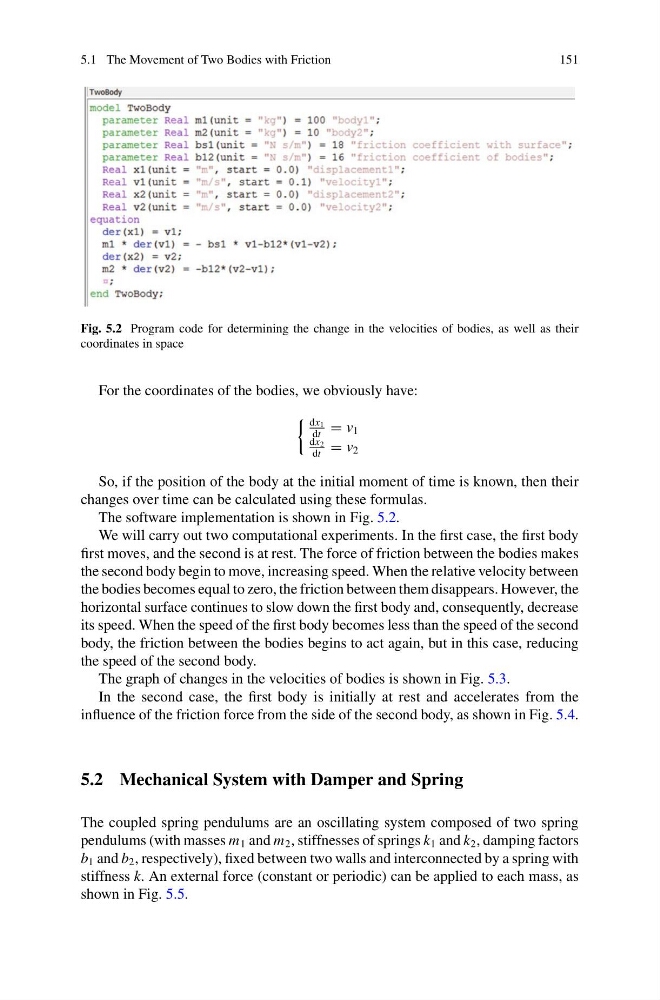
Fig. 5.2 Program code for determining the change in the velocities of bodies, as well as their
coordinates in space
For the coordinates of the bodies, we obviously have:
dx 1
dt
= v 1
dx 2
dt
= v 2
So, if the position of the body at the initial moment of time is known, then their
changes over time can be calculated using these formulas.
The software implementation is shown in Fig. 5.2.
We will carry out two computational experiments. In the first case, the first body
first moves, and the second is at rest. The force of friction between the bodies makes
the second body begin to move, increasing speed. When the relative velocity between
the bodies becomes equal to zero, the friction between them disappears. However, the
horizontal surface continues to slow down the first body and, consequently, decrease
its speed. When the speed of the first body becomes less than the speed of the second
body, the friction between the bodies begins to act again, but in this case, reducing
the speed of the second body.
The graph of changes in the velocities of bodies is shown in Fig. 5.3.
In the second case, the first body is initially at rest and accelerates from the
influence of the friction force from the side of the second body, as shown in Fig. 5.4.
5.2 Mechanical System with Damper and Spring
The coupled spring pendulums are an oscillating system composed of two spring
pendulums (with masses m 1 and m 2 , stiffnesses of springs k 1 and k 2 , damping factors
b 1 and b 2 , respectively), fixed between two walls and interconnected by a spring with
stiffness k. An external force (constant or periodic) can be applied to each mass, as
shown in Fig. 5.5.
151
Fig. 5.2 Program code for determining the change in the velocities of bodies, as well as their
coordinates in space
For the coordinates of the bodies, we obviously have:
dx 1
dt
= v 1
dx 2
dt
= v 2
So, if the position of the body at the initial moment of time is known, then their
changes over time can be calculated using these formulas.
The software implementation is shown in Fig. 5.2.
We will carry out two computational experiments. In the first case, the first body
first moves, and the second is at rest. The force of friction between the bodies makes
the second body begin to move, increasing speed. When the relative velocity between
the bodies becomes equal to zero, the friction between them disappears. However, the
horizontal surface continues to slow down the first body and, consequently, decrease
its speed. When the speed of the first body becomes less than the speed of the second
body, the friction between the bodies begins to act again, but in this case, reducing
the speed of the second body.
The graph of changes in the velocities of bodies is shown in Fig. 5.3.
In the second case, the first body is initially at rest and accelerates from the
influence of the friction force from the side of the second body, as shown in Fig. 5.4.
5.2 Mechanical System with Damper and Spring
The coupled spring pendulums are an oscillating system composed of two spring
pendulums (with masses m 1 and m 2 , stiffnesses of springs k 1 and k 2 , damping factors
b 1 and b 2 , respectively), fixed between two walls and interconnected by a spring with
stiffness k. An external force (constant or periodic) can be applied to each mass, as
shown in Fig. 5.5.