

3.4 Universality of a Computer Model and Equivalent Physical …
129
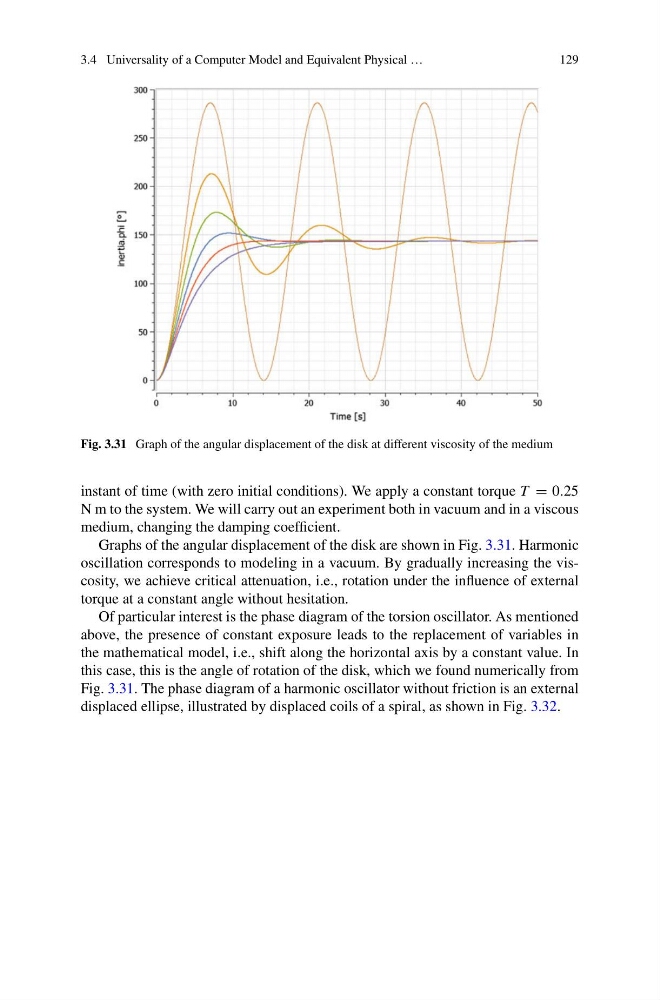
Fig. 3.31 Graph of the angular displacement of the disk at different viscosity of the medium
instant of time (with zero initial conditions). We apply a constant torque T = 0.25
N m to the system. We will carry out an experiment both in vacuum and in a viscous
medium, changing the damping coefficient.
Graphs of the angular displacement of the disk are shown in Fig. 3.31. Harmonic
oscillation corresponds to modeling in a vacuum. By gradually increasing the viscosity, we achieve critical attenuation, i.e., rotation under the influence of external
torque at a constant angle without hesitation.
Of particular interest is the phase diagram of the torsion oscillator. As mentioned
above, the presence of constant exposure leads to the replacement of variables in
the mathematical model, i.e., shift along the horizontal axis by a constant value. In
this case, this is the angle of rotation of the disk, which we found numerically from
Fig. 3.31. The phase diagram of a harmonic oscillator without friction is an external
displaced ellipse, illustrated by displaced coils of a spiral, as shown in Fig. 3.32.
129
Fig. 3.31 Graph of the angular displacement of the disk at different viscosity of the medium
instant of time (with zero initial conditions). We apply a constant torque T = 0.25
N m to the system. We will carry out an experiment both in vacuum and in a viscous
medium, changing the damping coefficient.
Graphs of the angular displacement of the disk are shown in Fig. 3.31. Harmonic
oscillation corresponds to modeling in a vacuum. By gradually increasing the viscosity, we achieve critical attenuation, i.e., rotation under the influence of external
torque at a constant angle without hesitation.
Of particular interest is the phase diagram of the torsion oscillator. As mentioned
above, the presence of constant exposure leads to the replacement of variables in
the mathematical model, i.e., shift along the horizontal axis by a constant value. In
this case, this is the angle of rotation of the disk, which we found numerically from
Fig. 3.31. The phase diagram of a harmonic oscillator without friction is an external
displaced ellipse, illustrated by displaced coils of a spiral, as shown in Fig. 3.32.