

3.3 Hierarchical Principles of Model Building
111
case of small deviations sin θ ≈ θ , this equation goes over into the equation of free
undamped oscillations, the solution of which is a periodic function.
Dry friction
Dry or Coulomb friction is observed when solids are in contact and move relative
to one another at the point of contact. Friction forces in the absence of lubrication
are almost independent of the magnitude of the speed of movement; their direction
is opposite to the speed of relative displacement.
In this case, the friction force is F = k 1 P, where k 1 is the coefficient of friction,
P = mg is the weight of the ball. It is always directed against the movement of the
ball, its sign is opposite to the sign of the speed of the ball υ = dr/dt, i.e.,
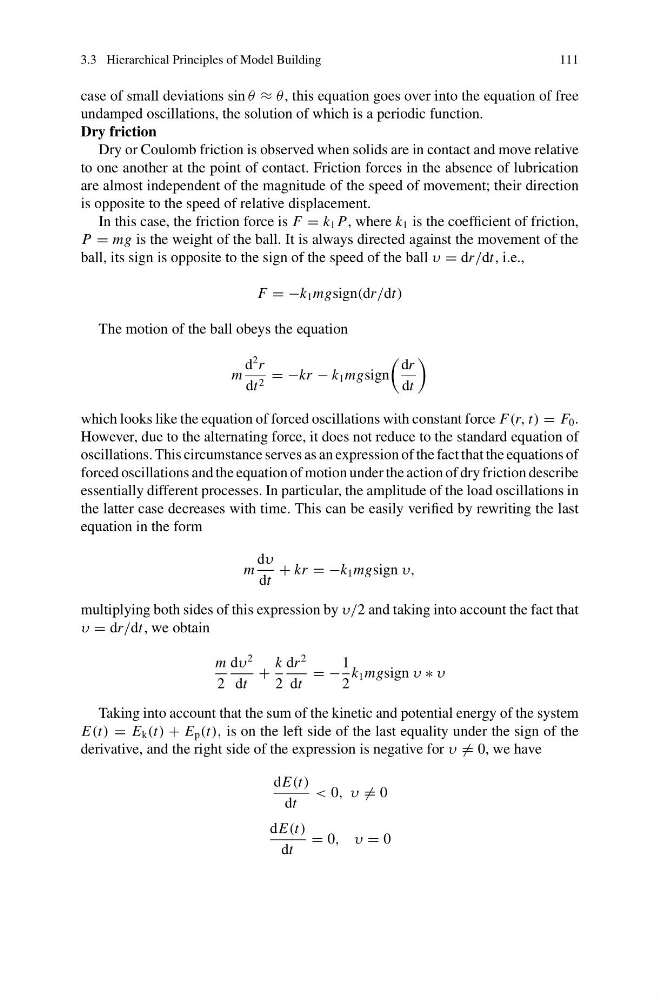
F = −k 1 mgsign(dr/dt)
The motion of the ball obeys the equation
m
d
2 r
dt 2 = −kr − k 1 mgsign
dr
dt
which looks like the equation of forced oscillations with constant force F(r, t) = F 0 .
However, due to the alternating force, it does not reduce to the standard equation of
oscillations. This circumstance serves as an expression of the fact that the equations of
forced oscillations and the equation of motion under the action of dry friction describe
essentially different processes. In particular, the amplitude of the load oscillations in
the latter case decreases with time. This can be easily verified by rewriting the last
equation in the form
m
dυ
dt
+ kr = −k 1 mgsign υ,
multiplying both sides of this expression by υ/2 and taking into account the fact that
υ = dr/dt, we obtain
m
2
dυ
2
dt
+
k
2
dr
2
dt
= −
1
2
k 1 mgsign υ ∗ υ
Taking into account that the sum of the kinetic and potential energy of the system
E(t) = E k (t) + E p (t), is on the left side of the last equality under the sign of the
derivative, and the right side of the expression is negative for υ = 0, we have
dE(t)
dt
< 0, υ = 0
dE(t)
dt
= 0, υ = 0
111
case of small deviations sin θ ≈ θ , this equation goes over into the equation of free
undamped oscillations, the solution of which is a periodic function.
Dry friction
Dry or Coulomb friction is observed when solids are in contact and move relative
to one another at the point of contact. Friction forces in the absence of lubrication
are almost independent of the magnitude of the speed of movement; their direction
is opposite to the speed of relative displacement.
In this case, the friction force is F = k 1 P, where k 1 is the coefficient of friction,
P = mg is the weight of the ball. It is always directed against the movement of the
ball, its sign is opposite to the sign of the speed of the ball υ = dr/dt, i.e.,
F = −k 1 mgsign(dr/dt)
The motion of the ball obeys the equation
m
d
2 r
dt 2 = −kr − k 1 mgsign
dr
dt
which looks like the equation of forced oscillations with constant force F(r, t) = F 0 .
However, due to the alternating force, it does not reduce to the standard equation of
oscillations. This circumstance serves as an expression of the fact that the equations of
forced oscillations and the equation of motion under the action of dry friction describe
essentially different processes. In particular, the amplitude of the load oscillations in
the latter case decreases with time. This can be easily verified by rewriting the last
equation in the form
m
dυ
dt
+ kr = −k 1 mgsign υ,
multiplying both sides of this expression by υ/2 and taking into account the fact that
υ = dr/dt, we obtain
m
2
dυ
2
dt
+
k
2
dr
2
dt
= −
1
2
k 1 mgsign υ ∗ υ
Taking into account that the sum of the kinetic and potential energy of the system
E(t) = E k (t) + E p (t), is on the left side of the last equality under the sign of the
derivative, and the right side of the expression is negative for υ = 0, we have
dE(t)
dt
< 0, υ = 0
dE(t)
dt
= 0, υ = 0