

5.2 Sol-Gel Method
85
of graphene aerogels on the basis of the polycondensation of resorcinol, formaldehyde, and graphene oxide with HCl as the catalyst and acetonitrile as the solvent
(shown in Fig. 5.2c) (Lim et al. 2015a, b). This synthetic approach greatly reduces
the gelation time from many hours or even several days (using the traditional basecatalyzed route) to just 1–2 h, making it easier to produce graphene aerogels on a
large scale within reasonable time and potentially reducing their cost. Conceivably,
the capacitance of the graphene aerogels could be further improved by tailoring
surface area and pore volume using CO 2 activation and varying the amount of GO
loading; or by experimenting with aqueous electrolytes with smaller ion size, as
opposed to the organic electrolyte used in this study.
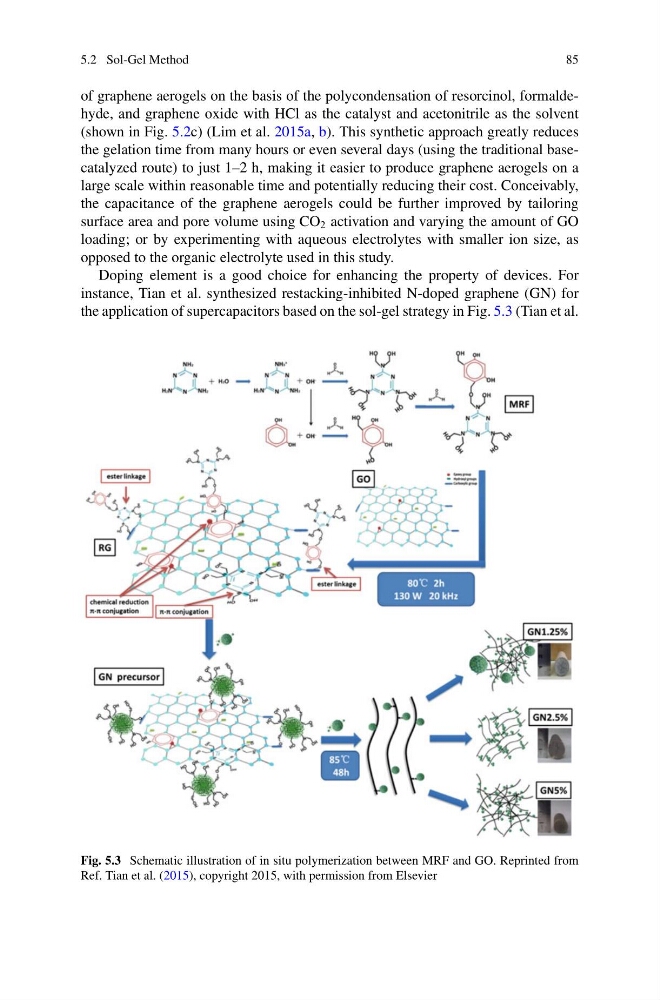
Doping element is a good choice for enhancing the property of devices. For
instance, Tian et al. synthesized restacking-inhibited N-doped graphene (GN) for
the application of supercapacitors based on the sol-gel strategy in Fig. 5.3 (Tian et al.
Fig. 5.3 Schematic illustration of in situ polymerization between MRF and GO. Reprinted from
Ref. Tian et al. (2015), copyright 2015, with permission from Elsevier
85
of graphene aerogels on the basis of the polycondensation of resorcinol, formaldehyde, and graphene oxide with HCl as the catalyst and acetonitrile as the solvent
(shown in Fig. 5.2c) (Lim et al. 2015a, b). This synthetic approach greatly reduces
the gelation time from many hours or even several days (using the traditional basecatalyzed route) to just 1–2 h, making it easier to produce graphene aerogels on a
large scale within reasonable time and potentially reducing their cost. Conceivably,
the capacitance of the graphene aerogels could be further improved by tailoring
surface area and pore volume using CO 2 activation and varying the amount of GO
loading; or by experimenting with aqueous electrolytes with smaller ion size, as
opposed to the organic electrolyte used in this study.
Doping element is a good choice for enhancing the property of devices. For
instance, Tian et al. synthesized restacking-inhibited N-doped graphene (GN) for
the application of supercapacitors based on the sol-gel strategy in Fig. 5.3 (Tian et al.
Fig. 5.3 Schematic illustration of in situ polymerization between MRF and GO. Reprinted from
Ref. Tian et al. (2015), copyright 2015, with permission from Elsevier