

80
5 Synthesis of Three-Dimensional Nanomaterials
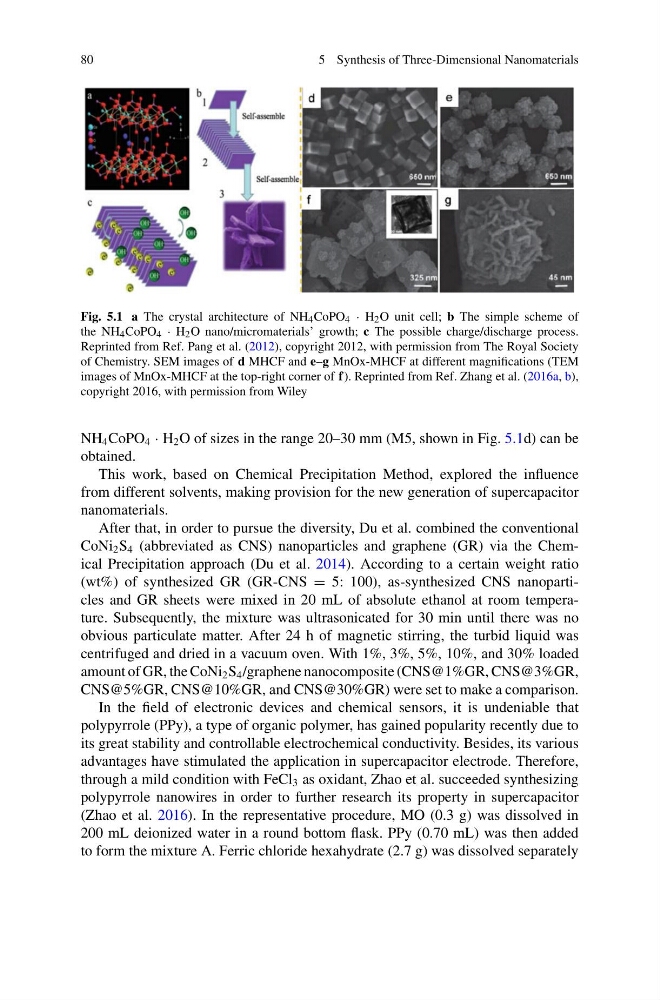
Fig. 5.1 a The crystal architecture of NH 4 CoPO 4 · H 2 O unit cell; b The simple scheme of
the NH 4 CoPO 4 · H 2 O nano/micromaterials’ growth; c The possible charge/discharge process.
Reprinted from Ref. Pang et al. (2012), copyright 2012, with permission from The Royal Society
of Chemistry. SEM images of d MHCF and e–g MnOx-MHCF at different magnifications (TEM
images of MnOx-MHCF at the top-right corner of f). Reprinted from Ref. Zhang et al. (2016a, b),
copyright 2016, with permission from Wiley
NH 4 CoPO 4 · H 2 O of sizes in the range 20–30 mm (M5, shown in Fig. 5.1d) can be
obtained.
This work, based on Chemical Precipitation Method, explored the influence
from different solvents, making provision for the new generation of supercapacitor
nanomaterials.
After that, in order to pursue the diversity, Du et al. combined the conventional
CoNi 2 S 4 (abbreviated as CNS) nanoparticles and graphene (GR) via the Chemical Precipitation approach (Du et al. 2014). According to a certain weight ratio
(wt%) of synthesized GR (GR-CNS = 5: 100), as-synthesized CNS nanoparticles and GR sheets were mixed in 20 mL of absolute ethanol at room temperature. Subsequently, the mixture was ultrasonicated for 30 min until there was no
obvious particulate matter. After 24 h of magnetic stirring, the turbid liquid was
centrifuged and dried in a vacuum oven. With 1%, 3%, 5%, 10%, and 30% loaded
amount of GR, the CoNi 2 S 4 /graphene nanocomposite (CNS@1%GR, CNS@3%GR,
CNS@5%GR, CNS@10%GR, and CNS@30%GR) were set to make a comparison.
In the field of electronic devices and chemical sensors, it is undeniable that
polypyrrole (PPy), a type of organic polymer, has gained popularity recently due to
its great stability and controllable electrochemical conductivity. Besides, its various
advantages have stimulated the application in supercapacitor electrode. Therefore,
through a mild condition with FeCl 3 as oxidant, Zhao et al. succeeded synthesizing
polypyrrole nanowires in order to further research its property in supercapacitor
(Zhao et al. 2016). In the representative procedure, MO (0.3 g) was dissolved in
200 mL deionized water in a round bottom flask. PPy (0.70 mL) was then added
to form the mixture A. Ferric chloride hexahydrate (2.7 g) was dissolved separately
5 Synthesis of Three-Dimensional Nanomaterials
Fig. 5.1 a The crystal architecture of NH 4 CoPO 4 · H 2 O unit cell; b The simple scheme of
the NH 4 CoPO 4 · H 2 O nano/micromaterials’ growth; c The possible charge/discharge process.
Reprinted from Ref. Pang et al. (2012), copyright 2012, with permission from The Royal Society
of Chemistry. SEM images of d MHCF and e–g MnOx-MHCF at different magnifications (TEM
images of MnOx-MHCF at the top-right corner of f). Reprinted from Ref. Zhang et al. (2016a, b),
copyright 2016, with permission from Wiley
NH 4 CoPO 4 · H 2 O of sizes in the range 20–30 mm (M5, shown in Fig. 5.1d) can be
obtained.
This work, based on Chemical Precipitation Method, explored the influence
from different solvents, making provision for the new generation of supercapacitor
nanomaterials.
After that, in order to pursue the diversity, Du et al. combined the conventional
CoNi 2 S 4 (abbreviated as CNS) nanoparticles and graphene (GR) via the Chemical Precipitation approach (Du et al. 2014). According to a certain weight ratio
(wt%) of synthesized GR (GR-CNS = 5: 100), as-synthesized CNS nanoparticles and GR sheets were mixed in 20 mL of absolute ethanol at room temperature. Subsequently, the mixture was ultrasonicated for 30 min until there was no
obvious particulate matter. After 24 h of magnetic stirring, the turbid liquid was
centrifuged and dried in a vacuum oven. With 1%, 3%, 5%, 10%, and 30% loaded
amount of GR, the CoNi 2 S 4 /graphene nanocomposite (CNS@1%GR, CNS@3%GR,
CNS@5%GR, CNS@10%GR, and CNS@30%GR) were set to make a comparison.
In the field of electronic devices and chemical sensors, it is undeniable that
polypyrrole (PPy), a type of organic polymer, has gained popularity recently due to
its great stability and controllable electrochemical conductivity. Besides, its various
advantages have stimulated the application in supercapacitor electrode. Therefore,
through a mild condition with FeCl 3 as oxidant, Zhao et al. succeeded synthesizing
polypyrrole nanowires in order to further research its property in supercapacitor
(Zhao et al. 2016). In the representative procedure, MO (0.3 g) was dissolved in
200 mL deionized water in a round bottom flask. PPy (0.70 mL) was then added
to form the mixture A. Ferric chloride hexahydrate (2.7 g) was dissolved separately