

4.3 2D Transition Metal Hydroxides
67
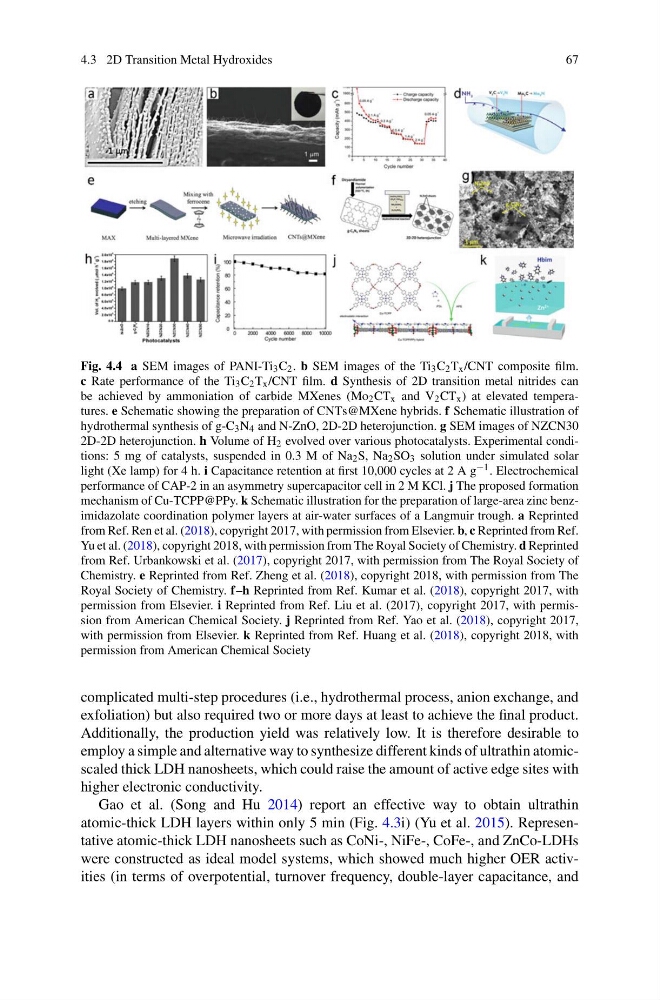
Fig. 4.4 a SEM images of PANI-Ti 3 C 2 . b SEM images of the Ti 3 C 2 T x /CNT composite film.
c Rate performance of the Ti 3 C 2 T x /CNT film. d Synthesis of 2D transition metal nitrides can
be achieved by ammoniation of carbide MXenes (Mo 2 CT x and V 2 CT x ) at elevated temperatures. e Schematic showing the preparation of CNTs@MXene hybrids. f Schematic illustration of
hydrothermal synthesis of g-C 3 N 4 and N-ZnO, 2D-2D heterojunction. g SEM images of NZCN30
2D-2D heterojunction. h Volume of H 2 evolved over various photocatalysts. Experimental conditions: 5 mg of catalysts, suspended in 0.3 M of Na 2 S, Na 2 SO 3 solution under simulated solar
light (Xe lamp) for 4 h. i Capacitance retention at first 10,000 cycles at 2 A g −1 . Electrochemical
performance of CAP-2 in an asymmetry supercapacitor cell in 2 M KCl. j The proposed formation
mechanism of Cu-TCPP@PPy. k Schematic illustration for the preparation of large-area zinc benzimidazolate coordination polymer layers at air-water surfaces of a Langmuir trough. a Reprinted
from Ref. Ren et al. (2018), copyright 2017, with permission from Elsevier. b, c Reprinted from Ref.
Yu et al. (2018), copyright 2018, with permission from The Royal Society of Chemistry. d Reprinted
from Ref. Urbankowski et al. (2017), copyright 2017, with permission from The Royal Society of
Chemistry. e Reprinted from Ref. Zheng et al. (2018), copyright 2018, with permission from The
Royal Society of Chemistry. f–h Reprinted from Ref. Kumar et al. (2018), copyright 2017, with
permission from Elsevier. i Reprinted from Ref. Liu et al. (2017), copyright 2017, with permission from American Chemical Society. j Reprinted from Ref. Yao et al. (2018), copyright 2017,
with permission from Elsevier. k Reprinted from Ref. Huang et al. (2018), copyright 2018, with
permission from American Chemical Society
complicated multi-step procedures (i.e., hydrothermal process, anion exchange, and
exfoliation) but also required two or more days at least to achieve the final product.
Additionally, the production yield was relatively low. It is therefore desirable to
employ a simple and alternative way to synthesize different kinds of ultrathin atomicscaled thick LDH nanosheets, which could raise the amount of active edge sites with
higher electronic conductivity.
Gao et al. (Song and Hu 2014) report an effective way to obtain ultrathin
atomic-thick LDH layers within only 5 min (Fig. 4.3i) (Yu et al. 2015). Representative atomic-thick LDH nanosheets such as CoNi-, NiFe-, CoFe-, and ZnCo-LDHs
were constructed as ideal model systems, which showed much higher OER activities (in terms of overpotential, turnover frequency, double-layer capacitance, and
67
Fig. 4.4 a SEM images of PANI-Ti 3 C 2 . b SEM images of the Ti 3 C 2 T x /CNT composite film.
c Rate performance of the Ti 3 C 2 T x /CNT film. d Synthesis of 2D transition metal nitrides can
be achieved by ammoniation of carbide MXenes (Mo 2 CT x and V 2 CT x ) at elevated temperatures. e Schematic showing the preparation of CNTs@MXene hybrids. f Schematic illustration of
hydrothermal synthesis of g-C 3 N 4 and N-ZnO, 2D-2D heterojunction. g SEM images of NZCN30
2D-2D heterojunction. h Volume of H 2 evolved over various photocatalysts. Experimental conditions: 5 mg of catalysts, suspended in 0.3 M of Na 2 S, Na 2 SO 3 solution under simulated solar
light (Xe lamp) for 4 h. i Capacitance retention at first 10,000 cycles at 2 A g −1 . Electrochemical
performance of CAP-2 in an asymmetry supercapacitor cell in 2 M KCl. j The proposed formation
mechanism of Cu-TCPP@PPy. k Schematic illustration for the preparation of large-area zinc benzimidazolate coordination polymer layers at air-water surfaces of a Langmuir trough. a Reprinted
from Ref. Ren et al. (2018), copyright 2017, with permission from Elsevier. b, c Reprinted from Ref.
Yu et al. (2018), copyright 2018, with permission from The Royal Society of Chemistry. d Reprinted
from Ref. Urbankowski et al. (2017), copyright 2017, with permission from The Royal Society of
Chemistry. e Reprinted from Ref. Zheng et al. (2018), copyright 2018, with permission from The
Royal Society of Chemistry. f–h Reprinted from Ref. Kumar et al. (2018), copyright 2017, with
permission from Elsevier. i Reprinted from Ref. Liu et al. (2017), copyright 2017, with permission from American Chemical Society. j Reprinted from Ref. Yao et al. (2018), copyright 2017,
with permission from Elsevier. k Reprinted from Ref. Huang et al. (2018), copyright 2018, with
permission from American Chemical Society
complicated multi-step procedures (i.e., hydrothermal process, anion exchange, and
exfoliation) but also required two or more days at least to achieve the final product.
Additionally, the production yield was relatively low. It is therefore desirable to
employ a simple and alternative way to synthesize different kinds of ultrathin atomicscaled thick LDH nanosheets, which could raise the amount of active edge sites with
higher electronic conductivity.
Gao et al. (Song and Hu 2014) report an effective way to obtain ultrathin
atomic-thick LDH layers within only 5 min (Fig. 4.3i) (Yu et al. 2015). Representative atomic-thick LDH nanosheets such as CoNi-, NiFe-, CoFe-, and ZnCo-LDHs
were constructed as ideal model systems, which showed much higher OER activities (in terms of overpotential, turnover frequency, double-layer capacitance, and