

60
4 Synthesis of Two-Dimensional (2D) Nanomaterials
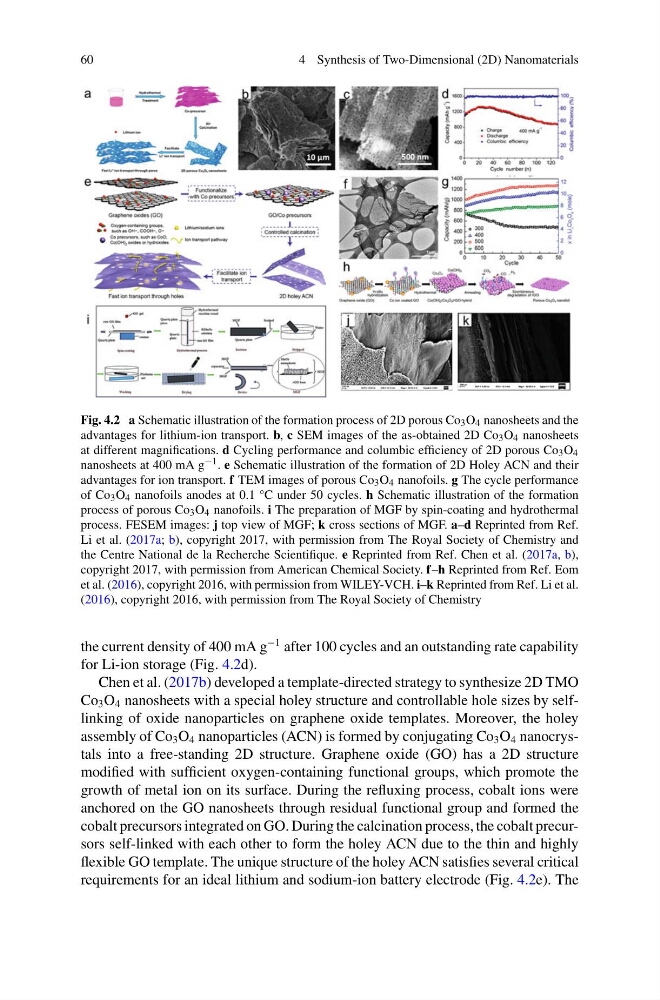
Fig. 4.2 a Schematic illustration of the formation process of 2D porous Co 3 O 4 nanosheets and the
advantages for lithium-ion transport. b, c SEM images of the as-obtained 2D Co 3 O 4 nanosheets
at different magnifications. d Cycling performance and columbic efficiency of 2D porous Co 3 O 4
nanosheets at 400 mA g −1 . e Schematic illustration of the formation of 2D Holey ACN and their
advantages for ion transport. f TEM images of porous Co 3 O 4 nanofoils. g The cycle performance
of Co 3 O 4 nanofoils anodes at 0.1 °C under 50 cycles. h Schematic illustration of the formation
process of porous Co 3 O 4 nanofoils. i The preparation of MGF by spin-coating and hydrothermal
process. FESEM images: j top view of MGF; k cross sections of MGF. a–d Reprinted from Ref.
Li et al. (2017a; b), copyright 2017, with permission from The Royal Society of Chemistry and
the Centre National de la Recherche Scientifique. e Reprinted from Ref. Chen et al. (2017a, b),
copyright 2017, with permission from American Chemical Society. f–h Reprinted from Ref. Eom
et al. (2016), copyright 2016, with permission from WILEY-VCH. i–k Reprinted from Ref. Li et al.
(2016), copyright 2016, with permission from The Royal Society of Chemistry
the current density of 400 mA g
−1 after 100 cycles and an outstanding rate capability
for Li-ion storage (Fig. 4.2d).
Chen et al. (2017b) developed a template-directed strategy to synthesize 2D TMO
Co 3 O 4 nanosheets with a special holey structure and controllable hole sizes by selflinking of oxide nanoparticles on graphene oxide templates. Moreover, the holey
assembly of Co 3 O 4 nanoparticles (ACN) is formed by conjugating Co 3 O 4 nanocrystals into a free-standing 2D structure. Graphene oxide (GO) has a 2D structure
modified with sufficient oxygen-containing functional groups, which promote the
growth of metal ion on its surface. During the refluxing process, cobalt ions were
anchored on the GO nanosheets through residual functional group and formed the
cobalt precursors integrated on GO. During the calcination process, the cobalt precursors self-linked with each other to form the holey ACN due to the thin and highly
flexible GO template. The unique structure of the holey ACN satisfies several critical
requirements for an ideal lithium and sodium-ion battery electrode (Fig. 4.2e). The
4 Synthesis of Two-Dimensional (2D) Nanomaterials
Fig. 4.2 a Schematic illustration of the formation process of 2D porous Co 3 O 4 nanosheets and the
advantages for lithium-ion transport. b, c SEM images of the as-obtained 2D Co 3 O 4 nanosheets
at different magnifications. d Cycling performance and columbic efficiency of 2D porous Co 3 O 4
nanosheets at 400 mA g −1 . e Schematic illustration of the formation of 2D Holey ACN and their
advantages for ion transport. f TEM images of porous Co 3 O 4 nanofoils. g The cycle performance
of Co 3 O 4 nanofoils anodes at 0.1 °C under 50 cycles. h Schematic illustration of the formation
process of porous Co 3 O 4 nanofoils. i The preparation of MGF by spin-coating and hydrothermal
process. FESEM images: j top view of MGF; k cross sections of MGF. a–d Reprinted from Ref.
Li et al. (2017a; b), copyright 2017, with permission from The Royal Society of Chemistry and
the Centre National de la Recherche Scientifique. e Reprinted from Ref. Chen et al. (2017a, b),
copyright 2017, with permission from American Chemical Society. f–h Reprinted from Ref. Eom
et al. (2016), copyright 2016, with permission from WILEY-VCH. i–k Reprinted from Ref. Li et al.
(2016), copyright 2016, with permission from The Royal Society of Chemistry
the current density of 400 mA g
−1 after 100 cycles and an outstanding rate capability
for Li-ion storage (Fig. 4.2d).
Chen et al. (2017b) developed a template-directed strategy to synthesize 2D TMO
Co 3 O 4 nanosheets with a special holey structure and controllable hole sizes by selflinking of oxide nanoparticles on graphene oxide templates. Moreover, the holey
assembly of Co 3 O 4 nanoparticles (ACN) is formed by conjugating Co 3 O 4 nanocrystals into a free-standing 2D structure. Graphene oxide (GO) has a 2D structure
modified with sufficient oxygen-containing functional groups, which promote the
growth of metal ion on its surface. During the refluxing process, cobalt ions were
anchored on the GO nanosheets through residual functional group and formed the
cobalt precursors integrated on GO. During the calcination process, the cobalt precursors self-linked with each other to form the holey ACN due to the thin and highly
flexible GO template. The unique structure of the holey ACN satisfies several critical
requirements for an ideal lithium and sodium-ion battery electrode (Fig. 4.2e). The