

56
4 Synthesis of Two-Dimensional (2D) Nanomaterials
suffer from low cycling durability and rate capability, which can be attributed to the
poor electronic conductivity of MoS 2 , undesired large volume change, and restacking
of MoS 2 nanosheets during the cycling. To address these issues, various solutions
have been developed to facilitate the electrochemical properties of MoS 2 nanosheets
by using carbonaceous materials as the conductive matrix. For example, graphene has
established itself as a promising matrix to construct MoS 2 -graphene composites for
facilitating the electrochemical properties of MoS 2 because of its excellent electrical
conductivity, superior flexibility, and high electrochemical stability (Chang et al.
2011; Chang and Chen 2011). There has been increasing interest in the use of MoS 2
for the synthesis and application of functional hybrid nanomaterials.
Deng et al. (2017) demonstrate an efficient electrochemical exfoliation approach
to simultaneously and scalablely fabricate 2D MoS 2 -grapehene (MoS 2 -G) hybrid
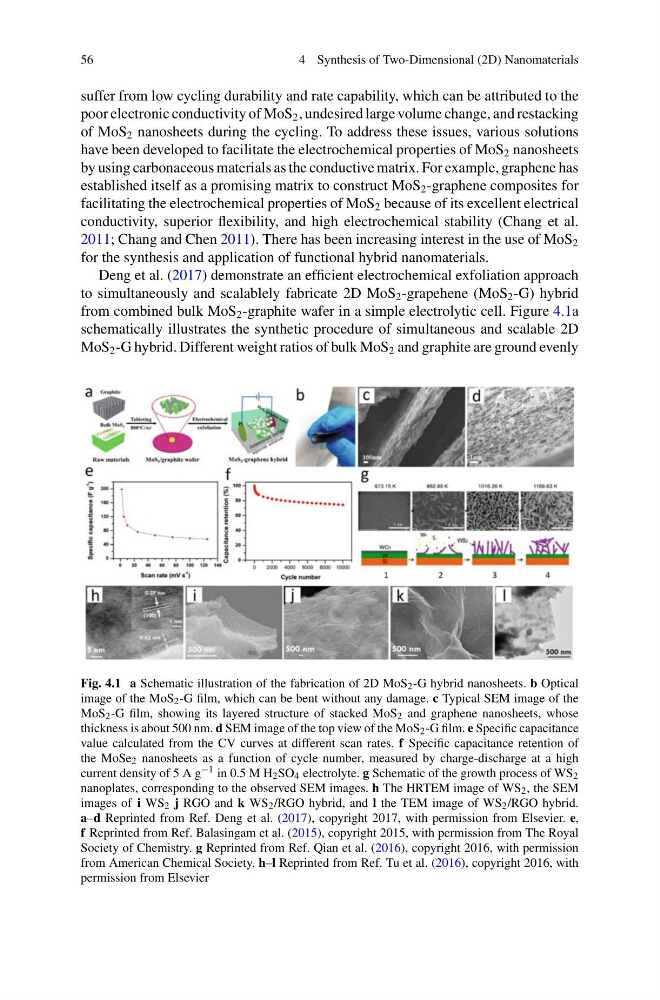
from combined bulk MoS 2 -graphite wafer in a simple electrolytic cell. Figure 4.1a
schematically illustrates the synthetic procedure of simultaneous and scalable 2D
MoS 2 -G hybrid. Different weight ratios of bulk MoS 2 and graphite are ground evenly
Fig. 4.1 a Schematic illustration of the fabrication of 2D MoS 2 -G hybrid nanosheets. b Optical
image of the MoS 2 -G film, which can be bent without any damage. c Typical SEM image of the
MoS 2 -G film, showing its layered structure of stacked MoS 2 and graphene nanosheets, whose
thickness is about 500 nm. d SEM image of the top view of the MoS 2 -G film. e Specific capacitance
value calculated from the CV curves at different scan rates. f Specific capacitance retention of
the MoSe 2 nanosheets as a function of cycle number, measured by charge-discharge at a high
current density of 5 A g −1 in 0.5 M H 2 SO 4 electrolyte. g Schematic of the growth process of WS 2
nanoplates, corresponding to the observed SEM images. h The HRTEM image of WS 2 , the SEM
images of i WS 2 j RGO and k WS 2 /RGO hybrid, and l the TEM image of WS 2 /RGO hybrid.
a–d Reprinted from Ref. Deng et al. (2017), copyright 2017, with permission from Elsevier. e,
f Reprinted from Ref. Balasingam et al. (2015), copyright 2015, with permission from The Royal
Society of Chemistry. g Reprinted from Ref. Qian et al. (2016), copyright 2016, with permission
from American Chemical Society. h–l Reprinted from Ref. Tu et al. (2016), copyright 2016, with
permission from Elsevier
4 Synthesis of Two-Dimensional (2D) Nanomaterials
suffer from low cycling durability and rate capability, which can be attributed to the
poor electronic conductivity of MoS 2 , undesired large volume change, and restacking
of MoS 2 nanosheets during the cycling. To address these issues, various solutions
have been developed to facilitate the electrochemical properties of MoS 2 nanosheets
by using carbonaceous materials as the conductive matrix. For example, graphene has
established itself as a promising matrix to construct MoS 2 -graphene composites for
facilitating the electrochemical properties of MoS 2 because of its excellent electrical
conductivity, superior flexibility, and high electrochemical stability (Chang et al.
2011; Chang and Chen 2011). There has been increasing interest in the use of MoS 2
for the synthesis and application of functional hybrid nanomaterials.
Deng et al. (2017) demonstrate an efficient electrochemical exfoliation approach
to simultaneously and scalablely fabricate 2D MoS 2 -grapehene (MoS 2 -G) hybrid
from combined bulk MoS 2 -graphite wafer in a simple electrolytic cell. Figure 4.1a
schematically illustrates the synthetic procedure of simultaneous and scalable 2D
MoS 2 -G hybrid. Different weight ratios of bulk MoS 2 and graphite are ground evenly
Fig. 4.1 a Schematic illustration of the fabrication of 2D MoS 2 -G hybrid nanosheets. b Optical
image of the MoS 2 -G film, which can be bent without any damage. c Typical SEM image of the
MoS 2 -G film, showing its layered structure of stacked MoS 2 and graphene nanosheets, whose
thickness is about 500 nm. d SEM image of the top view of the MoS 2 -G film. e Specific capacitance
value calculated from the CV curves at different scan rates. f Specific capacitance retention of
the MoSe 2 nanosheets as a function of cycle number, measured by charge-discharge at a high
current density of 5 A g −1 in 0.5 M H 2 SO 4 electrolyte. g Schematic of the growth process of WS 2
nanoplates, corresponding to the observed SEM images. h The HRTEM image of WS 2 , the SEM
images of i WS 2 j RGO and k WS 2 /RGO hybrid, and l the TEM image of WS 2 /RGO hybrid.
a–d Reprinted from Ref. Deng et al. (2017), copyright 2017, with permission from Elsevier. e,
f Reprinted from Ref. Balasingam et al. (2015), copyright 2015, with permission from The Royal
Society of Chemistry. g Reprinted from Ref. Qian et al. (2016), copyright 2016, with permission
from American Chemical Society. h–l Reprinted from Ref. Tu et al. (2016), copyright 2016, with
permission from Elsevier