

46
3 Synthesis of One-Dimensional Nanomaterials
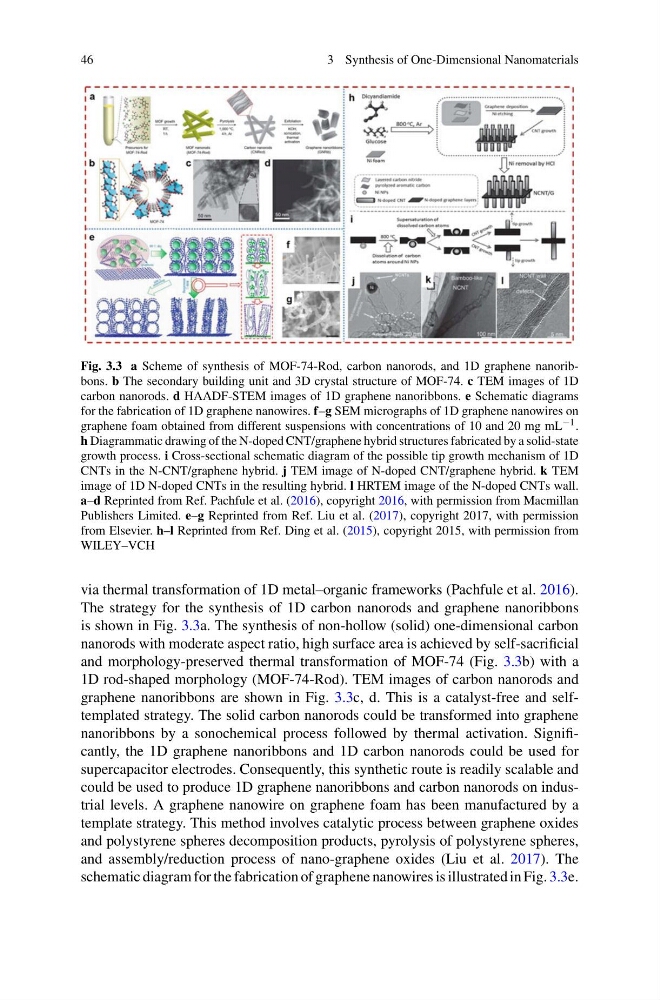
Fig. 3.3 a Scheme of synthesis of MOF-74-Rod, carbon nanorods, and 1D graphene nanoribbons. b The secondary building unit and 3D crystal structure of MOF-74. c TEM images of 1D
carbon nanorods. d HAADF-STEM images of 1D graphene nanoribbons. e Schematic diagrams
for the fabrication of 1D graphene nanowires. f–g SEM micrographs of 1D graphene nanowires on
graphene foam obtained from different suspensions with concentrations of 10 and 20 mg mL −1 .
h Diagrammatic drawing of the N-doped CNT/graphene hybrid structures fabricated by a solid-state
growth process. i Cross-sectional schematic diagram of the possible tip growth mechanism of 1D
CNTs in the N-CNT/graphene hybrid. j TEM image of N-doped CNT/graphene hybrid. k TEM
image of 1D N-doped CNTs in the resulting hybrid. l HRTEM image of the N-doped CNTs wall.
a–d Reprinted from Ref. Pachfule et al. (2016), copyright 2016, with permission from Macmillan
Publishers Limited. e–g Reprinted from Ref. Liu et al. (2017), copyright 2017, with permission
from Elsevier. h–l Reprinted from Ref. Ding et al. (2015), copyright 2015, with permission from
WILEY–VCH
via thermal transformation of 1D metal–organic frameworks (Pachfule et al. 2016).
The strategy for the synthesis of 1D carbon nanorods and graphene nanoribbons
is shown in Fig. 3.3a. The synthesis of non-hollow (solid) one-dimensional carbon
nanorods with moderate aspect ratio, high surface area is achieved by self-sacrificial
and morphology-preserved thermal transformation of MOF-74 (Fig. 3.3b) with a
1D rod-shaped morphology (MOF-74-Rod). TEM images of carbon nanorods and
graphene nanoribbons are shown in Fig. 3.3c, d. This is a catalyst-free and selftemplated strategy. The solid carbon nanorods could be transformed into graphene
nanoribbons by a sonochemical process followed by thermal activation. Significantly, the 1D graphene nanoribbons and 1D carbon nanorods could be used for
supercapacitor electrodes. Consequently, this synthetic route is readily scalable and
could be used to produce 1D graphene nanoribbons and carbon nanorods on industrial levels. A graphene nanowire on graphene foam has been manufactured by a
template strategy. This method involves catalytic process between graphene oxides
and polystyrene spheres decomposition products, pyrolysis of polystyrene spheres,
and assembly/reduction process of nano-graphene oxides (Liu et al. 2017). The
schematic diagram for the fabrication of graphene nanowires is illustrated in Fig. 3.3e.
3 Synthesis of One-Dimensional Nanomaterials
Fig. 3.3 a Scheme of synthesis of MOF-74-Rod, carbon nanorods, and 1D graphene nanoribbons. b The secondary building unit and 3D crystal structure of MOF-74. c TEM images of 1D
carbon nanorods. d HAADF-STEM images of 1D graphene nanoribbons. e Schematic diagrams
for the fabrication of 1D graphene nanowires. f–g SEM micrographs of 1D graphene nanowires on
graphene foam obtained from different suspensions with concentrations of 10 and 20 mg mL −1 .
h Diagrammatic drawing of the N-doped CNT/graphene hybrid structures fabricated by a solid-state
growth process. i Cross-sectional schematic diagram of the possible tip growth mechanism of 1D
CNTs in the N-CNT/graphene hybrid. j TEM image of N-doped CNT/graphene hybrid. k TEM
image of 1D N-doped CNTs in the resulting hybrid. l HRTEM image of the N-doped CNTs wall.
a–d Reprinted from Ref. Pachfule et al. (2016), copyright 2016, with permission from Macmillan
Publishers Limited. e–g Reprinted from Ref. Liu et al. (2017), copyright 2017, with permission
from Elsevier. h–l Reprinted from Ref. Ding et al. (2015), copyright 2015, with permission from
WILEY–VCH
via thermal transformation of 1D metal–organic frameworks (Pachfule et al. 2016).
The strategy for the synthesis of 1D carbon nanorods and graphene nanoribbons
is shown in Fig. 3.3a. The synthesis of non-hollow (solid) one-dimensional carbon
nanorods with moderate aspect ratio, high surface area is achieved by self-sacrificial
and morphology-preserved thermal transformation of MOF-74 (Fig. 3.3b) with a
1D rod-shaped morphology (MOF-74-Rod). TEM images of carbon nanorods and
graphene nanoribbons are shown in Fig. 3.3c, d. This is a catalyst-free and selftemplated strategy. The solid carbon nanorods could be transformed into graphene
nanoribbons by a sonochemical process followed by thermal activation. Significantly, the 1D graphene nanoribbons and 1D carbon nanorods could be used for
supercapacitor electrodes. Consequently, this synthetic route is readily scalable and
could be used to produce 1D graphene nanoribbons and carbon nanorods on industrial levels. A graphene nanowire on graphene foam has been manufactured by a
template strategy. This method involves catalytic process between graphene oxides
and polystyrene spheres decomposition products, pyrolysis of polystyrene spheres,
and assembly/reduction process of nano-graphene oxides (Liu et al. 2017). The
schematic diagram for the fabrication of graphene nanowires is illustrated in Fig. 3.3e.