

36
3 Synthesis of One-Dimensional Nanomaterials
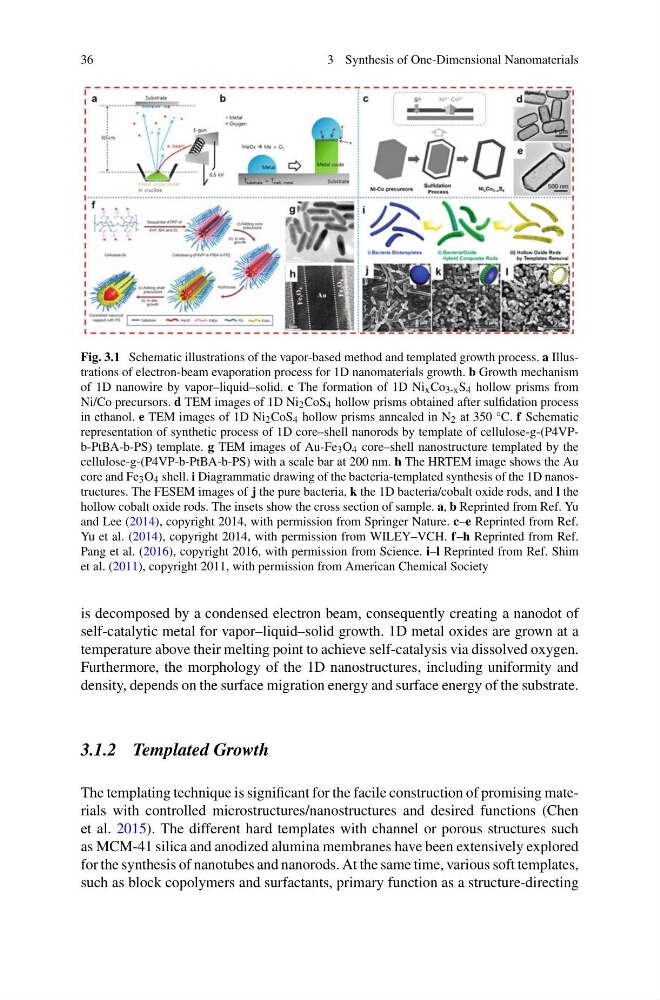
Fig. 3.1 Schematic illustrations of the vapor-based method and templated growth process. a Illustrations of electron-beam evaporation process for 1D nanomaterials growth. b Growth mechanism
of 1D nanowire by vapor–liquid–solid. c The formation of 1D Ni x Co 3-x S 4 hollow prisms from
Ni/Co precursors. d TEM images of 1D Ni 2 CoS 4 hollow prisms obtained after sulfidation process
in ethanol. e TEM images of 1D Ni 2 CoS 4 hollow prisms annealed in N 2 at 350 °C. f Schematic
representation of synthetic process of 1D core–shell nanorods by template of cellulose-g-(P4VPb-PtBA-b-PS) template. g TEM images of Au-Fe 3 O 4 core–shell nanostructure templated by the
cellulose-g-(P4VP-b-PtBA-b-PS) with a scale bar at 200 nm. h The HRTEM image shows the Au
core and Fe 3 O 4 shell. i Diagrammatic drawing of the bacteria-templated synthesis of the 1D nanostructures. The FESEM images of j the pure bacteria, k the 1D bacteria/cobalt oxide rods, and l the
hollow cobalt oxide rods. The insets show the cross section of sample. a, b Reprinted from Ref. Yu
and Lee (2014), copyright 2014, with permission from Springer Nature. c–e Reprinted from Ref.
Yu et al. (2014), copyright 2014, with permission from WILEY–VCH. f–h Reprinted from Ref.
Pang et al. (2016), copyright 2016, with permission from Science. i–l Reprinted from Ref. Shim
et al. (2011), copyright 2011, with permission from American Chemical Society
is decomposed by a condensed electron beam, consequently creating a nanodot of
self-catalytic metal for vapor–liquid–solid growth. 1D metal oxides are grown at a
temperature above their melting point to achieve self-catalysis via dissolved oxygen.
Furthermore, the morphology of the 1D nanostructures, including uniformity and
density, depends on the surface migration energy and surface energy of the substrate.
3.1.2 Templated Growth
The templating technique is significant for the facile construction of promising materials with controlled microstructures/nanostructures and desired functions (Chen
et al. 2015). The different hard templates with channel or porous structures such
as MCM-41 silica and anodized alumina membranes have been extensively explored
for the synthesis of nanotubes and nanorods. At the same time, various soft templates,
such as block copolymers and surfactants, primary function as a structure-directing
3 Synthesis of One-Dimensional Nanomaterials
Fig. 3.1 Schematic illustrations of the vapor-based method and templated growth process. a Illustrations of electron-beam evaporation process for 1D nanomaterials growth. b Growth mechanism
of 1D nanowire by vapor–liquid–solid. c The formation of 1D Ni x Co 3-x S 4 hollow prisms from
Ni/Co precursors. d TEM images of 1D Ni 2 CoS 4 hollow prisms obtained after sulfidation process
in ethanol. e TEM images of 1D Ni 2 CoS 4 hollow prisms annealed in N 2 at 350 °C. f Schematic
representation of synthetic process of 1D core–shell nanorods by template of cellulose-g-(P4VPb-PtBA-b-PS) template. g TEM images of Au-Fe 3 O 4 core–shell nanostructure templated by the
cellulose-g-(P4VP-b-PtBA-b-PS) with a scale bar at 200 nm. h The HRTEM image shows the Au
core and Fe 3 O 4 shell. i Diagrammatic drawing of the bacteria-templated synthesis of the 1D nanostructures. The FESEM images of j the pure bacteria, k the 1D bacteria/cobalt oxide rods, and l the
hollow cobalt oxide rods. The insets show the cross section of sample. a, b Reprinted from Ref. Yu
and Lee (2014), copyright 2014, with permission from Springer Nature. c–e Reprinted from Ref.
Yu et al. (2014), copyright 2014, with permission from WILEY–VCH. f–h Reprinted from Ref.
Pang et al. (2016), copyright 2016, with permission from Science. i–l Reprinted from Ref. Shim
et al. (2011), copyright 2011, with permission from American Chemical Society
is decomposed by a condensed electron beam, consequently creating a nanodot of
self-catalytic metal for vapor–liquid–solid growth. 1D metal oxides are grown at a
temperature above their melting point to achieve self-catalysis via dissolved oxygen.
Furthermore, the morphology of the 1D nanostructures, including uniformity and
density, depends on the surface migration energy and surface energy of the substrate.
3.1.2 Templated Growth
The templating technique is significant for the facile construction of promising materials with controlled microstructures/nanostructures and desired functions (Chen
et al. 2015). The different hard templates with channel or porous structures such
as MCM-41 silica and anodized alumina membranes have been extensively explored
for the synthesis of nanotubes and nanorods. At the same time, various soft templates,
such as block copolymers and surfactants, primary function as a structure-directing