

2.3 Nonmetallic Quantum Dots
23
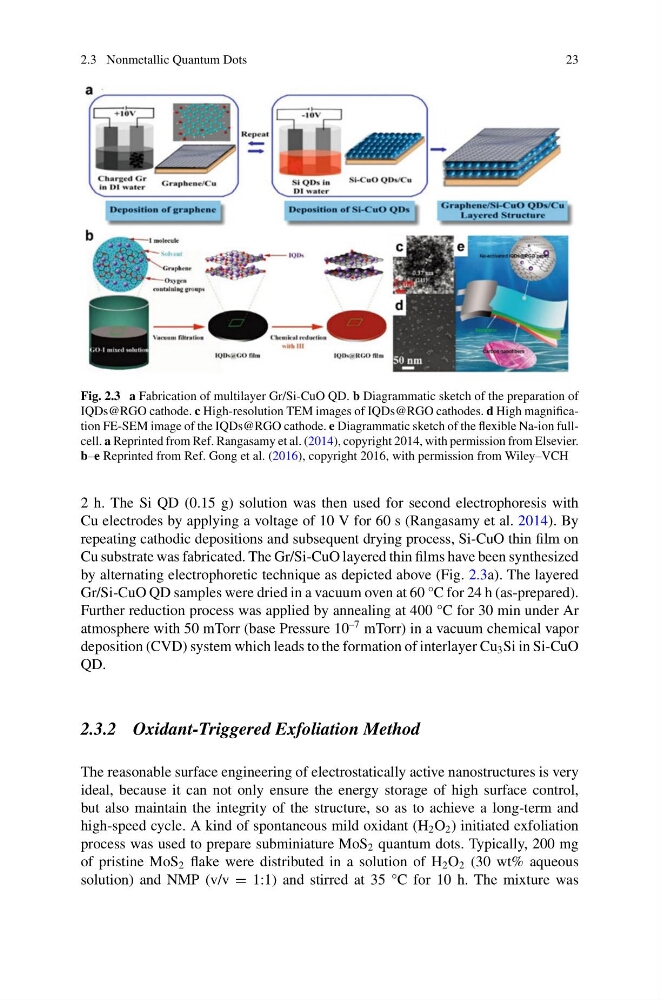
Fig. 2.3 a Fabrication of multilayer Gr/Si-CuO QD. b Diagrammatic sketch of the preparation of
IQDs@RGO cathode. c High-resolution TEM images of IQDs@RGO cathodes. d High magnification FE-SEM image of the IQDs@RGO cathode. e Diagrammatic sketch of the flexible Na-ion fullcell. a Reprinted from Ref. Rangasamy et al. (2014), copyright 2014, with permission from Elsevier.
b–e Reprinted from Ref. Gong et al. (2016), copyright 2016, with permission from Wiley–VCH
2 h. The Si QD (0.15 g) solution was then used for second electrophoresis with
Cu electrodes by applying a voltage of 10 V for 60 s (Rangasamy et al. 2014). By
repeating cathodic depositions and subsequent drying process, Si-CuO thin film on
Cu substrate was fabricated. The Gr/Si-CuO layered thin films have been synthesized
by alternating electrophoretic technique as depicted above (Fig. 2.3a). The layered
Gr/Si-CuO QD samples were dried in a vacuum oven at 60 °C for 24 h (as-prepared).
Further reduction process was applied by annealing at 400 °C for 30 min under Ar
atmosphere with 50 mTorr (base Pressure 10
–7 mTorr) in a vacuum chemical vapor
deposition (CVD) system which leads to the formation of interlayer Cu 3 Si in Si-CuO
QD.
2.3.2 Oxidant-Triggered Exfoliation Method
The reasonable surface engineering of electrostatically active nanostructures is very
ideal, because it can not only ensure the energy storage of high surface control,
but also maintain the integrity of the structure, so as to achieve a long-term and
high-speed cycle. A kind of spontaneous mild oxidant (H 2 O 2 ) initiated exfoliation
process was used to prepare subminiature MoS 2 quantum dots. Typically, 200 mg
of pristine MoS 2 flake were distributed in a solution of H 2 O 2 (30 wt% aqueous
solution) and NMP (v/v = 1:1) and stirred at 35 °C for 10 h. The mixture was
23
Fig. 2.3 a Fabrication of multilayer Gr/Si-CuO QD. b Diagrammatic sketch of the preparation of
IQDs@RGO cathode. c High-resolution TEM images of IQDs@RGO cathodes. d High magnification FE-SEM image of the IQDs@RGO cathode. e Diagrammatic sketch of the flexible Na-ion fullcell. a Reprinted from Ref. Rangasamy et al. (2014), copyright 2014, with permission from Elsevier.
b–e Reprinted from Ref. Gong et al. (2016), copyright 2016, with permission from Wiley–VCH
2 h. The Si QD (0.15 g) solution was then used for second electrophoresis with
Cu electrodes by applying a voltage of 10 V for 60 s (Rangasamy et al. 2014). By
repeating cathodic depositions and subsequent drying process, Si-CuO thin film on
Cu substrate was fabricated. The Gr/Si-CuO layered thin films have been synthesized
by alternating electrophoretic technique as depicted above (Fig. 2.3a). The layered
Gr/Si-CuO QD samples were dried in a vacuum oven at 60 °C for 24 h (as-prepared).
Further reduction process was applied by annealing at 400 °C for 30 min under Ar
atmosphere with 50 mTorr (base Pressure 10
–7 mTorr) in a vacuum chemical vapor
deposition (CVD) system which leads to the formation of interlayer Cu 3 Si in Si-CuO
QD.
2.3.2 Oxidant-Triggered Exfoliation Method
The reasonable surface engineering of electrostatically active nanostructures is very
ideal, because it can not only ensure the energy storage of high surface control,
but also maintain the integrity of the structure, so as to achieve a long-term and
high-speed cycle. A kind of spontaneous mild oxidant (H 2 O 2 ) initiated exfoliation
process was used to prepare subminiature MoS 2 quantum dots. Typically, 200 mg
of pristine MoS 2 flake were distributed in a solution of H 2 O 2 (30 wt% aqueous
solution) and NMP (v/v = 1:1) and stirred at 35 °C for 10 h. The mixture was