

2.2 Metal/Metal Oxides Quantum Dots
21
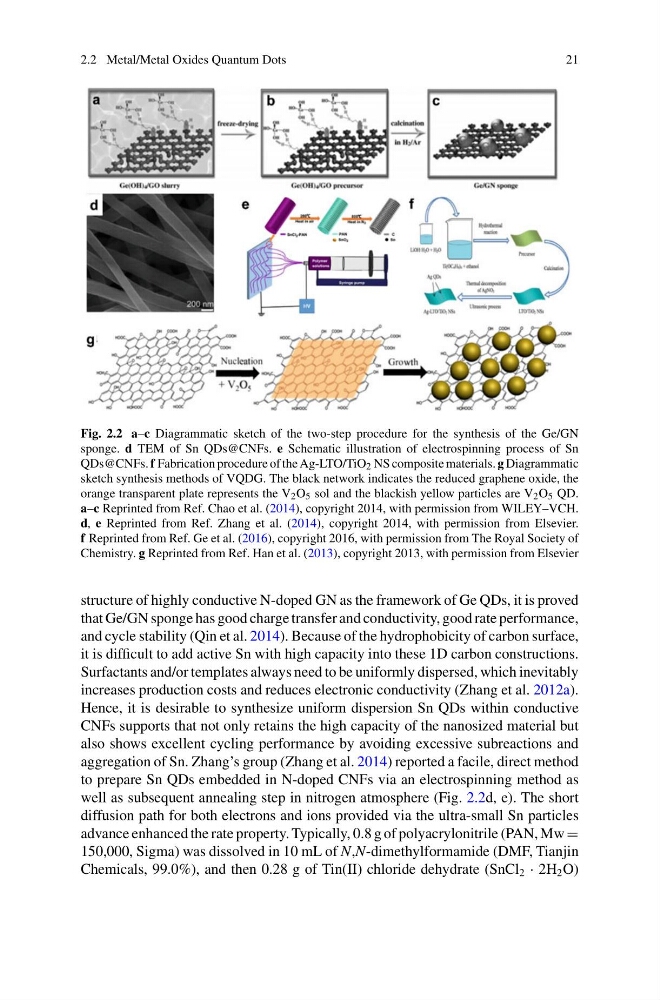
Fig. 2.2 a–c Diagrammatic sketch of the two-step procedure for the synthesis of the Ge/GN
sponge. d TEM of Sn QDs@CNFs. e Schematic illustration of electrospinning process of Sn
QDs@CNFs. f Fabrication procedure of the Ag-LTO/TiO 2 NS composite materials. g Diagrammatic
sketch synthesis methods of VQDG. The black network indicates the reduced graphene oxide, the
orange transparent plate represents the V 2 O 5 sol and the blackish yellow particles are V 2 O 5 QD.
a–c Reprinted from Ref. Chao et al. (2014), copyright 2014, with permission from WILEY–VCH.
d, e Reprinted from Ref. Zhang et al. (2014), copyright 2014, with permission from Elsevier.
f Reprinted from Ref. Ge et al. (2016), copyright 2016, with permission from The Royal Society of
Chemistry. g Reprinted from Ref. Han et al. (2013), copyright 2013, with permission from Elsevier
structure of highly conductive N-doped GN as the framework of Ge QDs, it is proved
that Ge/GN sponge has good charge transfer and conductivity, good rate performance,
and cycle stability (Qin et al. 2014). Because of the hydrophobicity of carbon surface,
it is difficult to add active Sn with high capacity into these 1D carbon constructions.
Surfactants and/or templates always need to be uniformly dispersed, which inevitably
increases production costs and reduces electronic conductivity (Zhang et al. 2012a).
Hence, it is desirable to synthesize uniform dispersion Sn QDs within conductive
CNFs supports that not only retains the high capacity of the nanosized material but
also shows excellent cycling performance by avoiding excessive subreactions and
aggregation of Sn. Zhang’s group (Zhang et al. 2014) reported a facile, direct method
to prepare Sn QDs embedded in N-doped CNFs via an electrospinning method as
well as subsequent annealing step in nitrogen atmosphere (Fig. 2.2d, e). The short
diffusion path for both electrons and ions provided via the ultra-small Sn particles
advance enhanced the rate property. Typically, 0.8 g of polyacrylonitrile (PAN, Mw =
150,000, Sigma) was dissolved in 10 mL of N,N-dimethylformamide (DMF, Tianjin
Chemicals, 99.0%), and then 0.28 g of Tin(II) chloride dehydrate (SnCl 2 · 2H 2 O)
21
Fig. 2.2 a–c Diagrammatic sketch of the two-step procedure for the synthesis of the Ge/GN
sponge. d TEM of Sn QDs@CNFs. e Schematic illustration of electrospinning process of Sn
QDs@CNFs. f Fabrication procedure of the Ag-LTO/TiO 2 NS composite materials. g Diagrammatic
sketch synthesis methods of VQDG. The black network indicates the reduced graphene oxide, the
orange transparent plate represents the V 2 O 5 sol and the blackish yellow particles are V 2 O 5 QD.
a–c Reprinted from Ref. Chao et al. (2014), copyright 2014, with permission from WILEY–VCH.
d, e Reprinted from Ref. Zhang et al. (2014), copyright 2014, with permission from Elsevier.
f Reprinted from Ref. Ge et al. (2016), copyright 2016, with permission from The Royal Society of
Chemistry. g Reprinted from Ref. Han et al. (2013), copyright 2013, with permission from Elsevier
structure of highly conductive N-doped GN as the framework of Ge QDs, it is proved
that Ge/GN sponge has good charge transfer and conductivity, good rate performance,
and cycle stability (Qin et al. 2014). Because of the hydrophobicity of carbon surface,
it is difficult to add active Sn with high capacity into these 1D carbon constructions.
Surfactants and/or templates always need to be uniformly dispersed, which inevitably
increases production costs and reduces electronic conductivity (Zhang et al. 2012a).
Hence, it is desirable to synthesize uniform dispersion Sn QDs within conductive
CNFs supports that not only retains the high capacity of the nanosized material but
also shows excellent cycling performance by avoiding excessive subreactions and
aggregation of Sn. Zhang’s group (Zhang et al. 2014) reported a facile, direct method
to prepare Sn QDs embedded in N-doped CNFs via an electrospinning method as
well as subsequent annealing step in nitrogen atmosphere (Fig. 2.2d, e). The short
diffusion path for both electrons and ions provided via the ultra-small Sn particles
advance enhanced the rate property. Typically, 0.8 g of polyacrylonitrile (PAN, Mw =
150,000, Sigma) was dissolved in 10 mL of N,N-dimethylformamide (DMF, Tianjin
Chemicals, 99.0%), and then 0.28 g of Tin(II) chloride dehydrate (SnCl 2 · 2H 2 O)