

7.3 Pseudocapacitors
209
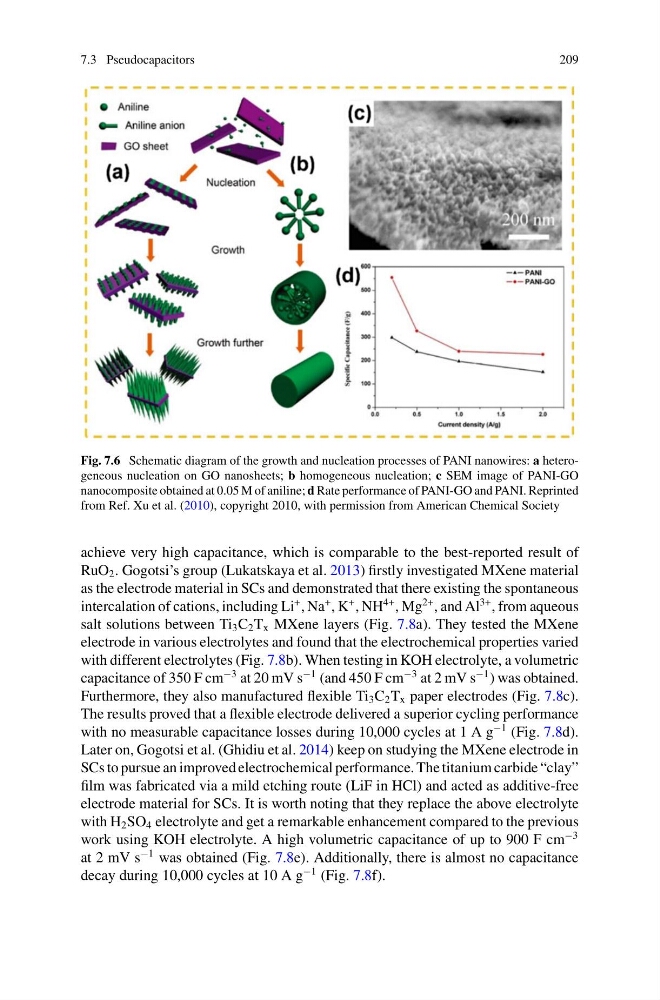
Fig. 7.6 Schematic diagram of the growth and nucleation processes of PANI nanowires: a heterogeneous nucleation on GO nanosheets; b homogeneous nucleation; c SEM image of PANI-GO
nanocomposite obtained at 0.05 M of aniline; d Rate performance of PANI-GO and PANI. Reprinted
from Ref. Xu et al. (2010), copyright 2010, with permission from American Chemical Society
achieve very high capacitance, which is comparable to the best-reported result of
RuO 2 . Gogotsi’s group (Lukatskaya et al. 2013) firstly investigated MXene material
as the electrode material in SCs and demonstrated that there existing the spontaneous
intercalation of cations, including Li
+ , Na
+ , K
+ , NH
4+ , Mg
2+ , and Al
3+ , from aqueous
salt solutions between Ti 3 C 2 T x MXene layers (Fig. 7.8a). They tested the MXene
electrode in various electrolytes and found that the electrochemical properties varied
with different electrolytes (Fig. 7.8b). When testing in KOH electrolyte, a volumetric
capacitance of 350 F cm
−3 at 20 mV s
−1 (and 450 F cm
−3 at 2 mV s
−1 ) was obtained.
Furthermore, they also manufactured flexible Ti 3 C 2 T x paper electrodes (Fig. 7.8c).
The results proved that a flexible electrode delivered a superior cycling performance
with no measurable capacitance losses during 10,000 cycles at 1 A g
−1 (Fig. 7.8d).
Later on, Gogotsi et al. (Ghidiu et al. 2014) keep on studying the MXene electrode in
SCs to pursue an improved electrochemical performance. The titanium carbide “clay”
film was fabricated via a mild etching route (LiF in HCl) and acted as additive-free
electrode material for SCs. It is worth noting that they replace the above electrolyte
with H 2 SO 4 electrolyte and get a remarkable enhancement compared to the previous
work using KOH electrolyte. A high volumetric capacitance of up to 900 F cm
−3
at 2 mV s
−1 was obtained (Fig. 7.8e). Additionally, there is almost no capacitance
decay during 10,000 cycles at 10 A g
−1 (Fig. 7.8f).
209
Fig. 7.6 Schematic diagram of the growth and nucleation processes of PANI nanowires: a heterogeneous nucleation on GO nanosheets; b homogeneous nucleation; c SEM image of PANI-GO
nanocomposite obtained at 0.05 M of aniline; d Rate performance of PANI-GO and PANI. Reprinted
from Ref. Xu et al. (2010), copyright 2010, with permission from American Chemical Society
achieve very high capacitance, which is comparable to the best-reported result of
RuO 2 . Gogotsi’s group (Lukatskaya et al. 2013) firstly investigated MXene material
as the electrode material in SCs and demonstrated that there existing the spontaneous
intercalation of cations, including Li
+ , Na
+ , K
+ , NH
4+ , Mg
2+ , and Al
3+ , from aqueous
salt solutions between Ti 3 C 2 T x MXene layers (Fig. 7.8a). They tested the MXene
electrode in various electrolytes and found that the electrochemical properties varied
with different electrolytes (Fig. 7.8b). When testing in KOH electrolyte, a volumetric
capacitance of 350 F cm
−3 at 20 mV s
−1 (and 450 F cm
−3 at 2 mV s
−1 ) was obtained.
Furthermore, they also manufactured flexible Ti 3 C 2 T x paper electrodes (Fig. 7.8c).
The results proved that a flexible electrode delivered a superior cycling performance
with no measurable capacitance losses during 10,000 cycles at 1 A g
−1 (Fig. 7.8d).
Later on, Gogotsi et al. (Ghidiu et al. 2014) keep on studying the MXene electrode in
SCs to pursue an improved electrochemical performance. The titanium carbide “clay”
film was fabricated via a mild etching route (LiF in HCl) and acted as additive-free
electrode material for SCs. It is worth noting that they replace the above electrolyte
with H 2 SO 4 electrolyte and get a remarkable enhancement compared to the previous
work using KOH electrolyte. A high volumetric capacitance of up to 900 F cm
−3
at 2 mV s
−1 was obtained (Fig. 7.8e). Additionally, there is almost no capacitance
decay during 10,000 cycles at 10 A g
−1 (Fig. 7.8f).