

7.3 Pseudocapacitors
205
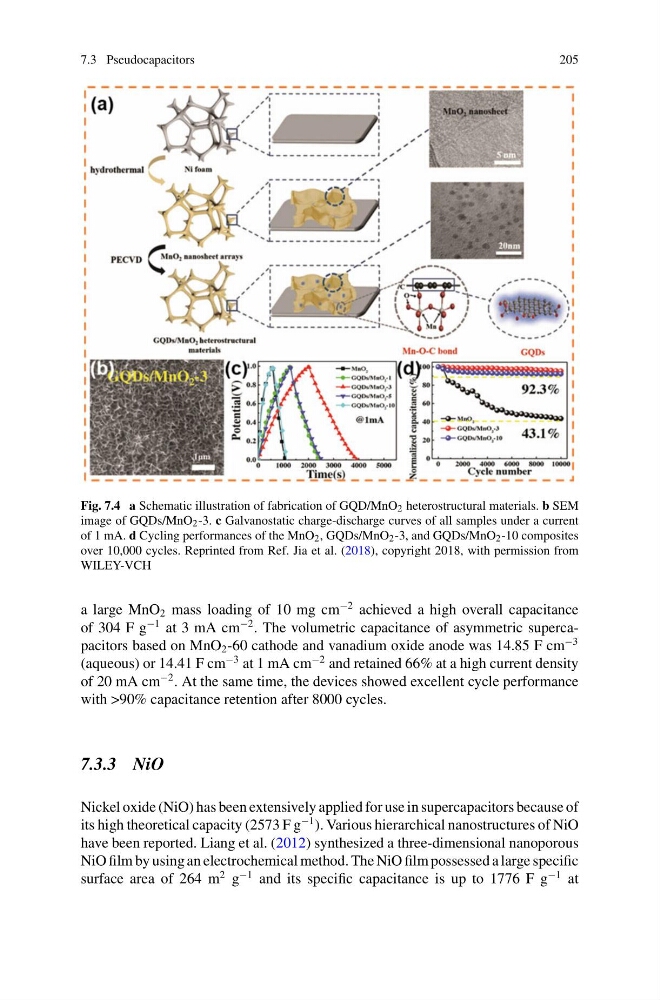
Fig. 7.4 a Schematic illustration of fabrication of GQD/MnO 2 heterostructural materials. b SEM
image of GQDs/MnO 2 -3. c Galvanostatic charge-discharge curves of all samples under a current
of 1 mA. d Cycling performances of the MnO 2 , GQDs/MnO 2 -3, and GQDs/MnO 2 -10 composites
over 10,000 cycles. Reprinted from Ref. Jia et al. (2018), copyright 2018, with permission from
WILEY-VCH
a large MnO 2 mass loading of 10 mg cm
−2 achieved a high overall capacitance
of 304 F g
−1 at 3 mA cm
−2 . The volumetric capacitance of asymmetric supercapacitors based on MnO 2 -60 cathode and vanadium oxide anode was 14.85 F cm
−3
(aqueous) or 14.41 F cm
−3 at 1 mA cm
−2 and retained 66% at a high current density
of 20 mA cm
−2 . At the same time, the devices showed excellent cycle performance
with >90% capacitance retention after 8000 cycles.
7.3.3 NiO
Nickel oxide (NiO) has been extensively applied for use in supercapacitors because of
its high theoretical capacity (2573 F g
−1 ). Various hierarchical nanostructures of NiO
have been reported. Liang et al. (2012) synthesized a three-dimensional nanoporous
NiO film by using an electrochemical method. The NiO film possessed a large specific
surface area of 264 m
2 g
−1 and its specific capacitance is up to 1776 F g
−1 at
205
Fig. 7.4 a Schematic illustration of fabrication of GQD/MnO 2 heterostructural materials. b SEM
image of GQDs/MnO 2 -3. c Galvanostatic charge-discharge curves of all samples under a current
of 1 mA. d Cycling performances of the MnO 2 , GQDs/MnO 2 -3, and GQDs/MnO 2 -10 composites
over 10,000 cycles. Reprinted from Ref. Jia et al. (2018), copyright 2018, with permission from
WILEY-VCH
a large MnO 2 mass loading of 10 mg cm
−2 achieved a high overall capacitance
of 304 F g
−1 at 3 mA cm
−2 . The volumetric capacitance of asymmetric supercapacitors based on MnO 2 -60 cathode and vanadium oxide anode was 14.85 F cm
−3
(aqueous) or 14.41 F cm
−3 at 1 mA cm
−2 and retained 66% at a high current density
of 20 mA cm
−2 . At the same time, the devices showed excellent cycle performance
with >90% capacitance retention after 8000 cycles.
7.3.3 NiO
Nickel oxide (NiO) has been extensively applied for use in supercapacitors because of
its high theoretical capacity (2573 F g
−1 ). Various hierarchical nanostructures of NiO
have been reported. Liang et al. (2012) synthesized a three-dimensional nanoporous
NiO film by using an electrochemical method. The NiO film possessed a large specific
surface area of 264 m
2 g
−1 and its specific capacitance is up to 1776 F g
−1 at