

7.3 Pseudocapacitors
203
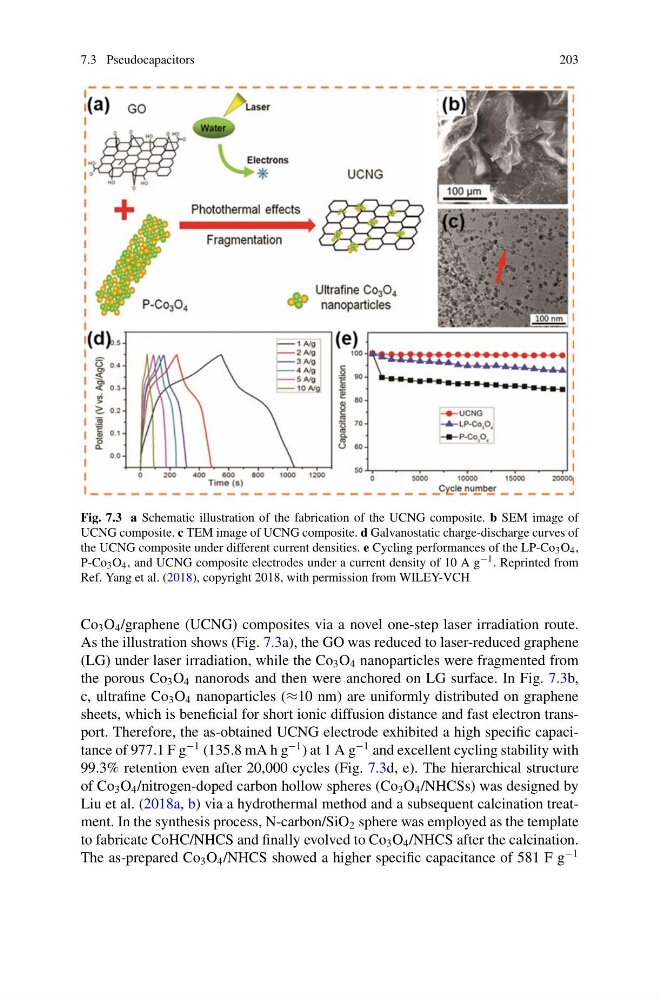
Fig. 7.3 a Schematic illustration of the fabrication of the UCNG composite. b SEM image of
UCNG composite. c TEM image of UCNG composite. d Galvanostatic charge-discharge curves of
the UCNG composite under different current densities. e Cycling performances of the LP-Co 3 O 4 ,
P-Co 3 O 4 , and UCNG composite electrodes under a current density of 10 A g −1 . Reprinted from
Ref. Yang et al. (2018), copyright 2018, with permission from WILEY-VCH
Co 3 O 4 /graphene (UCNG) composites via a novel one-step laser irradiation route.
As the illustration shows (Fig. 7.3a), the GO was reduced to laser-reduced graphene
(LG) under laser irradiation, while the Co 3 O 4 nanoparticles were fragmented from
the porous Co 3 O 4 nanorods and then were anchored on LG surface. In Fig. 7.3b,
c, ultrafine Co 3 O 4 nanoparticles (≈10 nm) are uniformly distributed on graphene
sheets, which is beneficial for short ionic diffusion distance and fast electron transport. Therefore, the as-obtained UCNG electrode exhibited a high specific capacitance of 977.1 F g
−1 (135.8 mA h g
−1 ) at 1 A g
−1 and excellent cycling stability with
99.3% retention even after 20,000 cycles (Fig. 7.3d, e). The hierarchical structure
of Co 3 O 4 /nitrogen-doped carbon hollow spheres (Co 3 O 4 /NHCSs) was designed by
Liu et al. (2018a, b) via a hydrothermal method and a subsequent calcination treatment. In the synthesis process, N-carbon/SiO 2 sphere was employed as the template
to fabricate CoHC/NHCS and finally evolved to Co 3 O 4 /NHCS after the calcination.
The as-prepared Co 3 O 4 /NHCS showed a higher specific capacitance of 581 F g
−1
203
Fig. 7.3 a Schematic illustration of the fabrication of the UCNG composite. b SEM image of
UCNG composite. c TEM image of UCNG composite. d Galvanostatic charge-discharge curves of
the UCNG composite under different current densities. e Cycling performances of the LP-Co 3 O 4 ,
P-Co 3 O 4 , and UCNG composite electrodes under a current density of 10 A g −1 . Reprinted from
Ref. Yang et al. (2018), copyright 2018, with permission from WILEY-VCH
Co 3 O 4 /graphene (UCNG) composites via a novel one-step laser irradiation route.
As the illustration shows (Fig. 7.3a), the GO was reduced to laser-reduced graphene
(LG) under laser irradiation, while the Co 3 O 4 nanoparticles were fragmented from
the porous Co 3 O 4 nanorods and then were anchored on LG surface. In Fig. 7.3b,
c, ultrafine Co 3 O 4 nanoparticles (≈10 nm) are uniformly distributed on graphene
sheets, which is beneficial for short ionic diffusion distance and fast electron transport. Therefore, the as-obtained UCNG electrode exhibited a high specific capacitance of 977.1 F g
−1 (135.8 mA h g
−1 ) at 1 A g
−1 and excellent cycling stability with
99.3% retention even after 20,000 cycles (Fig. 7.3d, e). The hierarchical structure
of Co 3 O 4 /nitrogen-doped carbon hollow spheres (Co 3 O 4 /NHCSs) was designed by
Liu et al. (2018a, b) via a hydrothermal method and a subsequent calcination treatment. In the synthesis process, N-carbon/SiO 2 sphere was employed as the template
to fabricate CoHC/NHCS and finally evolved to Co 3 O 4 /NHCS after the calcination.
The as-prepared Co 3 O 4 /NHCS showed a higher specific capacitance of 581 F g
−1