

7.2 Double-Layer Capacitor
199
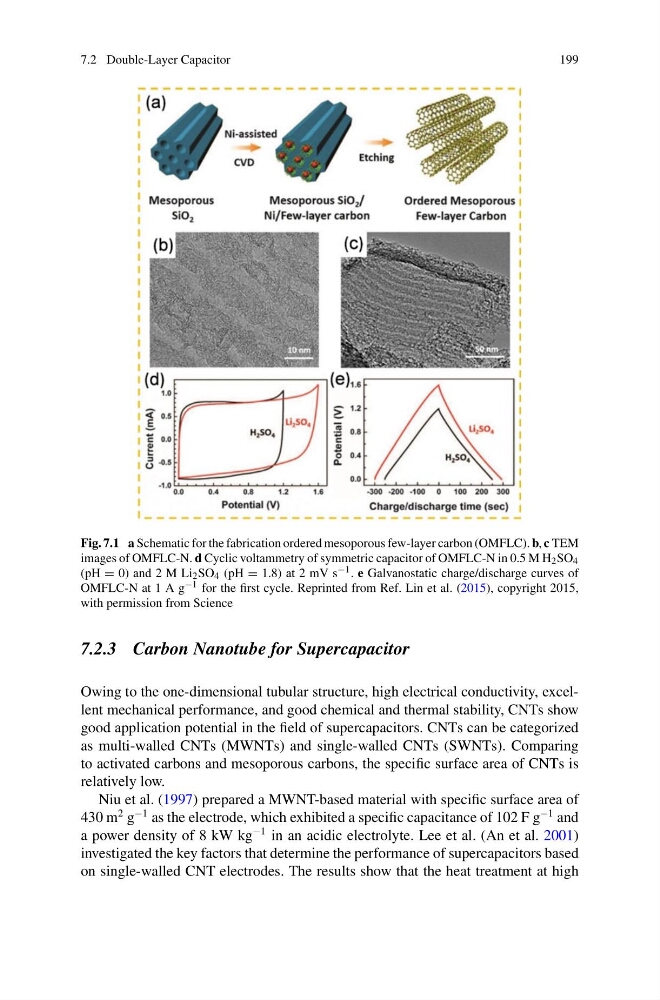
Fig. 7.1 a Schematic for the fabrication ordered mesoporous few-layer carbon (OMFLC). b, c TEM
images of OMFLC-N. d Cyclic voltammetry of symmetric capacitor of OMFLC-N in 0.5 M H 2 SO 4
(pH = 0) and 2 M Li 2 SO 4 (pH = 1.8) at 2 mV s −1 . e Galvanostatic charge/discharge curves of
OMFLC-N at 1 A g −1 for the first cycle. Reprinted from Ref. Lin et al. (2015), copyright 2015,
with permission from Science
7.2.3 Carbon Nanotube for Supercapacitor
Owing to the one-dimensional tubular structure, high electrical conductivity, excellent mechanical performance, and good chemical and thermal stability, CNTs show
good application potential in the field of supercapacitors. CNTs can be categorized
as multi-walled CNTs (MWNTs) and single-walled CNTs (SWNTs). Comparing
to activated carbons and mesoporous carbons, the specific surface area of CNTs is
relatively low.
Niu et al. (1997) prepared a MWNT-based material with specific surface area of
430 m
2 g
−1 as the electrode, which exhibited a specific capacitance of 102 F g
−1 and
a power density of 8 kW kg
−1 in an acidic electrolyte. Lee et al. (An et al. 2001)
investigated the key factors that determine the performance of supercapacitors based
on single-walled CNT electrodes. The results show that the heat treatment at high
199
Fig. 7.1 a Schematic for the fabrication ordered mesoporous few-layer carbon (OMFLC). b, c TEM
images of OMFLC-N. d Cyclic voltammetry of symmetric capacitor of OMFLC-N in 0.5 M H 2 SO 4
(pH = 0) and 2 M Li 2 SO 4 (pH = 1.8) at 2 mV s −1 . e Galvanostatic charge/discharge curves of
OMFLC-N at 1 A g −1 for the first cycle. Reprinted from Ref. Lin et al. (2015), copyright 2015,
with permission from Science
7.2.3 Carbon Nanotube for Supercapacitor
Owing to the one-dimensional tubular structure, high electrical conductivity, excellent mechanical performance, and good chemical and thermal stability, CNTs show
good application potential in the field of supercapacitors. CNTs can be categorized
as multi-walled CNTs (MWNTs) and single-walled CNTs (SWNTs). Comparing
to activated carbons and mesoporous carbons, the specific surface area of CNTs is
relatively low.
Niu et al. (1997) prepared a MWNT-based material with specific surface area of
430 m
2 g
−1 as the electrode, which exhibited a specific capacitance of 102 F g
−1 and
a power density of 8 kW kg
−1 in an acidic electrolyte. Lee et al. (An et al. 2001)
investigated the key factors that determine the performance of supercapacitors based
on single-walled CNT electrodes. The results show that the heat treatment at high