

180
6 Nanomaterials for Batteries
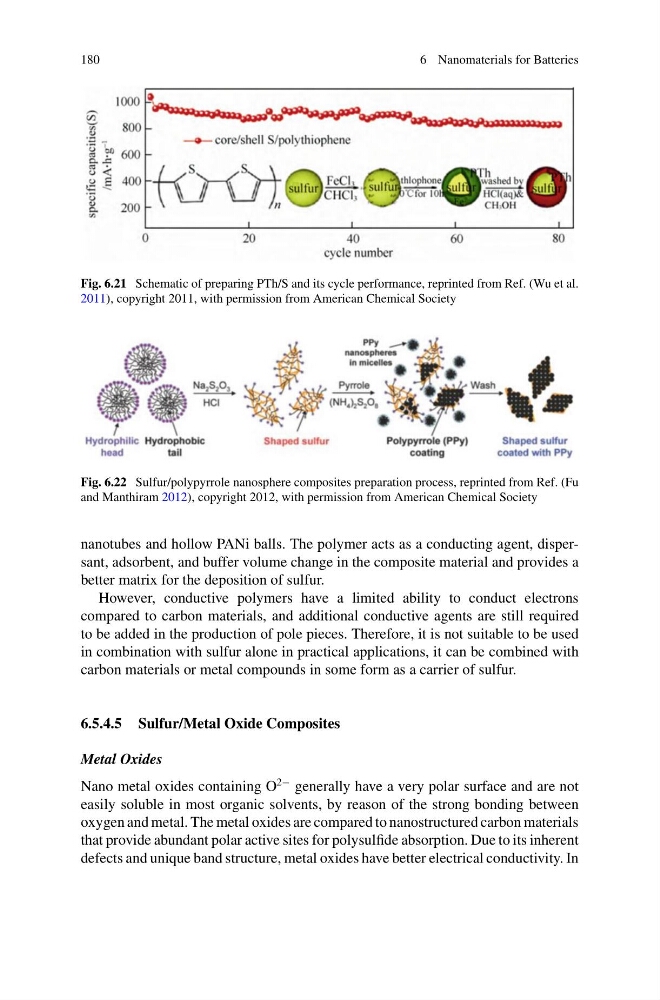
Fig. 6.21 Schematic of preparing PTh/S and its cycle performance, reprinted from Ref. (Wu et al.
2011), copyright 2011, with permission from American Chemical Society
Fig. 6.22 Sulfur/polypyrrole nanosphere composites preparation process, reprinted from Ref. (Fu
and Manthiram 2012), copyright 2012, with permission from American Chemical Society
nanotubes and hollow PANi balls. The polymer acts as a conducting agent, dispersant, adsorbent, and buffer volume change in the composite material and provides a
better matrix for the deposition of sulfur.
However, conductive polymers have a limited ability to conduct electrons
compared to carbon materials, and additional conductive agents are still required
to be added in the production of pole pieces. Therefore, it is not suitable to be used
in combination with sulfur alone in practical applications, it can be combined with
carbon materials or metal compounds in some form as a carrier of sulfur.
6.5.4.5 Sulfur/Metal Oxide Composites
Metal Oxides
Nano metal oxides containing O
2− generally have a very polar surface and are not
easily soluble in most organic solvents, by reason of the strong bonding between
oxygen and metal. The metal oxides are compared to nanostructured carbon materials
that provide abundant polar active sites for polysulfide absorption. Due to its inherent
defects and unique band structure, metal oxides have better electrical conductivity. In
6 Nanomaterials for Batteries
Fig. 6.21 Schematic of preparing PTh/S and its cycle performance, reprinted from Ref. (Wu et al.
2011), copyright 2011, with permission from American Chemical Society
Fig. 6.22 Sulfur/polypyrrole nanosphere composites preparation process, reprinted from Ref. (Fu
and Manthiram 2012), copyright 2012, with permission from American Chemical Society
nanotubes and hollow PANi balls. The polymer acts as a conducting agent, dispersant, adsorbent, and buffer volume change in the composite material and provides a
better matrix for the deposition of sulfur.
However, conductive polymers have a limited ability to conduct electrons
compared to carbon materials, and additional conductive agents are still required
to be added in the production of pole pieces. Therefore, it is not suitable to be used
in combination with sulfur alone in practical applications, it can be combined with
carbon materials or metal compounds in some form as a carrier of sulfur.
6.5.4.5 Sulfur/Metal Oxide Composites
Metal Oxides
Nano metal oxides containing O
2− generally have a very polar surface and are not
easily soluble in most organic solvents, by reason of the strong bonding between
oxygen and metal. The metal oxides are compared to nanostructured carbon materials
that provide abundant polar active sites for polysulfide absorption. Due to its inherent
defects and unique band structure, metal oxides have better electrical conductivity. In