

6.4 Metal-Air Battery
161
6.4.5 The Development of Metal-Air Battery
6.4.5.1 Zinc-Air Battery
Zinc-air battery, a kind of metal-air battery, is known as zinc-oxygen battery
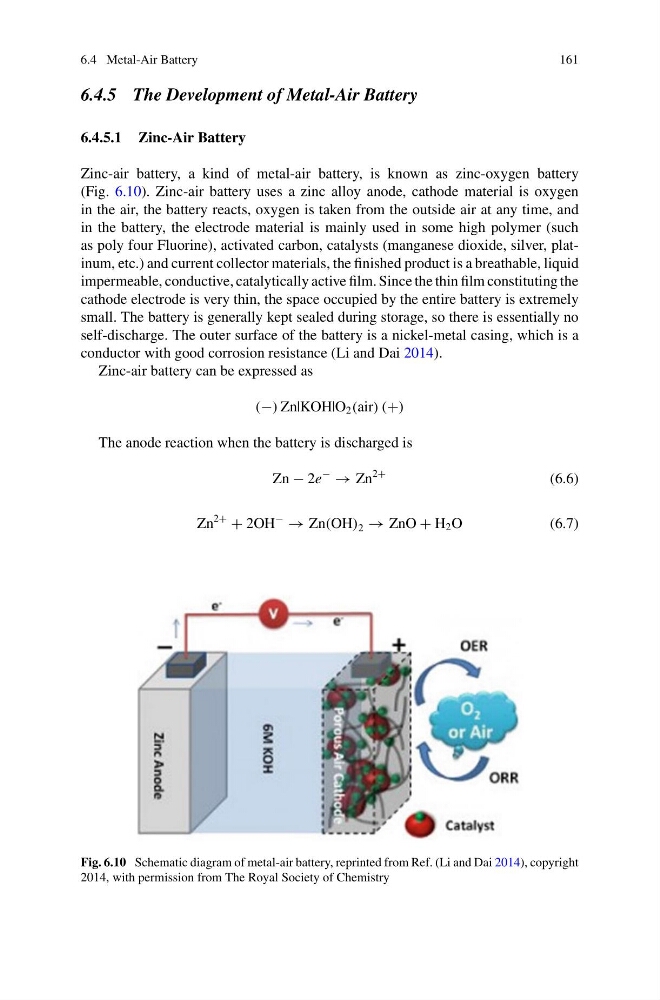
(Fig. 6.10). Zinc-air battery uses a zinc alloy anode, cathode material is oxygen
in the air, the battery reacts, oxygen is taken from the outside air at any time, and
in the battery, the electrode material is mainly used in some high polymer (such
as poly four Fluorine), activated carbon, catalysts (manganese dioxide, silver, platinum, etc.) and current collector materials, the finished product is a breathable, liquid
impermeable, conductive, catalytically active film. Since the thin film constituting the
cathode electrode is very thin, the space occupied by the entire battery is extremely
small. The battery is generally kept sealed during storage, so there is essentially no
self-discharge. The outer surface of the battery is a nickel-metal casing, which is a
conductor with good corrosion resistance (Li and Dai 2014).
Zinc-air battery can be expressed as
(−) Zn|KOH|O 2 (air) (+)
The anode reaction when the battery is discharged is
Zn − 2e
−
→ Zn
2+
(6.6)
Zn
2+
+ 2OH
−
→ Zn(OH) 2 → ZnO + H 2 O
(6.7)
Fig. 6.10 Schematic diagram of metal-air battery, reprinted from Ref. (Li and Dai 2014), copyright
2014, with permission from The Royal Society of Chemistry
161
6.4.5 The Development of Metal-Air Battery
6.4.5.1 Zinc-Air Battery
Zinc-air battery, a kind of metal-air battery, is known as zinc-oxygen battery
(Fig. 6.10). Zinc-air battery uses a zinc alloy anode, cathode material is oxygen
in the air, the battery reacts, oxygen is taken from the outside air at any time, and
in the battery, the electrode material is mainly used in some high polymer (such
as poly four Fluorine), activated carbon, catalysts (manganese dioxide, silver, platinum, etc.) and current collector materials, the finished product is a breathable, liquid
impermeable, conductive, catalytically active film. Since the thin film constituting the
cathode electrode is very thin, the space occupied by the entire battery is extremely
small. The battery is generally kept sealed during storage, so there is essentially no
self-discharge. The outer surface of the battery is a nickel-metal casing, which is a
conductor with good corrosion resistance (Li and Dai 2014).
Zinc-air battery can be expressed as
(−) Zn|KOH|O 2 (air) (+)
The anode reaction when the battery is discharged is
Zn − 2e
−
→ Zn
2+
(6.6)
Zn
2+
+ 2OH
−
→ Zn(OH) 2 → ZnO + H 2 O
(6.7)
Fig. 6.10 Schematic diagram of metal-air battery, reprinted from Ref. (Li and Dai 2014), copyright
2014, with permission from The Royal Society of Chemistry