

6.4 Metal-Air Battery
157
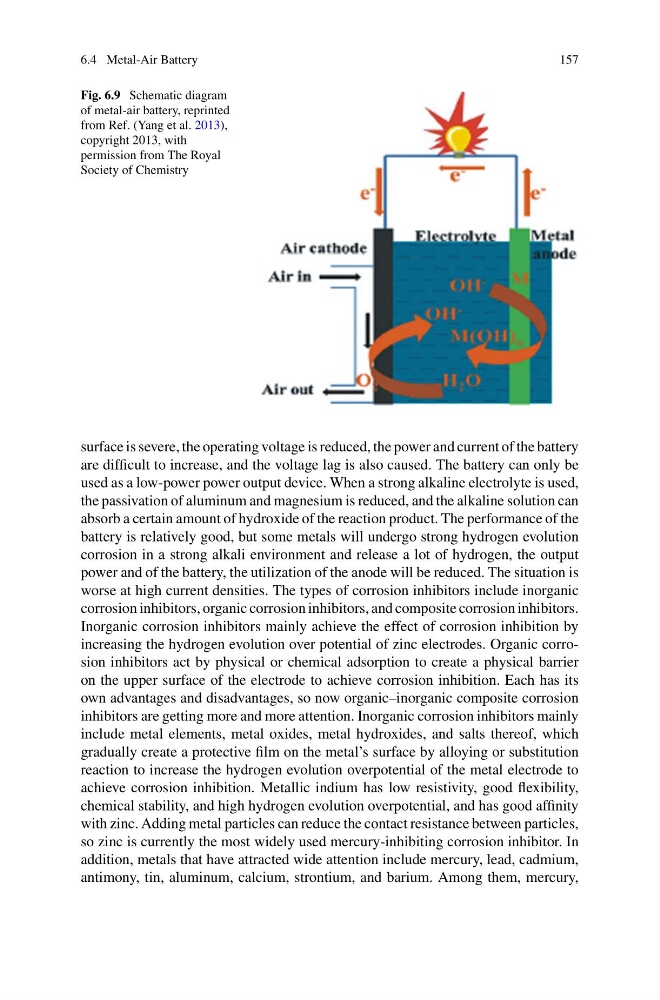
Fig. 6.9 Schematic diagram
of metal-air battery, reprinted
from Ref. (Yang et al. 2013),
copyright 2013, with
permission from The Royal
Society of Chemistry
surface is severe, the operating voltage is reduced, the power and current of the battery
are difficult to increase, and the voltage lag is also caused. The battery can only be
used as a low-power power output device. When a strong alkaline electrolyte is used,
the passivation of aluminum and magnesium is reduced, and the alkaline solution can
absorb a certain amount of hydroxide of the reaction product. The performance of the
battery is relatively good, but some metals will undergo strong hydrogen evolution
corrosion in a strong alkali environment and release a lot of hydrogen, the output
power and of the battery, the utilization of the anode will be reduced. The situation is
worse at high current densities. The types of corrosion inhibitors include inorganic
corrosion inhibitors, organic corrosion inhibitors, and composite corrosion inhibitors.
Inorganic corrosion inhibitors mainly achieve the effect of corrosion inhibition by
increasing the hydrogen evolution over potential of zinc electrodes. Organic corrosion inhibitors act by physical or chemical adsorption to create a physical barrier
on the upper surface of the electrode to achieve corrosion inhibition. Each has its
own advantages and disadvantages, so now organic–inorganic composite corrosion
inhibitors are getting more and more attention. Inorganic corrosion inhibitors mainly
include metal elements, metal oxides, metal hydroxides, and salts thereof, which
gradually create a protective film on the metal’s surface by alloying or substitution
reaction to increase the hydrogen evolution overpotential of the metal electrode to
achieve corrosion inhibition. Metallic indium has low resistivity, good flexibility,
chemical stability, and high hydrogen evolution overpotential, and has good affinity
with zinc. Adding metal particles can reduce the contact resistance between particles,
so zinc is currently the most widely used mercury-inhibiting corrosion inhibitor. In
addition, metals that have attracted wide attention include mercury, lead, cadmium,
antimony, tin, aluminum, calcium, strontium, and barium. Among them, mercury,
157
Fig. 6.9 Schematic diagram
of metal-air battery, reprinted
from Ref. (Yang et al. 2013),
copyright 2013, with
permission from The Royal
Society of Chemistry
surface is severe, the operating voltage is reduced, the power and current of the battery
are difficult to increase, and the voltage lag is also caused. The battery can only be
used as a low-power power output device. When a strong alkaline electrolyte is used,
the passivation of aluminum and magnesium is reduced, and the alkaline solution can
absorb a certain amount of hydroxide of the reaction product. The performance of the
battery is relatively good, but some metals will undergo strong hydrogen evolution
corrosion in a strong alkali environment and release a lot of hydrogen, the output
power and of the battery, the utilization of the anode will be reduced. The situation is
worse at high current densities. The types of corrosion inhibitors include inorganic
corrosion inhibitors, organic corrosion inhibitors, and composite corrosion inhibitors.
Inorganic corrosion inhibitors mainly achieve the effect of corrosion inhibition by
increasing the hydrogen evolution over potential of zinc electrodes. Organic corrosion inhibitors act by physical or chemical adsorption to create a physical barrier
on the upper surface of the electrode to achieve corrosion inhibition. Each has its
own advantages and disadvantages, so now organic–inorganic composite corrosion
inhibitors are getting more and more attention. Inorganic corrosion inhibitors mainly
include metal elements, metal oxides, metal hydroxides, and salts thereof, which
gradually create a protective film on the metal’s surface by alloying or substitution
reaction to increase the hydrogen evolution overpotential of the metal electrode to
achieve corrosion inhibition. Metallic indium has low resistivity, good flexibility,
chemical stability, and high hydrogen evolution overpotential, and has good affinity
with zinc. Adding metal particles can reduce the contact resistance between particles,
so zinc is currently the most widely used mercury-inhibiting corrosion inhibitor. In
addition, metals that have attracted wide attention include mercury, lead, cadmium,
antimony, tin, aluminum, calcium, strontium, and barium. Among them, mercury,