

152
6 Nanomaterials for Batteries
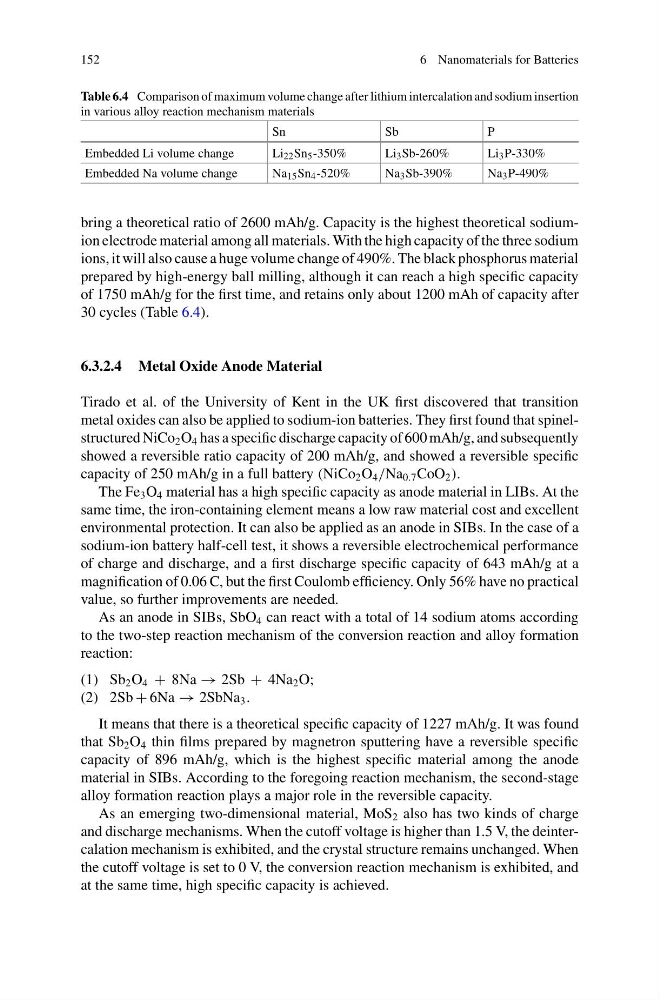
Table 6.4 Comparison of maximum volume change after lithium intercalation and sodium insertion
in various alloy reaction mechanism materials
Sn
Sb
P
Embedded Li volume change
Li 22 Sn 5 -350%
Li 3 Sb-260%
Li 3 P-330%
Embedded Na volume change
Na 15 Sn 4 -520%
Na 3 Sb-390%
Na 3 P-490%
bring a theoretical ratio of 2600 mAh/g. Capacity is the highest theoretical sodiumion electrode material among all materials. With the high capacity of the three sodium
ions, it will also cause a huge volume change of 490%. The black phosphorus material
prepared by high-energy ball milling, although it can reach a high specific capacity
of 1750 mAh/g for the first time, and retains only about 1200 mAh of capacity after
30 cycles (Table 6.4).
6.3.2.4 Metal Oxide Anode Material
Tirado et al. of the University of Kent in the UK first discovered that transition
metal oxides can also be applied to sodium-ion batteries. They first found that spinelstructured NiCo 2 O 4 has a specific discharge capacity of 600 mAh/g, and subsequently
showed a reversible ratio capacity of 200 mAh/g, and showed a reversible specific
capacity of 250 mAh/g in a full battery (NiCo 2 O 4 /Na 0.7 CoO 2 ).
The Fe 3 O 4 material has a high specific capacity as anode material in LIBs. At the
same time, the iron-containing element means a low raw material cost and excellent
environmental protection. It can also be applied as an anode in SIBs. In the case of a
sodium-ion battery half-cell test, it shows a reversible electrochemical performance
of charge and discharge, and a first discharge specific capacity of 643 mAh/g at a
magnification of 0.06 C, but the first Coulomb efficiency. Only 56% have no practical
value, so further improvements are needed.
As an anode in SIBs, SbO 4 can react with a total of 14 sodium atoms according
to the two-step reaction mechanism of the conversion reaction and alloy formation
reaction:
(1) Sb 2 O 4 + 8Na → 2Sb + 4Na 2 O;
(2) 2Sb + 6Na → 2SbNa 3 .
It means that there is a theoretical specific capacity of 1227 mAh/g. It was found
that Sb 2 O 4 thin films prepared by magnetron sputtering have a reversible specific
capacity of 896 mAh/g, which is the highest specific material among the anode
material in SIBs. According to the foregoing reaction mechanism, the second-stage
alloy formation reaction plays a major role in the reversible capacity.
As an emerging two-dimensional material, MoS 2 also has two kinds of charge
and discharge mechanisms. When the cutoff voltage is higher than 1.5 V, the deintercalation mechanism is exhibited, and the crystal structure remains unchanged. When
the cutoff voltage is set to 0 V, the conversion reaction mechanism is exhibited, and
at the same time, high specific capacity is achieved.
6 Nanomaterials for Batteries
Table 6.4 Comparison of maximum volume change after lithium intercalation and sodium insertion
in various alloy reaction mechanism materials
Sn
Sb
P
Embedded Li volume change
Li 22 Sn 5 -350%
Li 3 Sb-260%
Li 3 P-330%
Embedded Na volume change
Na 15 Sn 4 -520%
Na 3 Sb-390%
Na 3 P-490%
bring a theoretical ratio of 2600 mAh/g. Capacity is the highest theoretical sodiumion electrode material among all materials. With the high capacity of the three sodium
ions, it will also cause a huge volume change of 490%. The black phosphorus material
prepared by high-energy ball milling, although it can reach a high specific capacity
of 1750 mAh/g for the first time, and retains only about 1200 mAh of capacity after
30 cycles (Table 6.4).
6.3.2.4 Metal Oxide Anode Material
Tirado et al. of the University of Kent in the UK first discovered that transition
metal oxides can also be applied to sodium-ion batteries. They first found that spinelstructured NiCo 2 O 4 has a specific discharge capacity of 600 mAh/g, and subsequently
showed a reversible ratio capacity of 200 mAh/g, and showed a reversible specific
capacity of 250 mAh/g in a full battery (NiCo 2 O 4 /Na 0.7 CoO 2 ).
The Fe 3 O 4 material has a high specific capacity as anode material in LIBs. At the
same time, the iron-containing element means a low raw material cost and excellent
environmental protection. It can also be applied as an anode in SIBs. In the case of a
sodium-ion battery half-cell test, it shows a reversible electrochemical performance
of charge and discharge, and a first discharge specific capacity of 643 mAh/g at a
magnification of 0.06 C, but the first Coulomb efficiency. Only 56% have no practical
value, so further improvements are needed.
As an anode in SIBs, SbO 4 can react with a total of 14 sodium atoms according
to the two-step reaction mechanism of the conversion reaction and alloy formation
reaction:
(1) Sb 2 O 4 + 8Na → 2Sb + 4Na 2 O;
(2) 2Sb + 6Na → 2SbNa 3 .
It means that there is a theoretical specific capacity of 1227 mAh/g. It was found
that Sb 2 O 4 thin films prepared by magnetron sputtering have a reversible specific
capacity of 896 mAh/g, which is the highest specific material among the anode
material in SIBs. According to the foregoing reaction mechanism, the second-stage
alloy formation reaction plays a major role in the reversible capacity.
As an emerging two-dimensional material, MoS 2 also has two kinds of charge
and discharge mechanisms. When the cutoff voltage is higher than 1.5 V, the deintercalation mechanism is exhibited, and the crystal structure remains unchanged. When
the cutoff voltage is set to 0 V, the conversion reaction mechanism is exhibited, and
at the same time, high specific capacity is achieved.