

6.3 The Theory and Research Progress of Sodium-Ion Batteries
145
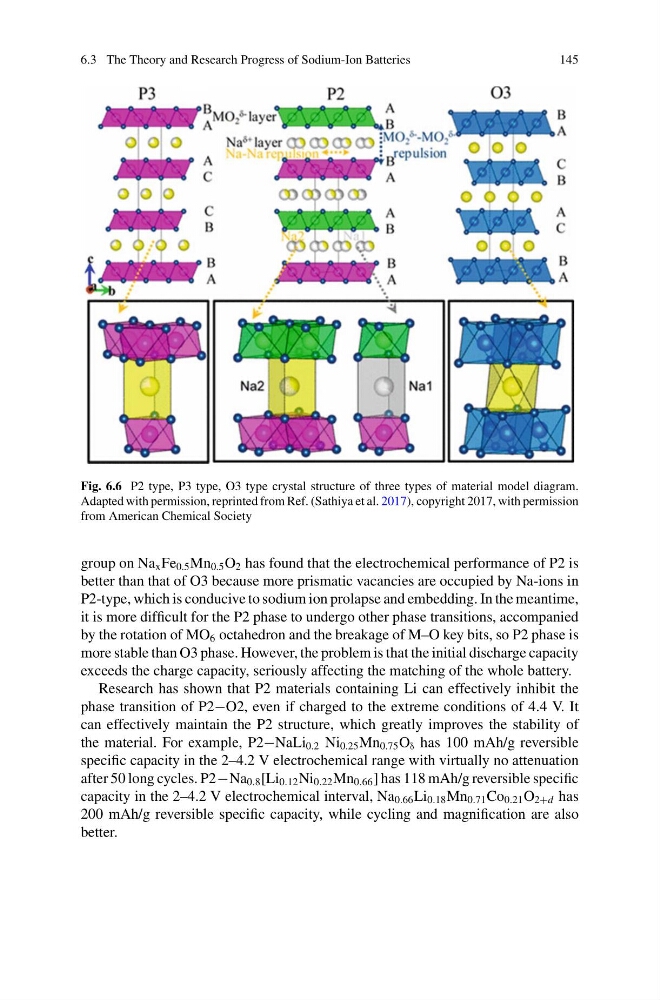
Fig. 6.6 P2 type, P3 type, O3 type crystal structure of three types of material model diagram.
Adapted with permission, reprinted from Ref. (Sathiya et al. 2017), copyright 2017, with permission
from American Chemical Society
group on Na x Fe 0.5 Mn 0.5 O 2 has found that the electrochemical performance of P2 is
better than that of O3 because more prismatic vacancies are occupied by Na-ions in
P2-type, which is conducive to sodium ion prolapse and embedding. In the meantime,
it is more difficult for the P2 phase to undergo other phase transitions, accompanied
by the rotation of MO 6 octahedron and the breakage of M–O key bits, so P2 phase is
more stable than O3 phase. However, the problem is that the initial discharge capacity
exceeds the charge capacity, seriously affecting the matching of the whole battery.
Research has shown that P2 materials containing Li can effectively inhibit the
phase transition of P2−O2, even if charged to the extreme conditions of 4.4 V. It
can effectively maintain the P2 structure, which greatly improves the stability of
the material. For example, P2−NaLi 0.2 Ni 0.25 Mn 0.75 O δ has 100 mAh/g reversible
specific capacity in the 2–4.2 V electrochemical range with virtually no attenuation
after 50 long cycles. P2−Na 0.8 [Li 0.12 Ni 0.22 Mn 0.66 ] has 118 mAh/g reversible specific
capacity in the 2–4.2 V electrochemical interval, Na 0.66 Li 0.18 Mn 0.71 Co 0.21 O 2+d has
200 mAh/g reversible specific capacity, while cycling and magnification are also
better.
145
Fig. 6.6 P2 type, P3 type, O3 type crystal structure of three types of material model diagram.
Adapted with permission, reprinted from Ref. (Sathiya et al. 2017), copyright 2017, with permission
from American Chemical Society
group on Na x Fe 0.5 Mn 0.5 O 2 has found that the electrochemical performance of P2 is
better than that of O3 because more prismatic vacancies are occupied by Na-ions in
P2-type, which is conducive to sodium ion prolapse and embedding. In the meantime,
it is more difficult for the P2 phase to undergo other phase transitions, accompanied
by the rotation of MO 6 octahedron and the breakage of M–O key bits, so P2 phase is
more stable than O3 phase. However, the problem is that the initial discharge capacity
exceeds the charge capacity, seriously affecting the matching of the whole battery.
Research has shown that P2 materials containing Li can effectively inhibit the
phase transition of P2−O2, even if charged to the extreme conditions of 4.4 V. It
can effectively maintain the P2 structure, which greatly improves the stability of
the material. For example, P2−NaLi 0.2 Ni 0.25 Mn 0.75 O δ has 100 mAh/g reversible
specific capacity in the 2–4.2 V electrochemical range with virtually no attenuation
after 50 long cycles. P2−Na 0.8 [Li 0.12 Ni 0.22 Mn 0.66 ] has 118 mAh/g reversible specific
capacity in the 2–4.2 V electrochemical interval, Na 0.66 Li 0.18 Mn 0.71 Co 0.21 O 2+d has
200 mAh/g reversible specific capacity, while cycling and magnification are also
better.