

130
6 Nanomaterials for Batteries
negative electrode materials include tin oxides, tin-based composite oxides, tin salts,
tin alloys, and the like.
Tin Oxide
The simple oxides of tin include tin oxide, stannous oxide and its mixture. Compared
with the theoretical capacity of 372 mAh/g of carbon material, the specific capacity
of tin oxide is much higher than that of 500 mAh/g, but the first irreversible capacity
is larger. There are two views on the mechanism of the Sn’s oxide storage: one is an
alloy type and the other is an ionic type. The deinserting process of Li in the ionic
mechanism is considered as follows:
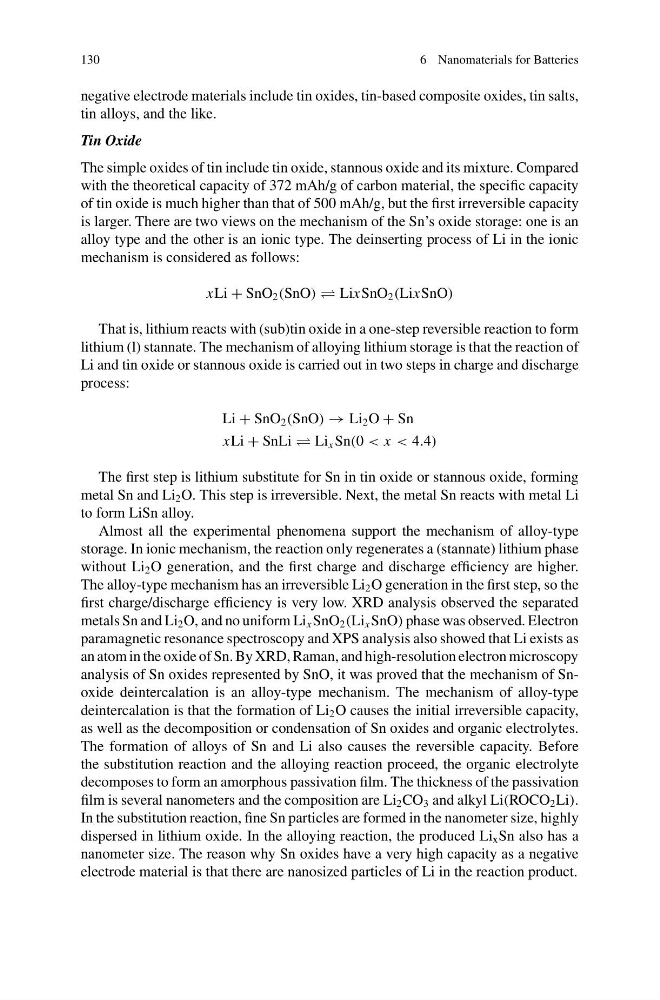
xLi + SnO 2 (SnO) LixSnO 2 (LixSnO)
That is, lithium reacts with (sub)tin oxide in a one-step reversible reaction to form
lithium (l) stannate. The mechanism of alloying lithium storage is that the reaction of
Li and tin oxide or stannous oxide is carried out in two steps in charge and discharge
process:
Li + SnO 2 (SnO) → Li 2 O + Sn
xLi + SnLi Li x Sn(0 < x < 4.4)
The first step is lithium substitute for Sn in tin oxide or stannous oxide, forming
metal Sn and Li 2 O. This step is irreversible. Next, the metal Sn reacts with metal Li
to form LiSn alloy.
Almost all the experimental phenomena support the mechanism of alloy-type
storage. In ionic mechanism, the reaction only regenerates a (stannate) lithium phase
without Li 2 O generation, and the first charge and discharge efficiency are higher.
The alloy-type mechanism has an irreversible Li 2 O generation in the first step, so the
first charge/discharge efficiency is very low. XRD analysis observed the separated
metals Sn and Li 2 O, and no uniform Li x SnO 2 (Li x SnO) phase was observed. Electron
paramagnetic resonance spectroscopy and XPS analysis also showed that Li exists as
an atom in the oxide of Sn. By XRD, Raman, and high-resolution electron microscopy
analysis of Sn oxides represented by SnO, it was proved that the mechanism of Snoxide deintercalation is an alloy-type mechanism. The mechanism of alloy-type
deintercalation is that the formation of Li 2 O causes the initial irreversible capacity,
as well as the decomposition or condensation of Sn oxides and organic electrolytes.
The formation of alloys of Sn and Li also causes the reversible capacity. Before
the substitution reaction and the alloying reaction proceed, the organic electrolyte
decomposes to form an amorphous passivation film. The thickness of the passivation
film is several nanometers and the composition are Li 2 CO 3 and alkyl Li(ROCO 2 Li).
In the substitution reaction, fine Sn particles are formed in the nanometer size, highly
dispersed in lithium oxide. In the alloying reaction, the produced Li x Sn also has a
nanometer size. The reason why Sn oxides have a very high capacity as a negative
electrode material is that there are nanosized particles of Li in the reaction product.
6 Nanomaterials for Batteries
negative electrode materials include tin oxides, tin-based composite oxides, tin salts,
tin alloys, and the like.
Tin Oxide
The simple oxides of tin include tin oxide, stannous oxide and its mixture. Compared
with the theoretical capacity of 372 mAh/g of carbon material, the specific capacity
of tin oxide is much higher than that of 500 mAh/g, but the first irreversible capacity
is larger. There are two views on the mechanism of the Sn’s oxide storage: one is an
alloy type and the other is an ionic type. The deinserting process of Li in the ionic
mechanism is considered as follows:
xLi + SnO 2 (SnO) LixSnO 2 (LixSnO)
That is, lithium reacts with (sub)tin oxide in a one-step reversible reaction to form
lithium (l) stannate. The mechanism of alloying lithium storage is that the reaction of
Li and tin oxide or stannous oxide is carried out in two steps in charge and discharge
process:
Li + SnO 2 (SnO) → Li 2 O + Sn
xLi + SnLi Li x Sn(0 < x < 4.4)
The first step is lithium substitute for Sn in tin oxide or stannous oxide, forming
metal Sn and Li 2 O. This step is irreversible. Next, the metal Sn reacts with metal Li
to form LiSn alloy.
Almost all the experimental phenomena support the mechanism of alloy-type
storage. In ionic mechanism, the reaction only regenerates a (stannate) lithium phase
without Li 2 O generation, and the first charge and discharge efficiency are higher.
The alloy-type mechanism has an irreversible Li 2 O generation in the first step, so the
first charge/discharge efficiency is very low. XRD analysis observed the separated
metals Sn and Li 2 O, and no uniform Li x SnO 2 (Li x SnO) phase was observed. Electron
paramagnetic resonance spectroscopy and XPS analysis also showed that Li exists as
an atom in the oxide of Sn. By XRD, Raman, and high-resolution electron microscopy
analysis of Sn oxides represented by SnO, it was proved that the mechanism of Snoxide deintercalation is an alloy-type mechanism. The mechanism of alloy-type
deintercalation is that the formation of Li 2 O causes the initial irreversible capacity,
as well as the decomposition or condensation of Sn oxides and organic electrolytes.
The formation of alloys of Sn and Li also causes the reversible capacity. Before
the substitution reaction and the alloying reaction proceed, the organic electrolyte
decomposes to form an amorphous passivation film. The thickness of the passivation
film is several nanometers and the composition are Li 2 CO 3 and alkyl Li(ROCO 2 Li).
In the substitution reaction, fine Sn particles are formed in the nanometer size, highly
dispersed in lithium oxide. In the alloying reaction, the produced Li x Sn also has a
nanometer size. The reason why Sn oxides have a very high capacity as a negative
electrode material is that there are nanosized particles of Li in the reaction product.