

6.2 Lithium Batteries and Lithium-Ion Batteries
125
not participate in the redox process during the entire charge/discharge process and
plays a role of stabilizing the material structure.
Vanadium Phosphate
Vanadium phosphate is used as a potential cathode material, researchers have also
done a lot of researches on many vanadium phosphates, including those with stable
structure, such as, Li 3 V 2 (PO 4 ) 3 , VOPO 4 , and LiVPO 4 . There are two main forms
of Li 3 V 2 (PO 4 ) 3 , one is a monoclinic with thermodynamic stability and the other is
a rhombohedral system formed by the exchange of ions in a stable Na
+ and Nasicon
structure. At about 3.80 V, two lithium ions in the rhombohedral system de-insert, but
only about 1.3 can be re-embedded in the reverse process. Monoclinic Li 3 V 2 (PO 4 ) 3
is currently a hot spot in the research of cathode materials, in which all three lithium
ions are well deintercalated and can be reversely inserted at a higher rate. So, we
focus on the monoclinic Li 3 V 2 (PO 4 ) 3 , however, the electrochemical activity of this
material is complicated. A series of scanning curves will appear during charging.
Monoclinic Li 3 V 2 (PO 4 ) 3 belongs to the monoclinic space group
(m − Li 3 V 2 (PO 4 ) 3 ), P2 1 /n space group with unit cell parameters of a =
0.86199 nm, b = 0.86095 nm, and c = 1.20559 nm. Li and V occupy the
octahedral sites, P occupy the tetrahedral sites, and each of the VO 6 octahedrons
has 6 PO 4 tetrahedrons surrounding it, while each PO 4 tetrahedron has 4 VO 6
octahedron. The polyhedron, PO 4 tetrahedron, and VO 6 octahedron make up the
spatial three-dimensional network structure by sharing the vertex oxygen atoms.
The vanadium atom has two positions V (1) and V (2) in the crystal structure of
lithium vanadium phosphate, and the lithium atom has three different positions in
lithium vanadium phosphate.
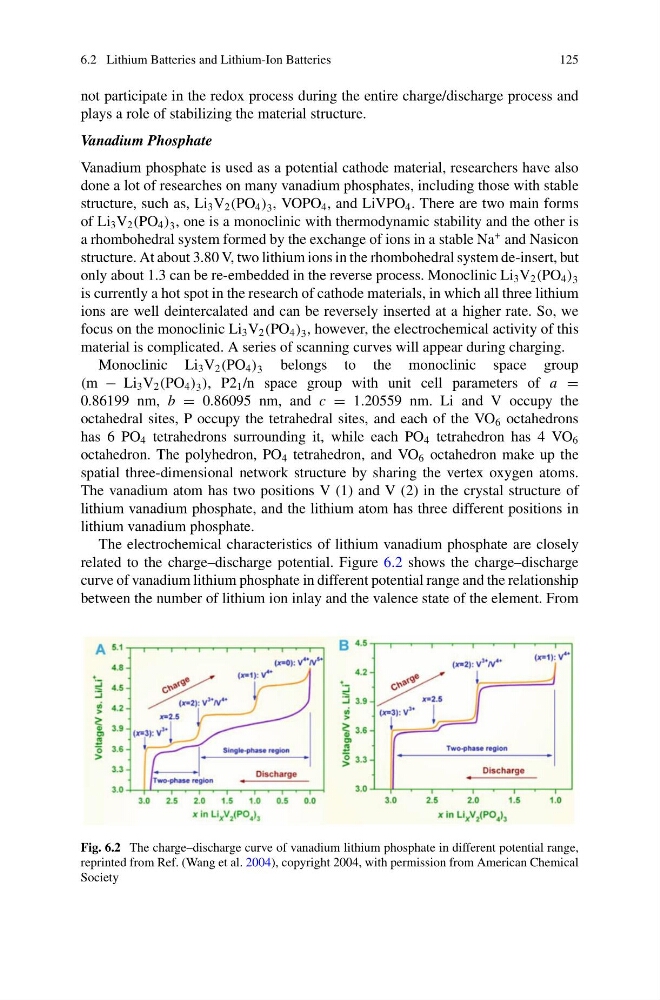
The electrochemical characteristics of lithium vanadium phosphate are closely
related to the charge–discharge potential. Figure 6.2 shows the charge–discharge
curve of vanadium lithium phosphate in different potential range and the relationship
between the number of lithium ion inlay and the valence state of the element. From
Fig. 6.2 The charge–discharge curve of vanadium lithium phosphate in different potential range,
reprinted from Ref. (Wang et al. 2004), copyright 2004, with permission from American Chemical
Society
125
not participate in the redox process during the entire charge/discharge process and
plays a role of stabilizing the material structure.
Vanadium Phosphate
Vanadium phosphate is used as a potential cathode material, researchers have also
done a lot of researches on many vanadium phosphates, including those with stable
structure, such as, Li 3 V 2 (PO 4 ) 3 , VOPO 4 , and LiVPO 4 . There are two main forms
of Li 3 V 2 (PO 4 ) 3 , one is a monoclinic with thermodynamic stability and the other is
a rhombohedral system formed by the exchange of ions in a stable Na
+ and Nasicon
structure. At about 3.80 V, two lithium ions in the rhombohedral system de-insert, but
only about 1.3 can be re-embedded in the reverse process. Monoclinic Li 3 V 2 (PO 4 ) 3
is currently a hot spot in the research of cathode materials, in which all three lithium
ions are well deintercalated and can be reversely inserted at a higher rate. So, we
focus on the monoclinic Li 3 V 2 (PO 4 ) 3 , however, the electrochemical activity of this
material is complicated. A series of scanning curves will appear during charging.
Monoclinic Li 3 V 2 (PO 4 ) 3 belongs to the monoclinic space group
(m − Li 3 V 2 (PO 4 ) 3 ), P2 1 /n space group with unit cell parameters of a =
0.86199 nm, b = 0.86095 nm, and c = 1.20559 nm. Li and V occupy the
octahedral sites, P occupy the tetrahedral sites, and each of the VO 6 octahedrons
has 6 PO 4 tetrahedrons surrounding it, while each PO 4 tetrahedron has 4 VO 6
octahedron. The polyhedron, PO 4 tetrahedron, and VO 6 octahedron make up the
spatial three-dimensional network structure by sharing the vertex oxygen atoms.
The vanadium atom has two positions V (1) and V (2) in the crystal structure of
lithium vanadium phosphate, and the lithium atom has three different positions in
lithium vanadium phosphate.
The electrochemical characteristics of lithium vanadium phosphate are closely
related to the charge–discharge potential. Figure 6.2 shows the charge–discharge
curve of vanadium lithium phosphate in different potential range and the relationship
between the number of lithium ion inlay and the valence state of the element. From
Fig. 6.2 The charge–discharge curve of vanadium lithium phosphate in different potential range,
reprinted from Ref. (Wang et al. 2004), copyright 2004, with permission from American Chemical
Society