

96
5 Synthesis of Three-Dimensional Nanomaterials
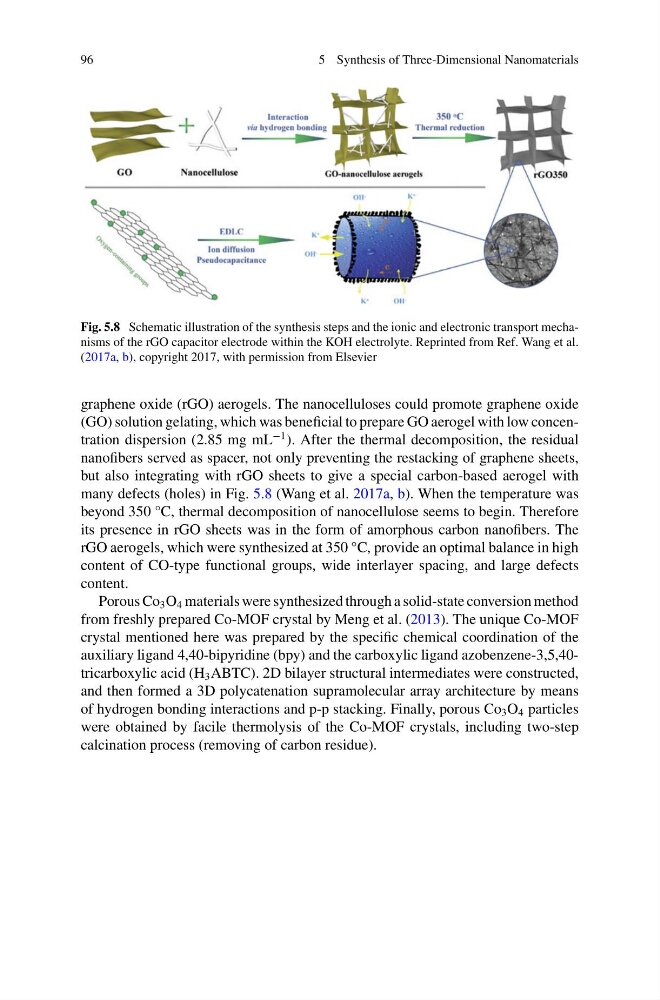
Fig. 5.8 Schematic illustration of the synthesis steps and the ionic and electronic transport mechanisms of the rGO capacitor electrode within the KOH electrolyte. Reprinted from Ref. Wang et al.
(2017a, b), copyright 2017, with permission from Elsevier
graphene oxide (rGO) aerogels. The nanocelluloses could promote graphene oxide
(GO) solution gelating, which was beneficial to prepare GO aerogel with low concentration dispersion (2.85 mg mL
−1 ). After the thermal decomposition, the residual
nanofibers served as spacer, not only preventing the restacking of graphene sheets,
but also integrating with rGO sheets to give a special carbon-based aerogel with
many defects (holes) in Fig. 5.8 (Wang et al. 2017a, b). When the temperature was
beyond 350 °C, thermal decomposition of nanocellulose seems to begin. Therefore
its presence in rGO sheets was in the form of amorphous carbon nanofibers. The
rGO aerogels, which were synthesized at 350 °C, provide an optimal balance in high
content of CO-type functional groups, wide interlayer spacing, and large defects
content.
Porous Co 3 O 4 materials were synthesized through a solid-state conversion method
from freshly prepared Co-MOF crystal by Meng et al. (2013). The unique Co-MOF
crystal mentioned here was prepared by the specific chemical coordination of the
auxiliary ligand 4,40-bipyridine (bpy) and the carboxylic ligand azobenzene-3,5,40tricarboxylic acid (H 3 ABTC). 2D bilayer structural intermediates were constructed,
and then formed a 3D polycatenation supramolecular array architecture by means
of hydrogen bonding interactions and p-p stacking. Finally, porous Co 3 O 4 particles
were obtained by facile thermolysis of the Co-MOF crystals, including two-step
calcination process (removing of carbon residue).
5 Synthesis of Three-Dimensional Nanomaterials
Fig. 5.8 Schematic illustration of the synthesis steps and the ionic and electronic transport mechanisms of the rGO capacitor electrode within the KOH electrolyte. Reprinted from Ref. Wang et al.
(2017a, b), copyright 2017, with permission from Elsevier
graphene oxide (rGO) aerogels. The nanocelluloses could promote graphene oxide
(GO) solution gelating, which was beneficial to prepare GO aerogel with low concentration dispersion (2.85 mg mL
−1 ). After the thermal decomposition, the residual
nanofibers served as spacer, not only preventing the restacking of graphene sheets,
but also integrating with rGO sheets to give a special carbon-based aerogel with
many defects (holes) in Fig. 5.8 (Wang et al. 2017a, b). When the temperature was
beyond 350 °C, thermal decomposition of nanocellulose seems to begin. Therefore
its presence in rGO sheets was in the form of amorphous carbon nanofibers. The
rGO aerogels, which were synthesized at 350 °C, provide an optimal balance in high
content of CO-type functional groups, wide interlayer spacing, and large defects
content.
Porous Co 3 O 4 materials were synthesized through a solid-state conversion method
from freshly prepared Co-MOF crystal by Meng et al. (2013). The unique Co-MOF
crystal mentioned here was prepared by the specific chemical coordination of the
auxiliary ligand 4,40-bipyridine (bpy) and the carboxylic ligand azobenzene-3,5,40tricarboxylic acid (H 3 ABTC). 2D bilayer structural intermediates were constructed,
and then formed a 3D polycatenation supramolecular array architecture by means
of hydrogen bonding interactions and p-p stacking. Finally, porous Co 3 O 4 particles
were obtained by facile thermolysis of the Co-MOF crystals, including two-step
calcination process (removing of carbon residue).