

A Look at Semantic Web Technology and the Potential Semantic …
73
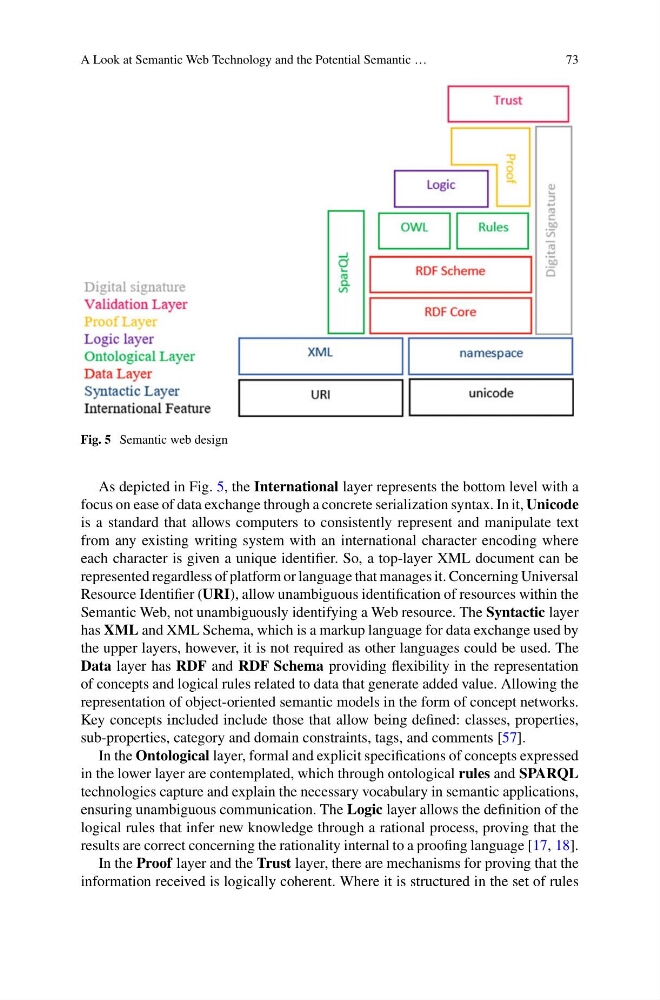
Fig. 5 Semantic web design
As depicted in Fig. 5, the International layer represents the bottom level with a
focus on ease of data exchange through a concrete serialization syntax. In it, Unicode
is a standard that allows computers to consistently represent and manipulate text
from any existing writing system with an international character encoding where
each character is given a unique identifier. So, a top-layer XML document can be
represented regardless of platform or language that manages it. Concerning Universal
Resource Identifier (URI), allow unambiguous identification of resources within the
Semantic Web, not unambiguously identifying a Web resource. The Syntactic layer
has XML and XML Schema, which is a markup language for data exchange used by
the upper layers, however, it is not required as other languages could be used. The
Data layer has RDF and RDF Schema providing flexibility in the representation
of concepts and logical rules related to data that generate added value. Allowing the
representation of object-oriented semantic models in the form of concept networks.
Key concepts included include those that allow being defined: classes, properties,
sub-properties, category and domain constraints, tags, and comments [57].
In the Ontological layer, formal and explicit specifications of concepts expressed
in the lower layer are contemplated, which through ontological rules and SPARQL
technologies capture and explain the necessary vocabulary in semantic applications,
ensuring unambiguous communication. The Logic layer allows the definition of the
logical rules that infer new knowledge through a rational process, proving that the
results are correct concerning the rationality internal to a proofing language [17, 18].
In the Proof layer and the Trust layer, there are mechanisms for proving that the
information received is logically coherent. Where it is structured in the set of rules
73
Fig. 5 Semantic web design
As depicted in Fig. 5, the International layer represents the bottom level with a
focus on ease of data exchange through a concrete serialization syntax. In it, Unicode
is a standard that allows computers to consistently represent and manipulate text
from any existing writing system with an international character encoding where
each character is given a unique identifier. So, a top-layer XML document can be
represented regardless of platform or language that manages it. Concerning Universal
Resource Identifier (URI), allow unambiguous identification of resources within the
Semantic Web, not unambiguously identifying a Web resource. The Syntactic layer
has XML and XML Schema, which is a markup language for data exchange used by
the upper layers, however, it is not required as other languages could be used. The
Data layer has RDF and RDF Schema providing flexibility in the representation
of concepts and logical rules related to data that generate added value. Allowing the
representation of object-oriented semantic models in the form of concept networks.
Key concepts included include those that allow being defined: classes, properties,
sub-properties, category and domain constraints, tags, and comments [57].
In the Ontological layer, formal and explicit specifications of concepts expressed
in the lower layer are contemplated, which through ontological rules and SPARQL
technologies capture and explain the necessary vocabulary in semantic applications,
ensuring unambiguous communication. The Logic layer allows the definition of the
logical rules that infer new knowledge through a rational process, proving that the
results are correct concerning the rationality internal to a proofing language [17, 18].
In the Proof layer and the Trust layer, there are mechanisms for proving that the
information received is logically coherent. Where it is structured in the set of rules