

62
R. P. França et al.
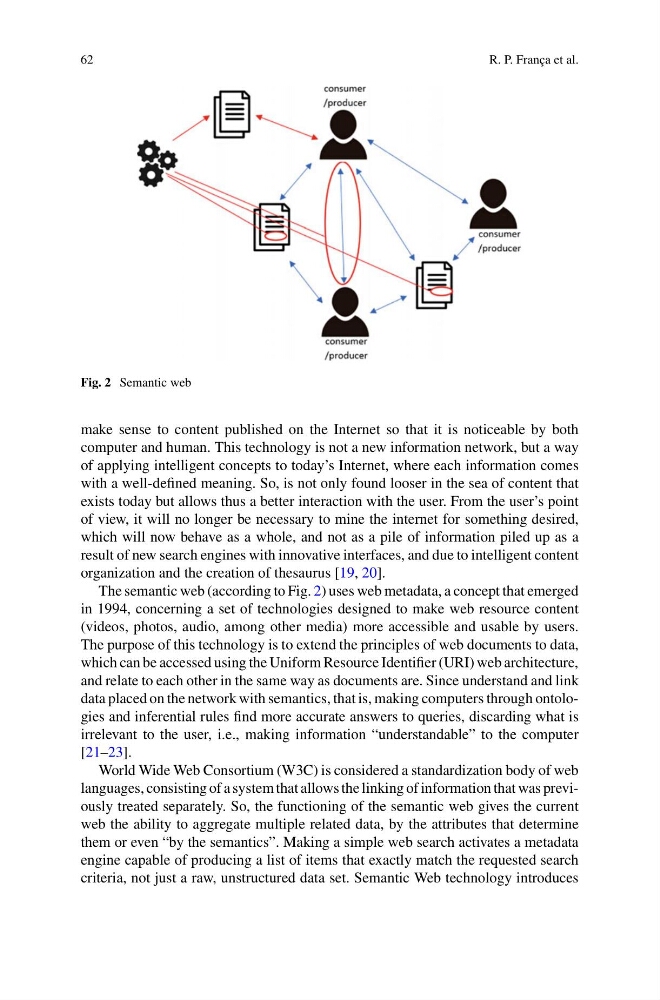
Fig. 2 Semantic web
make sense to content published on the Internet so that it is noticeable by both
computer and human. This technology is not a new information network, but a way
of applying intelligent concepts to today’s Internet, where each information comes
with a well-defined meaning. So, is not only found looser in the sea of content that
exists today but allows thus a better interaction with the user. From the user’s point
of view, it will no longer be necessary to mine the internet for something desired,
which will now behave as a whole, and not as a pile of information piled up as a
result of new search engines with innovative interfaces, and due to intelligent content
organization and the creation of thesaurus [19, 20].
The semantic web (according to Fig. 2) uses web metadata, a concept that emerged
in 1994, concerning a set of technologies designed to make web resource content
(videos, photos, audio, among other media) more accessible and usable by users.
The purpose of this technology is to extend the principles of web documents to data,
which can be accessed using the Uniform Resource Identifier (URI) web architecture,
and relate to each other in the same way as documents are. Since understand and link
data placed on the network with semantics, that is, making computers through ontologies and inferential rules find more accurate answers to queries, discarding what is
irrelevant to the user, i.e., making information “understandable” to the computer
[21–23].
World Wide Web Consortium (W3C) is considered a standardization body of web
languages, consisting of a system that allows the linking of information that was previously treated separately. So, the functioning of the semantic web gives the current
web the ability to aggregate multiple related data, by the attributes that determine
them or even “by the semantics”. Making a simple web search activates a metadata
engine capable of producing a list of items that exactly match the requested search
criteria, not just a raw, unstructured data set. Semantic Web technology introduces
R. P. França et al.
Fig. 2 Semantic web
make sense to content published on the Internet so that it is noticeable by both
computer and human. This technology is not a new information network, but a way
of applying intelligent concepts to today’s Internet, where each information comes
with a well-defined meaning. So, is not only found looser in the sea of content that
exists today but allows thus a better interaction with the user. From the user’s point
of view, it will no longer be necessary to mine the internet for something desired,
which will now behave as a whole, and not as a pile of information piled up as a
result of new search engines with innovative interfaces, and due to intelligent content
organization and the creation of thesaurus [19, 20].
The semantic web (according to Fig. 2) uses web metadata, a concept that emerged
in 1994, concerning a set of technologies designed to make web resource content
(videos, photos, audio, among other media) more accessible and usable by users.
The purpose of this technology is to extend the principles of web documents to data,
which can be accessed using the Uniform Resource Identifier (URI) web architecture,
and relate to each other in the same way as documents are. Since understand and link
data placed on the network with semantics, that is, making computers through ontologies and inferential rules find more accurate answers to queries, discarding what is
irrelevant to the user, i.e., making information “understandable” to the computer
[21–23].
World Wide Web Consortium (W3C) is considered a standardization body of web
languages, consisting of a system that allows the linking of information that was previously treated separately. So, the functioning of the semantic web gives the current
web the ability to aggregate multiple related data, by the attributes that determine
them or even “by the semantics”. Making a simple web search activates a metadata
engine capable of producing a list of items that exactly match the requested search
criteria, not just a raw, unstructured data set. Semantic Web technology introduces