

Semantic Localization for IoT
379
The advantage of an open ontology is the ability to evaluate formula regarding known
information without being forced to make questionable assumptions on the unknown
parts of the model.
The next section provides some examples of valid logical inference procedures
for open relational ontologies.
3 Logical Inference on Ontologies
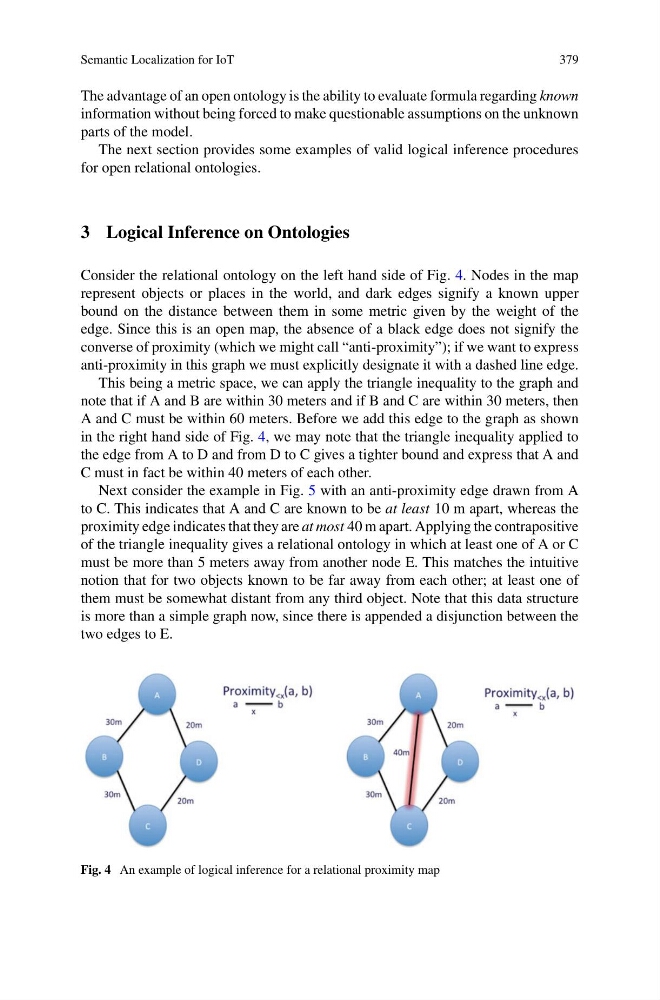
Consider the relational ontology on the left hand side of Fig. 4. Nodes in the map
represent objects or places in the world, and dark edges signify a known upper
bound on the distance between them in some metric given by the weight of the
edge. Since this is an open map, the absence of a black edge does not signify the
converse of proximity (which we might call “anti-proximity”); if we want to express
anti-proximity in this graph we must explicitly designate it with a dashed line edge.
This being a metric space, we can apply the triangle inequality to the graph and
note that if A and B are within 30 meters and if B and C are within 30 meters, then
A and C must be within 60 meters. Before we add this edge to the graph as shown
in the right hand side of Fig. 4, we may note that the triangle inequality applied to
the edge from A to D and from D to C gives a tighter bound and express that A and
C must in fact be within 40 meters of each other.
Next consider the example in Fig. 5 with an anti-proximity edge drawn from A
to C. This indicates that A and C are known to be at least 10 m apart, whereas the
proximity edge indicates that they are at most 40 m apart. Applying the contrapositive
of the triangle inequality gives a relational ontology in which at least one of A or C
must be more than 5 meters away from another node E. This matches the intuitive
notion that for two objects known to be far away from each other; at least one of
them must be somewhat distant from any third object. Note that this data structure
is more than a simple graph now, since there is appended a disjunction between the
two edges to E.
Fig. 4 An example of logical inference for a relational proximity map
379
The advantage of an open ontology is the ability to evaluate formula regarding known
information without being forced to make questionable assumptions on the unknown
parts of the model.
The next section provides some examples of valid logical inference procedures
for open relational ontologies.
3 Logical Inference on Ontologies
Consider the relational ontology on the left hand side of Fig. 4. Nodes in the map
represent objects or places in the world, and dark edges signify a known upper
bound on the distance between them in some metric given by the weight of the
edge. Since this is an open map, the absence of a black edge does not signify the
converse of proximity (which we might call “anti-proximity”); if we want to express
anti-proximity in this graph we must explicitly designate it with a dashed line edge.
This being a metric space, we can apply the triangle inequality to the graph and
note that if A and B are within 30 meters and if B and C are within 30 meters, then
A and C must be within 60 meters. Before we add this edge to the graph as shown
in the right hand side of Fig. 4, we may note that the triangle inequality applied to
the edge from A to D and from D to C gives a tighter bound and express that A and
C must in fact be within 40 meters of each other.
Next consider the example in Fig. 5 with an anti-proximity edge drawn from A
to C. This indicates that A and C are known to be at least 10 m apart, whereas the
proximity edge indicates that they are at most 40 m apart. Applying the contrapositive
of the triangle inequality gives a relational ontology in which at least one of A or C
must be more than 5 meters away from another node E. This matches the intuitive
notion that for two objects known to be far away from each other; at least one of
them must be somewhat distant from any third object. Note that this data structure
is more than a simple graph now, since there is appended a disjunction between the
two edges to E.
Fig. 4 An example of logical inference for a relational proximity map