

Semantic Web and IoT
19
Table 1 TBox and ABox axioms
Name
Syntax
Semantics
Concept inclusion
C D
C I D I
Concept equality
C ≡ D
C I = D I
Role equality
R ≡ S
R I = S I
Role inclusion
R D
R I ⊆ S I
Concept assertion
C(a)
a I ∈ C I
Role assertion
R(a, b)
(a I , b I ) ∈ R I
contains axioms which define entities of the real world, for example Cat(Daisy) and
isLocated(Daisy,garden) express that Daisy is a cat and she is located in the garden.
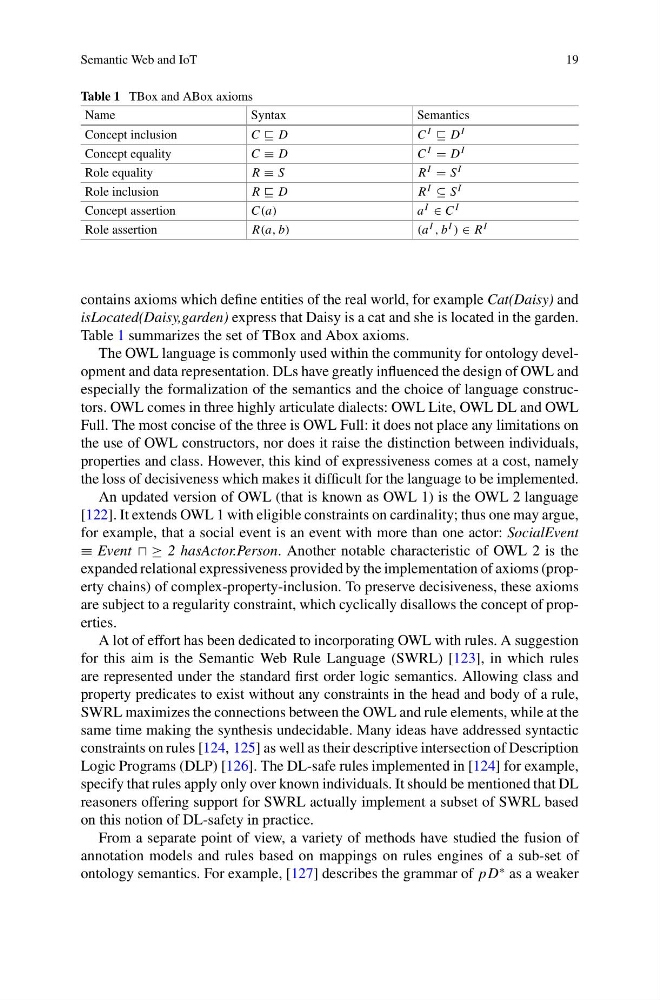
Table 1 summarizes the set of TBox and Abox axioms.
The OWL language is commonly used within the community for ontology development and data representation. DLs have greatly influenced the design of OWL and
especially the formalization of the semantics and the choice of language constructors. OWL comes in three highly articulate dialects: OWL Lite, OWL DL and OWL
Full. The most concise of the three is OWL Full: it does not place any limitations on
the use of OWL constructors, nor does it raise the distinction between individuals,
properties and class. However, this kind of expressiveness comes at a cost, namely
the loss of decisiveness which makes it difficult for the language to be implemented.
An updated version of OWL (that is known as OWL 1) is the OWL 2 language
[122]. It extends OWL 1 with eligible constraints on cardinality; thus one may argue,
for example, that a social event is an event with more than one actor: SocialEvent
≡ Event ≥ 2 hasActor.Person. Another notable characteristic of OWL 2 is the
expanded relational expressiveness provided by the implementation of axioms (property chains) of complex-property-inclusion. To preserve decisiveness, these axioms
are subject to a regularity constraint, which cyclically disallows the concept of properties.
A lot of effort has been dedicated to incorporating OWL with rules. A suggestion
for this aim is the Semantic Web Rule Language (SWRL) [123], in which rules
are represented under the standard first order logic semantics. Allowing class and
property predicates to exist without any constraints in the head and body of a rule,
SWRL maximizes the connections between the OWL and rule elements, while at the
same time making the synthesis undecidable. Many ideas have addressed syntactic
constraints on rules [124, 125] as well as their descriptive intersection of Description
Logic Programs (DLP) [126]. The DL-safe rules implemented in [124] for example,
specify that rules apply only over known individuals. It should be mentioned that DL
reasoners offering support for SWRL actually implement a subset of SWRL based
on this notion of DL-safety in practice.
From a separate point of view, a variety of methods have studied the fusion of
annotation models and rules based on mappings on rules engines of a sub-set of
ontology semantics. For example, [127] describes the grammar of pD
∗ as a weaker
19
Table 1 TBox and ABox axioms
Name
Syntax
Semantics
Concept inclusion
C D
C I D I
Concept equality
C ≡ D
C I = D I
Role equality
R ≡ S
R I = S I
Role inclusion
R D
R I ⊆ S I
Concept assertion
C(a)
a I ∈ C I
Role assertion
R(a, b)
(a I , b I ) ∈ R I
contains axioms which define entities of the real world, for example Cat(Daisy) and
isLocated(Daisy,garden) express that Daisy is a cat and she is located in the garden.
Table 1 summarizes the set of TBox and Abox axioms.
The OWL language is commonly used within the community for ontology development and data representation. DLs have greatly influenced the design of OWL and
especially the formalization of the semantics and the choice of language constructors. OWL comes in three highly articulate dialects: OWL Lite, OWL DL and OWL
Full. The most concise of the three is OWL Full: it does not place any limitations on
the use of OWL constructors, nor does it raise the distinction between individuals,
properties and class. However, this kind of expressiveness comes at a cost, namely
the loss of decisiveness which makes it difficult for the language to be implemented.
An updated version of OWL (that is known as OWL 1) is the OWL 2 language
[122]. It extends OWL 1 with eligible constraints on cardinality; thus one may argue,
for example, that a social event is an event with more than one actor: SocialEvent
≡ Event ≥ 2 hasActor.Person. Another notable characteristic of OWL 2 is the
expanded relational expressiveness provided by the implementation of axioms (property chains) of complex-property-inclusion. To preserve decisiveness, these axioms
are subject to a regularity constraint, which cyclically disallows the concept of properties.
A lot of effort has been dedicated to incorporating OWL with rules. A suggestion
for this aim is the Semantic Web Rule Language (SWRL) [123], in which rules
are represented under the standard first order logic semantics. Allowing class and
property predicates to exist without any constraints in the head and body of a rule,
SWRL maximizes the connections between the OWL and rule elements, while at the
same time making the synthesis undecidable. Many ideas have addressed syntactic
constraints on rules [124, 125] as well as their descriptive intersection of Description
Logic Programs (DLP) [126]. The DL-safe rules implemented in [124] for example,
specify that rules apply only over known individuals. It should be mentioned that DL
reasoners offering support for SWRL actually implement a subset of SWRL based
on this notion of DL-safety in practice.
From a separate point of view, a variety of methods have studied the fusion of
annotation models and rules based on mappings on rules engines of a sub-set of
ontology semantics. For example, [127] describes the grammar of pD
∗ as a weaker