

342
R. Gonzalez-Usach et al.
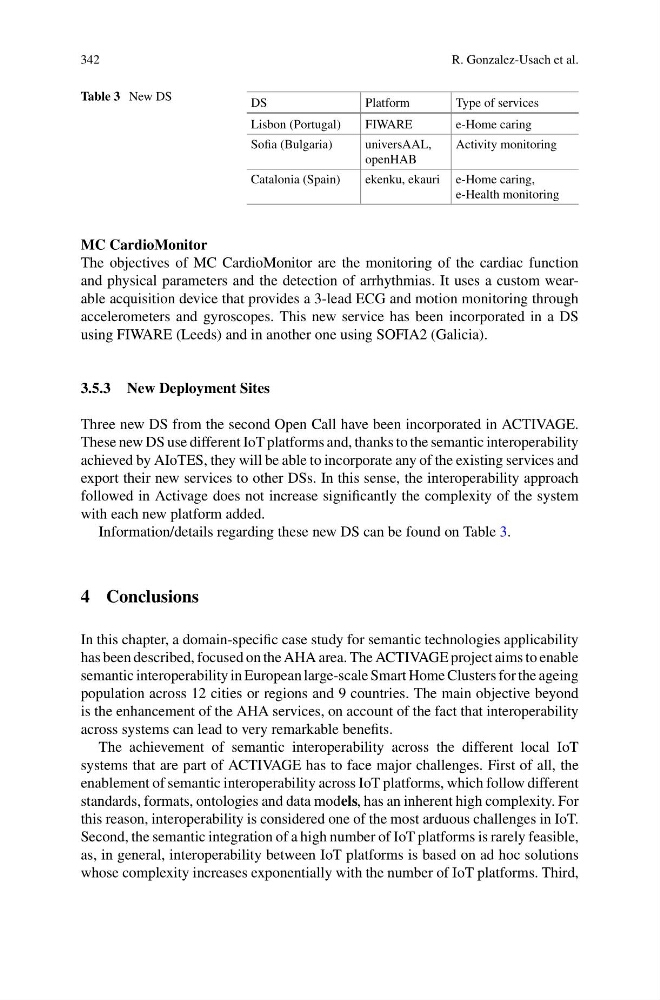
Table 3 New DS
DS
Platform
Type of services
Lisbon (Portugal)
FIWARE
e-Home caring
Sofia (Bulgaria)
universAAL,
openHAB
Activity monitoring
Catalonia (Spain)
ekenku, ekauri e-Home caring,
e-Health monitoring
MC CardioMonitor
The objectives of MC CardioMonitor are the monitoring of the cardiac function
and physical parameters and the detection of arrhythmias. It uses a custom wearable acquisition device that provides a 3-lead ECG and motion monitoring through
accelerometers and gyroscopes. This new service has been incorporated in a DS
using FIWARE (Leeds) and in another one using SOFIA2 (Galicia).
3.5.3 New Deployment Sites
Three new DS from the second Open Call have been incorporated in ACTIVAGE.
These new DS use different IoT platforms and, thanks to the semantic interoperability
achieved by AIoTES, they will be able to incorporate any of the existing services and
export their new services to other DSs. In this sense, the interoperability approach
followed in Activage does not increase significantly the complexity of the system
with each new platform added.
Information/details regarding these new DS can be found on Table 3.
4 Conclusions
In this chapter, a domain-specific case study for semantic technologies applicability
has been described, focused on the AHA area. The ACTIVAGE project aims to enable
semantic interoperability in European large-scale Smart Home Clusters for the ageing
population across 12 cities or regions and 9 countries. The main objective beyond
is the enhancement of the AHA services, on account of the fact that interoperability
across systems can lead to very remarkable benefits.
The achievement of semantic interoperability across the different local IoT
systems that are part of ACTIVAGE has to face major challenges. First of all, the
enablement of semantic interoperability across IoT platforms, which follow different
standards, formats, ontologies and data models, has an inherent high complexity. For
this reason, interoperability is considered one of the most arduous challenges in IoT.
Second, the semantic integration of a high number of IoT platforms is rarely feasible,
as, in general, interoperability between IoT platforms is based on ad hoc solutions
whose complexity increases exponentially with the number of IoT platforms. Third,
R. Gonzalez-Usach et al.
Table 3 New DS
DS
Platform
Type of services
Lisbon (Portugal)
FIWARE
e-Home caring
Sofia (Bulgaria)
universAAL,
openHAB
Activity monitoring
Catalonia (Spain)
ekenku, ekauri e-Home caring,
e-Health monitoring
MC CardioMonitor
The objectives of MC CardioMonitor are the monitoring of the cardiac function
and physical parameters and the detection of arrhythmias. It uses a custom wearable acquisition device that provides a 3-lead ECG and motion monitoring through
accelerometers and gyroscopes. This new service has been incorporated in a DS
using FIWARE (Leeds) and in another one using SOFIA2 (Galicia).
3.5.3 New Deployment Sites
Three new DS from the second Open Call have been incorporated in ACTIVAGE.
These new DS use different IoT platforms and, thanks to the semantic interoperability
achieved by AIoTES, they will be able to incorporate any of the existing services and
export their new services to other DSs. In this sense, the interoperability approach
followed in Activage does not increase significantly the complexity of the system
with each new platform added.
Information/details regarding these new DS can be found on Table 3.
4 Conclusions
In this chapter, a domain-specific case study for semantic technologies applicability
has been described, focused on the AHA area. The ACTIVAGE project aims to enable
semantic interoperability in European large-scale Smart Home Clusters for the ageing
population across 12 cities or regions and 9 countries. The main objective beyond
is the enhancement of the AHA services, on account of the fact that interoperability
across systems can lead to very remarkable benefits.
The achievement of semantic interoperability across the different local IoT
systems that are part of ACTIVAGE has to face major challenges. First of all, the
enablement of semantic interoperability across IoT platforms, which follow different
standards, formats, ontologies and data models, has an inherent high complexity. For
this reason, interoperability is considered one of the most arduous challenges in IoT.
Second, the semantic integration of a high number of IoT platforms is rarely feasible,
as, in general, interoperability between IoT platforms is based on ad hoc solutions
whose complexity increases exponentially with the number of IoT platforms. Third,