

336
R. Gonzalez-Usach et al.
• Semantic alignments between each platform’s semantics and the central AHA
ontology, which are needed by the IPSM to perform ontology-to-ontology translations [39]. These alignments specify the translation rules and matches between
ontologies and are written using the IPSM-AF format [19], and have to be defined
and stored in specific files before performing the translation process.
3.4.2 ACTIVAGE IoT Ecosystem Suite (AIoTES)
The ACTIVAGE IoT Ecosystem Suite (AIoTES) has been developed in order to
provide the necessary interoperability for ACTIVAGE and to enable the security
and privacy features needed for the use of AHA information. AIoTES is defined
as a set of tools, techniques and methodology for interoperability between existing
IoT platforms while ensuring security and privacy. Each DS will be able to deploy
their devices using its own IoT platforms and the new AHA applications will be
deployed over a local instance of AIoTES. The use of AIoTES will provide semantic
interoperability by design and allow the integration of new services in the DS, such
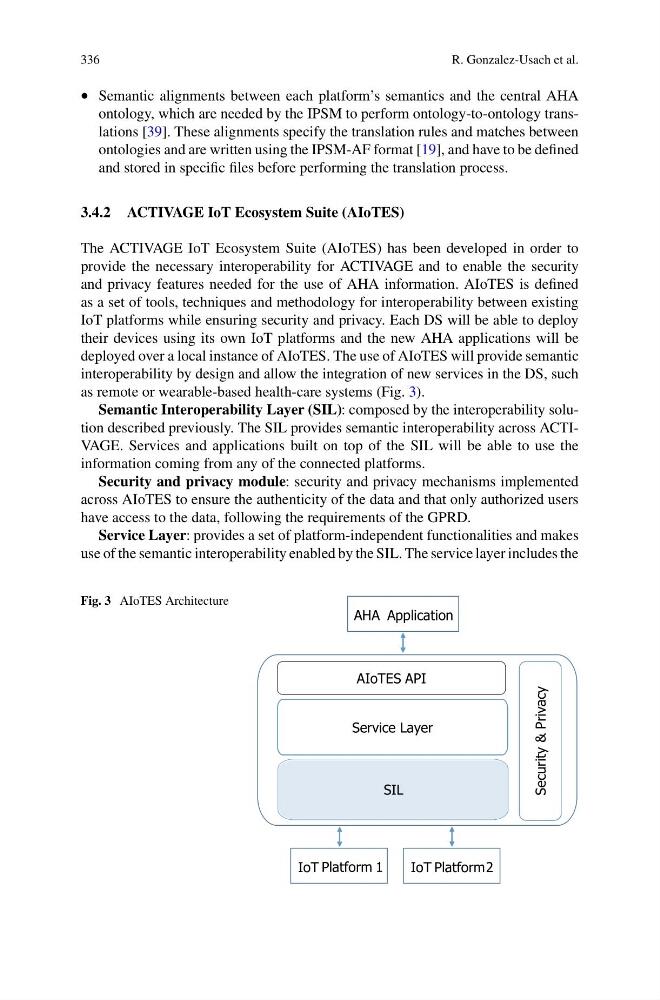
as remote or wearable-based health-care systems (Fig. 3).
Semantic Interoperability Layer (SIL): composed by the interoperability solution described previously. The SIL provides semantic interoperability across ACTIVAGE. Services and applications built on top of the SIL will be able to use the
information coming from any of the connected platforms.
Security and privacy module: security and privacy mechanisms implemented
across AIoTES to ensure the authenticity of the data and that only authorized users
have access to the data, following the requirements of the GPRD.
Service Layer: provides a set of platform-independent functionalities and makes
use of the semantic interoperability enabled by the SIL. The service layer includes the
Fig. 3 AIoTES Architecture
Security & Privacy
SIL
IoT Platform 1
AHA Application
AIoTES API
IoT Platform 2
Service Layer
R. Gonzalez-Usach et al.
• Semantic alignments between each platform’s semantics and the central AHA
ontology, which are needed by the IPSM to perform ontology-to-ontology translations [39]. These alignments specify the translation rules and matches between
ontologies and are written using the IPSM-AF format [19], and have to be defined
and stored in specific files before performing the translation process.
3.4.2 ACTIVAGE IoT Ecosystem Suite (AIoTES)
The ACTIVAGE IoT Ecosystem Suite (AIoTES) has been developed in order to
provide the necessary interoperability for ACTIVAGE and to enable the security
and privacy features needed for the use of AHA information. AIoTES is defined
as a set of tools, techniques and methodology for interoperability between existing
IoT platforms while ensuring security and privacy. Each DS will be able to deploy
their devices using its own IoT platforms and the new AHA applications will be
deployed over a local instance of AIoTES. The use of AIoTES will provide semantic
interoperability by design and allow the integration of new services in the DS, such
as remote or wearable-based health-care systems (Fig. 3).
Semantic Interoperability Layer (SIL): composed by the interoperability solution described previously. The SIL provides semantic interoperability across ACTIVAGE. Services and applications built on top of the SIL will be able to use the
information coming from any of the connected platforms.
Security and privacy module: security and privacy mechanisms implemented
across AIoTES to ensure the authenticity of the data and that only authorized users
have access to the data, following the requirements of the GPRD.
Service Layer: provides a set of platform-independent functionalities and makes
use of the semantic interoperability enabled by the SIL. The service layer includes the
Fig. 3 AIoTES Architecture
Security & Privacy
SIL
IoT Platform 1
AHA Application
AIoTES API
IoT Platform 2
Service Layer