

326
R. Gonzalez-Usach et al.
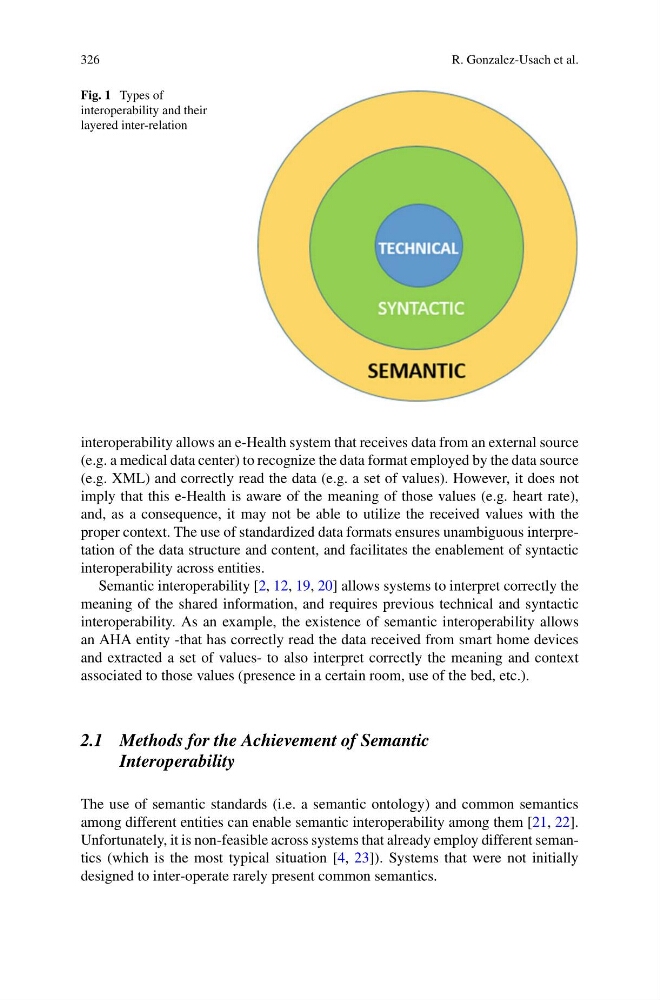
Fig. 1 Types of
interoperability and their
layered inter-relation
interoperability allows an e-Health system that receives data from an external source
(e.g. a medical data center) to recognize the data format employed by the data source
(e.g. XML) and correctly read the data (e.g. a set of values). However, it does not
imply that this e-Health is aware of the meaning of those values (e.g. heart rate),
and, as a consequence, it may not be able to utilize the received values with the
proper context. The use of standardized data formats ensures unambiguous interpretation of the data structure and content, and facilitates the enablement of syntactic
interoperability across entities.
Semantic interoperability [2, 12, 19, 20] allows systems to interpret correctly the
meaning of the shared information, and requires previous technical and syntactic
interoperability. As an example, the existence of semantic interoperability allows
an AHA entity -that has correctly read the data received from smart home devices
and extracted a set of values- to also interpret correctly the meaning and context
associated to those values (presence in a certain room, use of the bed, etc.).
2.1 Methods for the Achievement of Semantic
Interoperability
The use of semantic standards (i.e. a semantic ontology) and common semantics
among different entities can enable semantic interoperability among them [21, 22].
Unfortunately, it is non-feasible across systems that already employ different semantics (which is the most typical situation [4, 23]). Systems that were not initially
designed to inter-operate rarely present common semantics.
R. Gonzalez-Usach et al.
Fig. 1 Types of
interoperability and their
layered inter-relation
interoperability allows an e-Health system that receives data from an external source
(e.g. a medical data center) to recognize the data format employed by the data source
(e.g. XML) and correctly read the data (e.g. a set of values). However, it does not
imply that this e-Health is aware of the meaning of those values (e.g. heart rate),
and, as a consequence, it may not be able to utilize the received values with the
proper context. The use of standardized data formats ensures unambiguous interpretation of the data structure and content, and facilitates the enablement of syntactic
interoperability across entities.
Semantic interoperability [2, 12, 19, 20] allows systems to interpret correctly the
meaning of the shared information, and requires previous technical and syntactic
interoperability. As an example, the existence of semantic interoperability allows
an AHA entity -that has correctly read the data received from smart home devices
and extracted a set of values- to also interpret correctly the meaning and context
associated to those values (presence in a certain room, use of the bed, etc.).
2.1 Methods for the Achievement of Semantic
Interoperability
The use of semantic standards (i.e. a semantic ontology) and common semantics
among different entities can enable semantic interoperability among them [21, 22].
Unfortunately, it is non-feasible across systems that already employ different semantics (which is the most typical situation [4, 23]). Systems that were not initially
designed to inter-operate rarely present common semantics.