

278
G. K. Shankhdhar et al.
like agents for fertilizers, pesticides, sprinklers, soil measures, moisture and disease
monitoring by use of UAVs and drones. Smart agents function as autonomous and
situated intelligent objects of farms, crops, fertilizers, manures, soil, weather, pests,
etc. [59, 60].
In order to develop agents to work in our domain firstly, O-MaSE methodology
for agent development is utilized. The primal work here is to first identify the goals
that are needed to be met in order to completely design a MAS for smart agriculture.
When the goals have been identified then the roles are acknowledged that function
for fulfilling the goals. Then the agents are identified based on the grouping of roles
[61]. For team goals, organizations do allow agents to work together by using best
cooperation among agents that work in collaboration even with previously unknown
agents resulting in mutual clubbing of each agent for joint functioning. In order to
develop a MAS, we need to follow a Agent Oriented Systems Engineering (AOSE)
technique. The development strategy followed here in this research is O-MaSE. There
are numerous benefits of O-MaSE that make it powerful [62].
3.2.1 Organizational Multi-Agent Systems Engineering (O-MaSE)
The authors have considered O-MaSE for designing the MAS for smart agriculture
and this is done in order to provide medium level projects that can be extended to
complex and high level projects as well. A thorough study of O-MaSE is provided
in [62].
O-MaSE is a meta-model and is tailored to match the project’s needs.
Twelve method-roles have been identified as part of the O-MaSE methodology:
requirements engineer, goal modeler, domain modeler, organization modeler, role
modeler, agent class modeler, protocol modeler, policy modeler, plan modeler, capabilities modeler, action modeler, and programmer. Each O-MaSE method-role is
responsible for carrying out the tasks by applying the appropriate techniques to
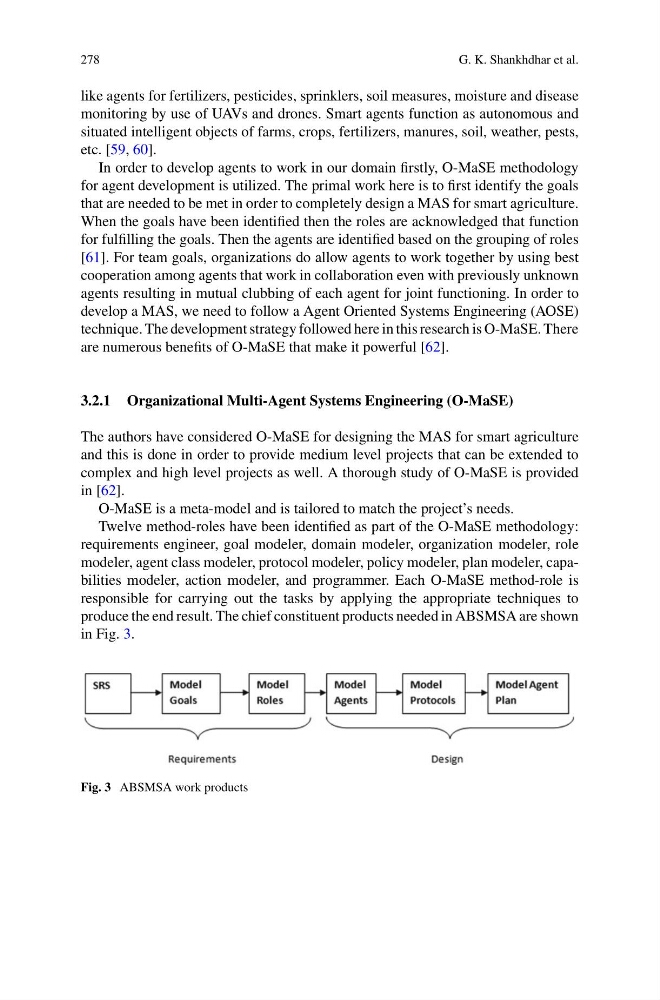
produce the end result. The chief constituent products needed in ABSMSA are shown
in Fig. 3.
Fig. 3 ABSMSA work products
G. K. Shankhdhar et al.
like agents for fertilizers, pesticides, sprinklers, soil measures, moisture and disease
monitoring by use of UAVs and drones. Smart agents function as autonomous and
situated intelligent objects of farms, crops, fertilizers, manures, soil, weather, pests,
etc. [59, 60].
In order to develop agents to work in our domain firstly, O-MaSE methodology
for agent development is utilized. The primal work here is to first identify the goals
that are needed to be met in order to completely design a MAS for smart agriculture.
When the goals have been identified then the roles are acknowledged that function
for fulfilling the goals. Then the agents are identified based on the grouping of roles
[61]. For team goals, organizations do allow agents to work together by using best
cooperation among agents that work in collaboration even with previously unknown
agents resulting in mutual clubbing of each agent for joint functioning. In order to
develop a MAS, we need to follow a Agent Oriented Systems Engineering (AOSE)
technique. The development strategy followed here in this research is O-MaSE. There
are numerous benefits of O-MaSE that make it powerful [62].
3.2.1 Organizational Multi-Agent Systems Engineering (O-MaSE)
The authors have considered O-MaSE for designing the MAS for smart agriculture
and this is done in order to provide medium level projects that can be extended to
complex and high level projects as well. A thorough study of O-MaSE is provided
in [62].
O-MaSE is a meta-model and is tailored to match the project’s needs.
Twelve method-roles have been identified as part of the O-MaSE methodology:
requirements engineer, goal modeler, domain modeler, organization modeler, role
modeler, agent class modeler, protocol modeler, policy modeler, plan modeler, capabilities modeler, action modeler, and programmer. Each O-MaSE method-role is
responsible for carrying out the tasks by applying the appropriate techniques to
produce the end result. The chief constituent products needed in ABSMSA are shown
in Fig. 3.
Fig. 3 ABSMSA work products