

SAGRO-Lite: A Light Weight Agent Based Semantic Model …
273
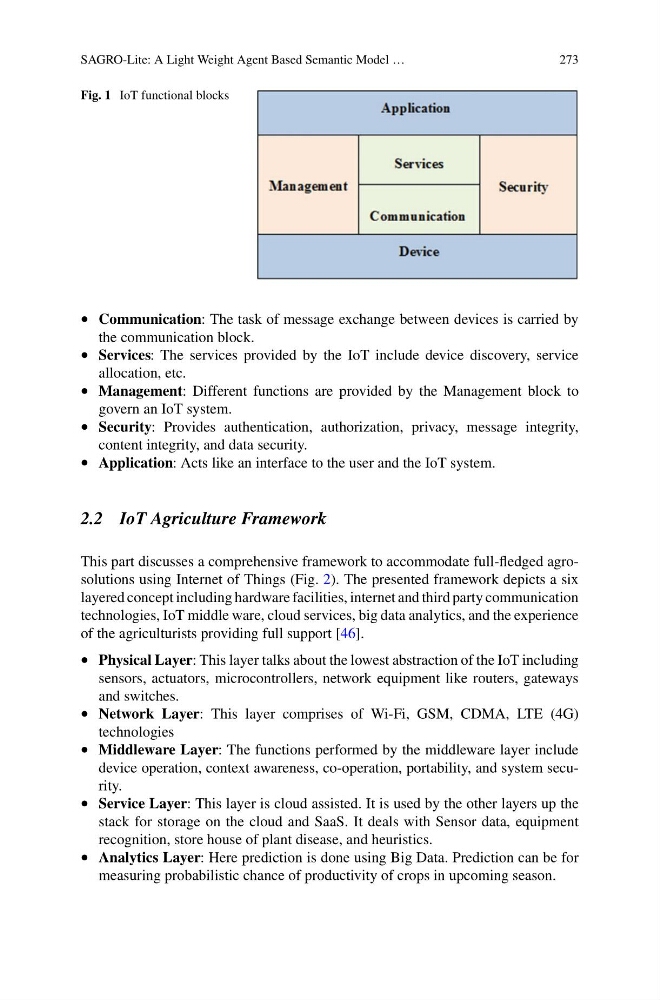
Fig. 1 IoT functional blocks
• Communication: The task of message exchange between devices is carried by
the communication block.
• Services: The services provided by the IoT include device discovery, service
allocation, etc.
• Management: Different functions are provided by the Management block to
govern an IoT system.
• Security: Provides authentication, authorization, privacy, message integrity,
content integrity, and data security.
• Application: Acts like an interface to the user and the IoT system.
2.2 IoT Agriculture Framework
This part discusses a comprehensive framework to accommodate full-fledged agrosolutions using Internet of Things (Fig. 2). The presented framework depicts a six
layered concept including hardware facilities, internet and third party communication
technologies, IoT middle ware, cloud services, big data analytics, and the experience
of the agriculturists providing full support [46].
• Physical Layer: This layer talks about the lowest abstraction of the IoT including
sensors, actuators, microcontrollers, network equipment like routers, gateways
and switches.
• Network Layer: This layer comprises of Wi-Fi, GSM, CDMA, LTE (4G)
technologies
• Middleware Layer: The functions performed by the middleware layer include
device operation, context awareness, co-operation, portability, and system security.
• Service Layer: This layer is cloud assisted. It is used by the other layers up the
stack for storage on the cloud and SaaS. It deals with Sensor data, equipment
recognition, store house of plant disease, and heuristics.
• Analytics Layer: Here prediction is done using Big Data. Prediction can be for
measuring probabilistic chance of productivity of crops in upcoming season.
273
Fig. 1 IoT functional blocks
• Communication: The task of message exchange between devices is carried by
the communication block.
• Services: The services provided by the IoT include device discovery, service
allocation, etc.
• Management: Different functions are provided by the Management block to
govern an IoT system.
• Security: Provides authentication, authorization, privacy, message integrity,
content integrity, and data security.
• Application: Acts like an interface to the user and the IoT system.
2.2 IoT Agriculture Framework
This part discusses a comprehensive framework to accommodate full-fledged agrosolutions using Internet of Things (Fig. 2). The presented framework depicts a six
layered concept including hardware facilities, internet and third party communication
technologies, IoT middle ware, cloud services, big data analytics, and the experience
of the agriculturists providing full support [46].
• Physical Layer: This layer talks about the lowest abstraction of the IoT including
sensors, actuators, microcontrollers, network equipment like routers, gateways
and switches.
• Network Layer: This layer comprises of Wi-Fi, GSM, CDMA, LTE (4G)
technologies
• Middleware Layer: The functions performed by the middleware layer include
device operation, context awareness, co-operation, portability, and system security.
• Service Layer: This layer is cloud assisted. It is used by the other layers up the
stack for storage on the cloud and SaaS. It deals with Sensor data, equipment
recognition, store house of plant disease, and heuristics.
• Analytics Layer: Here prediction is done using Big Data. Prediction can be for
measuring probabilistic chance of productivity of crops in upcoming season.