

Semantic IoT Interoperability and Data Analytics Using …
255
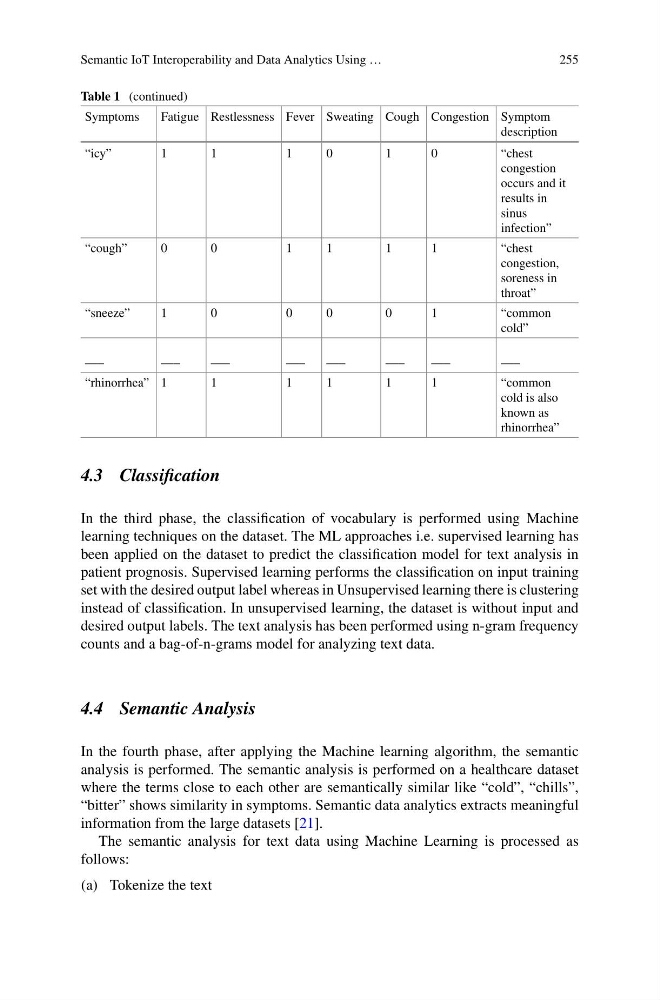
Table 1 (continued)
Symptoms
Fatigue Restlessness Fever Sweating Cough Congestion Symptom
description
“icy”
1
1
1
0
1
0
“chest
congestion
occurs and it
results in
sinus
infection”
“cough”
0
0
1
1
1
1
“chest
congestion,
soreness in
throat”
“sneeze”
1
0
0
0
0
1
“common
cold”
—–
—–
—–
—–
—–
—–
—–
—–
“rhinorrhea” 1
1
1
1
1
1
“common
cold is also
known as
rhinorrhea”
4.3 Classification
In the third phase, the classification of vocabulary is performed using Machine
learning techniques on the dataset. The ML approaches i.e. supervised learning has
been applied on the dataset to predict the classification model for text analysis in
patient prognosis. Supervised learning performs the classification on input training
set with the desired output label whereas in Unsupervised learning there is clustering
instead of classification. In unsupervised learning, the dataset is without input and
desired output labels. The text analysis has been performed using n-gram frequency
counts and a bag-of-n-grams model for analyzing text data.
4.4 Semantic Analysis
In the fourth phase, after applying the Machine learning algorithm, the semantic
analysis is performed. The semantic analysis is performed on a healthcare dataset
where the terms close to each other are semantically similar like “cold”, “chills”,
“bitter” shows similarity in symptoms. Semantic data analytics extracts meaningful
information from the large datasets [21].
The semantic analysis for text data using Machine Learning is processed as
follows:
(a) Tokenize the text
255
Table 1 (continued)
Symptoms
Fatigue Restlessness Fever Sweating Cough Congestion Symptom
description
“icy”
1
1
1
0
1
0
“chest
congestion
occurs and it
results in
sinus
infection”
“cough”
0
0
1
1
1
1
“chest
congestion,
soreness in
throat”
“sneeze”
1
0
0
0
0
1
“common
cold”
—–
—–
—–
—–
—–
—–
—–
—–
“rhinorrhea” 1
1
1
1
1
1
“common
cold is also
known as
rhinorrhea”
4.3 Classification
In the third phase, the classification of vocabulary is performed using Machine
learning techniques on the dataset. The ML approaches i.e. supervised learning has
been applied on the dataset to predict the classification model for text analysis in
patient prognosis. Supervised learning performs the classification on input training
set with the desired output label whereas in Unsupervised learning there is clustering
instead of classification. In unsupervised learning, the dataset is without input and
desired output labels. The text analysis has been performed using n-gram frequency
counts and a bag-of-n-grams model for analyzing text data.
4.4 Semantic Analysis
In the fourth phase, after applying the Machine learning algorithm, the semantic
analysis is performed. The semantic analysis is performed on a healthcare dataset
where the terms close to each other are semantically similar like “cold”, “chills”,
“bitter” shows similarity in symptoms. Semantic data analytics extracts meaningful
information from the large datasets [21].
The semantic analysis for text data using Machine Learning is processed as
follows:
(a) Tokenize the text